Saturday, July 11, 2009

Church of England Under Pressure to Accept Gay Marriage

MAIL Online: The Church of England warned last night that it is under pressure to accept gay marriage.

But two senior bishops - writing on behalf of the CofE - said it is not prepared to abandon its traditional teachings in favour of the idea of 'gender neutral' marriage.

They said that the Church of England considers 'it is vital for the Church to maintain a critical distance from the state and to resist what the state is doing if this is at odds with Scripture.'

The fears over same sex marriage were made public at a meeting of the Church's parliament, the General Synod.

They come at a time of high tension between Labour ministers and leading churches over gay rights and equality laws[.]

The concerns were raised in a letter from Bishop of Guildford Dr Christopher Hill and Bishop of Chichester Dr John Hinds to leaders of the Swedish state church which has close and formal links with the Anglicans.

The bishops - writing on behalf of the CofE - said they could not accept beliefs 'in which the idea of a fundamental distinction between the genders is seen as irrelevant and in which marriage is therefore seen as something that can and should be gender neutral.'

Their letter was a response to moves in the Church of Sweden to offer gender neutral marriage services which could be used for either brides and grooms or for same sex couples.

But it made plain that the CofE will resist pressure from the Government in Britain to introduce any form of same sex marriage. >>> Steve Doughty | Saturday, July 11, 2009
More Sh** from the White House! Reform Obama First!

To expect people to die for their country and then deny them cigarettes is disgraceful! – ©Mark

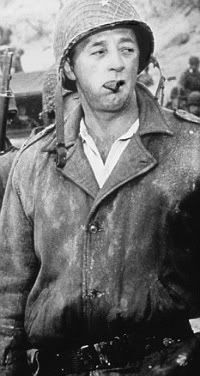
MAIL Online: It is an iconic image of movies and real life - a battle-weary GI sits down during a lull in the fighting and sucks on a calming cigarette.

It has endured through two world wars, and major conflicts such as Korea, Vietnam, and Iraq and numerous Hollywood blockbusters - John Wayne and Robert Mitchum in the D-Day blockbuster, The Longest Day and Tom Hanks in Saving Private Ryan.

But it could all soon be a thing of the past - because of health and cost concerns.

Pentagon health experts are urging US Defence Secretary Robert Gates to ban smoking by troops and end the sale of tobacco in PXs, the military base shops where cut-price cigarettes have always been a popular line.

And it’s all due to a new study revealing the hidden cost to America’s three million men and women serving in the US Army, Navy, Air Force, and the Reserve.

An investigation by the influential Institute of Medicine, commissioned by the Pentagon found that one in three members of the US services use tobacco, compared with one in five adult Americans.

The heaviest smokers - maybe, not surprisingly - were soldiers and Marines who had done most of the fighting in Iraq and Afghanistan.

About 37 per cent of soldiers used tobacco and 36 per cent of Marines.

Combat veterans were 50 per cent more likely to use tobacco than troops who hadn't seen combat, it said. The report acknowledges that it is calling for a seismic change.

The sheer number of troops smoking also had economic costs. Researchers discovered that smoking and chewing tobacco costs the Pentagon more than £540 million a year in medical care and lost productivity.

The Department of Veterans Affairs spent up to £4billion a year on treatment for tobacco-related illnesses, the report added.
In comparison, tobacco sales in PXs netted less than £60 million a year which was spent on base recreation schemes and family support programmes.

It said: ‘A ban would confront a military culture in which the image of the battle-weary soldier in fatigues and helmet, fighting for his country, has frequently included his lit cigarette.

Troops worn out by repeated deployments often relied on cigarettes as a ‘stress reliever.’ Pentagon calls for smoking ban among US soldiers >>> Barry Whigmore | Friday, July 09, 2009

Friday, July 10, 2009

China Closes Urumqi Mosques on Day of Prayer

TIMES ONLINE: Padlocks secured the iron grill gates to mosques across the city of Urumqi this morning as Muslim Uighurs were told to stay home and pray.

Officials have notified all mosques in the city, where 156 people were killed and more than 1,000 injured when minority Muslim Uighurs rampaged through the streets baying for the blood of Han Chinese last weekend, that today's noon prayers must be cancelled.

At the Say Bag District Mosque, security officials sat in the shaded entrance behind the locked gates, some had electric truncheons on the table in front of them in case of renewed violence. A notice on an entrance pillar asked people to worship at home today and to stay away.

Prayers were cancelled, it said: “Because of the complicated situation at the moment and to safeguard the security of the Muslim masses and to protect the property of the mosque and so as to give no opportunity to violent terrorists.”

It concluded: “We hope the Muslim masses will understand this and will notify each other.” >>> Jane Macartney in Urumqi | Friday, July 10, 2009
Maryam and Marzieh – In Danger of Being Forgotten in Iran

PERSECUTED CHURCH WEBLOG: Two Iranian Christian women, Maryam Rustampoor (27) and Marzieh Amirizadeh (30), continue to be held in Evin prison in Iran because of their Christian faith, unfairly labelled as ‘anti-government activists’, because of the hostility of the government towards practising Christians.

In the aftermath of the political turmoil in Iran, they are now in danger of being forgotten. One church leader from Iran said, “With so many hundreds of protestors now in the prison system, Maryam and Marzieh are likely to be forgotten.”

Arrested on March 5 , 2009, the two young women have now been in prison for four months. After being in solitary confinement for three weeks in May and early June, they were then put one small cell together for about two weeks. Then, following the arrests of thousands of protestors after the disputed presidential elections, Marzieh and Maryam were moved to a larger cell to make room for new prisoners. About 600 women were brought Evin prison during the days of the protests. There is still no clarity regarding their case. In one court session in June a judge told them that he would make sure they were both executed as ‘apostates’. Maryam and Marzieh have responded with courage, however, telling the judge to “expedite his sentence.” >>> Glenn Penner | Thursday, July 09, 2009

Hat tip: JihadWatch >>>
Tehran: Army of Police and Militiamen Attack Unarmed Protesters

TIMES ONLINE: The Iranian regime warned that any demonstrations would be mercilessly crushed, and meant it. As darkness fell on baking, dust-shrouded Tehran last night an army of riot police and hardline basiji militiamen used batons, gun butts and tear gas to beat back thousands of Iranians converging on the city centre.

"The security presence was massive. It was like a military occupation," one witness told The Times. "They were clubbing the hell out of people."

The greater victory belonged to the demonstrators, however. Male and female, some quite old, they came armed with nothing more than a burning sense of injustice. They defied the risk of serious physical injury, and the very real possibility of arrest, incarceration and torture. They did this to show the world that their resistance to Iran's brutal and illegitimate government has not been extinguished.

"We went today to show them that we are still here and are not going away and they can’t talk or scare us away. And we'll be back every time there is an occasion to commemorate or when we're asked to," said Maryam, a young female office worker nursing an arm injured by a baton blow. “We want to be heard. We are not going to let the regime ignore us,” said Ahmad, a young man in his twenties. >>> Martin Fletcher | Friday, July 10, 2009

Thursday, July 09, 2009

Joke: Two Coffees

A Muslim dies and finds himself before the pearly Gates. He is very excited, as all his life he has longed to meet the Prophet Mohammed. Having arrived at the Gates of Heaven, he meets a man with a beard.

'Are you Mohammed?', he asks. 'No, my son. I am Peter. Mohammed is higher up.' And he points to a ladder that rises into the clouds.

Delighted that Mohammed should be higher than Peter, he climbs the ladder in great strides, climbs through the clouds coming to a room where he meets another bearded man.

He asks again, 'Are you Mohammed? 'No, I am Moses. Mohammed is higher still.

Exhausted, but with a heart full of joy, he continues to climb the ladder and, yet again, he discovers an even larger room where he meets another man with a beard.

Full of hope, he asks again, 'Are you Mohammed?' 'No, I am Jesus...You will find Mohammed higher up.'

Mohammed higher than Jesus! The poor man can hardly contain his delight and climbs and climbs, ever higher once again, he reaches a larger room where he meets a man with a beard and repeats his question:

'Are you Mohammed?' he gasps, as he is by now, totally out of breath from all his climbing. 'No, my son. I am God. But you look exhausted. Would you like a coffee?'

'Yes, please, my Lord'

God looks behind him, claps his hands and calls out: ' Hey, Mohammed, two coffees!' [Source: Unknown]
Extremist Group Announces Split from al-Qaeda

THE TELEGRAPH: A North African extremist group, whose senior leaders were crucial allies of Osama bin Laden, has denounced terrorism and become the first organisation ever to leave al-Qaeda.

The Libyan Islamic Fighting Group (LIFG), which once sought to overthrow Col Muammar Gaddafi, dealt a blow to bin Laden by reversing a decision made in 2007 to join al-Qaeda.

A statement from the LIFG leadership criticised "indiscriminate bombings" and the "targeting of civilians", saying that violence "did not achieve the aims of the group in removing oppression".

Al-Qaeda has come under mounting pressure in recent months. Missile attacks executed by American drones in Pakistan's Tribal Areas have taken a heavy toll on its core leadership.

Meanwhile, there are tentative signs of a backlash against bin Laden's ideology in the wider Muslim world. A former extremist leader, Sayyid Imam al-Sharif, better known as "Dr Fadl", has condemned al-Qaeda from inside an Egyptian prison.

The LIFG appears to have judged that the balance of advantage lies with leaving al-Qaeda. Officials doubt whether this will, on its own, have a significant impact on al-Qaeda's ability mount attacks.

But one official pointed out that LIFG figures had "graduated to become major players" in al-Qaeda and the group's withdrawal amounted to a "moral blow" to the network. >>> David Blair, Diplomatic Editor | Thursday, July 09, 2009
'United for Neda' Is Artists' Song for Iranian People


The Story: Spurred by the continuing political unrest in Iran, more than two dozen Iranian expatriate superstars are uniting to spread a musical message of non-violent resistance.

The entertainers, poets, thinkers and actors are harmonizing on the song "United for Neda," a call to action against human rights violations by the Iranian government against Iranians protesting the disputed outcome of recent presidential elections.

The song was inspired by the plight of Neda Agha-Soltan, the 26-year old Iranian woman who was fatally shot on the streets of Tehran on June 20. The ordeal was recorded on cell phone video and received international attention when it hit the Internet.


Read full article >>>
Iranian Police Disperse Pro-reformists: Witness

REUTERS: TEHRAN - Iranian police used tear gas and fired into the air to disperse about 250 pro-reform protesters gathered near Tehran University on Thursday in defiance of a ban on gatherings for the anniversary of violent 1999 student unrest, a witness said.

"Police used tear gas twice to disperse the crowd. There was also many Basij militia on motorbikes patrolling the area," said the witness, who asked not to be named.

Another witness said police urged passers by through loudspeakers to leave the area.

"They were about 250 people who shouted in favor of (defeated presidential candidate Mirhossein) Mousavi and made the victory sign. Police dispersed them," said the witness, who also asked not to be named. >>> Writing by Parisa Hafezi, Editing by Janet Lawrence | Thursday, July 09, 2009

THE NEW YORK TIMES: Iran Security Moves to Crush New Protests in Tehran

CAIRO — Security forces began clashing with protesters shortly after they began massing in the streets of Tehran on Thursday evening, as an initially festive demonstration quickly turned grim, witnesses said.

Tear gas was fired into Lelah Park, they said, and a woman whose coat was covered in blood ran from Revolution Square, one of the main gathering spots during the initial weeks of protests over the June 12 election. She said that police officers were beating protesters.

It was the first protest in 11 days, and was called to commemorate the 10th anniversary of violent confrontations at Tehran University when protesting students were beaten and jailed. Iranian authorities had announced earlier that the demonstration was illegal and would be met with a “crushing response.”

But at the end of the work day, hundreds of protesters began packing the streets of one area of Tehran, chanting, clapping and sitting in jammed traffic as drivers honked their horns, witnesses said. Families brought their children. Many held a hand in the air in the defiant V for victory.

The security forces quickly moved in. >>> Michael Slackman and Alan Cowell | Thursday, July 09, 2009

NZZ Online: Iranische Opposition erneut auf der Strasse: Erstmals seit über einer Woche wieder Proteste gegen umstrittene Wahl

Erstmals seit über einer Woche haben im Iran wieder Anhänger der Opposition gegen das Ergebnis der umstrittenen Präsidentenwahl protestiert. Die Polizei ging mit einem massiven Tränengaseinsatz gegen die Demonstranten vor.

Mehrere hundert Demonstranten zogen am Donnerstag durch die Innenstadt von Teheran und skandierten «Tod dem Diktator». Zuvor hatte der Gouverneur der Stadt die Anhänger von Oppositionsführer Mir Hossein Moussavi vor weiteren Protesten gewarnt und mit deren Niederschlagung gedroht.

Sicherheitskräfte bemühten sich laut Augenzeugen unter Einsatz von Tränengas, die Kundgebungen aufzulösen. Zunächst versammelten sich etwa 300 Oppositionsanhänger in der Nähe der Universität, innerhalb kürzester Zeit wuchs ihre Zahl auf etwa 700 an. Auch an anderen Plätzen im Stadtzentrum versammelten sich hunderte Demonstranten. Viele von ihnen trugen Atemschutzmasken in Grün, der Kennfarbe Moussavis. >>> ap | Donnerstag, 09. Juli 2009

LE FIGARO: Une manifestation dispersée à Téhéran

La police iranienne a lancé des gaz lacrymogènes contre des milliers de manifestants. De nouvelles interpellations auraient eu lieu.

A Téhéran, plusieurs milliers de personnes ont bravé jeudi l'interdiction de rassemblement. La police a dispersé des cortèges de manifestants venus commémorer les émeutes étudiantes de 1999 et afficher leur hostilité au pouvoir. Il s'agit des premiers rassemblements d'opposants depuis la confirmation le 29 juin de la réélection de Mahmoud Ahmadinejad, où le pouvoir avait promis «d'écraser » toute nouvelle manifestation.

Environ 3.000 personnes se sont rassemblées sur l'avenue Taleghani, proche de l'université, au centre de la ville, lançant des slogans hostiles au pouvoir, tels que «Libérez les prisonniers politiques!» ou encore «mort au dictateur!», selon des témoins, qui ont également rapporté que la police avait arrêté plusieurs manifestants. De mêmes sources, «la police a fait usage de gaz lacrymogène pour disperser» le cortège et les forces anti-émeutes ont pris position dans le quartier. Peu auparavant, la police avait déjà eu recours au gaz lacrymogène contre 200 à 300 manifestants qui scandaient des slogans similaires, près de la place Enghelab. >>> F.G (lefigaro.fr) avec AFP | Jeudi 09 Juillet 2009
Gay Muslim Discusses His Sexuality and Islam

Al-Andalus: الأندلس

Al-Andalus : Alhambra Palace

Hack Attack


REUTERS: More Web Attacks, North Korea Suspected

SEOUL - A fresh wave of cyber attacks that slowed U.S. and South Korean websites this week hit more targets on Thursday, a Web security firm said, while the South's spy agency has said the hacking may be linked to North Korea.

The impact of the attacks, aimed so far at dozens of sites including the White House and the South's presidential office, was seen as negligible, experts said, but served as a reminder that Pyongyang has been planning for cyber warfare.

"The anticipated attack did take place, but considerable counter-measures were taken and it did act as a defense to some degree," an official at the online security firm Ahnlab said.

Some government websites, including the Defense Ministry and the National Intelligence Service, were affected. Access to some U.S. government sites, including the State and Defense Department, from South Korea appeared to be disabled. >>> Jack Kim | Thursday, July 09, 2009
Opinion – Martin Sherman: Netanyahu’s Misguided Vision

YNET NEWS: Israel needs leader willing to face Obama and say: ‘No, you can’t’

"…for the first time we have reached a national agreement on the two states for two people concept." – Prime Minister Benjamin Netanyahu at cabinet meeting, June 5, 2009.

In uttering these words, Benjamin Netanyahu proved himself to be unworthy of the leadership of the nation. For they clearly show that he lacks either the political wisdom or the political will for the task.

The stark contrast between Netanyahu's cabinet statement and his first rousing and resolute address to the Likud Central Committee as premier in 1996, evoke feelings of profound sadness, bitter disappointment, and deep concern. His opening words then to the eager crowd were: "There will be no Palestinian State."

Rarely does history afford leaders of nations a second chance to redeem themselves. Netanyahu is one the fortunate few who has been afforded such an opportunity. Sadly he has proven unworthy of the extraordinary favor fate granted him, His mettle has been tested and found wanting. His capitulation – however reluctant - to the notion of "two-states" which he has rejected reflects a failure of will or of intellect - or of both.

The essential point for the Israeli leadership to grasp and for the Israeli public to internalize is that the conflict between Israel, as the nation-state of the Jewish people, on the one hand, and both the Palestinians and the wider Arab world on the other, is neither complex nor complicated. Any attempt to characterize it differently reflects neither erudite sophistication nor progressive enlightenment – but rather, ill-informed ignorance at best and disingenuous denial at worst.

For the unvarnished truth is indeed brutal - and binary: In the narrow sliver of land between "The River" and "The Sea" there can prevail – and eventually there will prevail – either exclusive Jewish political sovereignty or exclusive Arab political sovereignty. The side that will endure will be the side whose political will is stronger and whose political vision is sharper. Who will protect Palestinian state? >>> Martin Sherman | Wednesday, July 08, 2009

Wednesday, July 08, 2009

Khamenei's Son Takes Control of Iran's Anti-protest Militia

THE GUARDIAN: Mojtaba Khamenei's move dismays clerics and Revolutionary Guard generals / Tehran doctor says death toll much higher than official figure

The son of Iran's supreme leader, Ayatollah Ali Khamenei, has taken control of the militia being used to crush the protest movement, according to a senior Iranian source.

The source, a politician with strong connections to the security apparatus, said that the leading role being played by Mojtaba Khamenei had dismayed many of the country's senior clerics, conservative politicians and Revolutionary Guard generals.

But these conservatives are reluctant to challenge the Khameneis openly out of fear that any conflict would destabilise the Islamic Republic and weaken Iran in the region. Instead they will use their positions in the organs of state to make it hard for the supreme leader and President Mahmoud Ahmadinejad to govern.

"This game has not finished. The game has only just started," the source said, on condition of anonymity because of the sensitivity of his own position in Iran.

He said Mojtaba had played a leading role in orchestrating Ahmadinejad's disputed election victory on 12 June and had led the backlash against protests through direct control of street militias, known as basiji.

The official death toll from that backlash is less than 20 but, according to a Tehran doctor who has given his account to the Guardian, the actual number is much higher – 38 in the first week at his hospital alone. He said the basiji covered up the deaths and pressured doctors not to talk. >>> Julian Borger, diplomatic editor | Wednesday, July 08, 2009
Iran's Crackdown Proves that the 'Twitter Revolution' Has Made Things Worse

THE TELEGRAPH: Iran's crackdown proves that the 'Twitter revolution' has made things worse

Almost a month on from Iran’s presidential election, it is now time to recognise that the so-called “Twitter revolution” has utterly failed to achieve anything - save dead and injured young Iranians, and up to 2,000 new political prisoners. President Ahmadinejad retains power after a violent crackdown. There has been no recount of the votes. And the blatantly rigged election results have been upheld.

So what went wrong? Well, I would argue that the answer is twofold. Firstly we need to accept that there was a hell of a lot of hype surrounding the online freedom emerging in Iran. Despite what Bobbie Johnson wrote in The Observer, Tweets do not “shake” the political world. More accurately, we have just witnessed a mini dotcom boom and bust: YouTube, Facebook, Twitter and Flickr were seen to be “powerful political tools”. They aren’t. Especially when they are only being used by a relatively small urban elite. >>> Will Heaven* | Wednesday, July 08, 2009

*Will Heaven is a 21-year-old journalist who writes about politics and religion.
Pakistani President Asif Zardari Admits Creating Terrorist Groups

THE TELEGRAPH: Pakistan's president has admitted his country created terrorist groups to help achieve its foreign policy goals.

Asif Zardari told a meeting of former senior civil servants in Islamabad, it was time to be honest about their deployment.

"Let us be truthful to ourselves and make a candid admission of the realities," he said. "The terrorists of today were the heroes of yesteryears until 9/11 occurred and they began to haunt us as well."

These groups were not thrown up because of government weakness, but as a matter of policy. He said they were deliberately "created and nurtured" as a policy to achieve some short-term tactical objectives.

His comments amount to an admission that Pakistan trained Islamic terrorists to launch attacks on India as part of its long war over its claim on Kashmir.

It came as at least 40 people were killed in a suspected US missile strike in north-west Pakistan.

Three US drones are believed to have fired missiles at militants near Ladha in South Waziristan. It is the third strike in two days and follows strikes in which 19 reportedly died.

Mr Zardari first confirmed that many of the Islamic militants now waging war against his government were once "strategic assets" in an interview with the Daily Telegraph earlier this week. >>> Dean Nelson, South Asia Editor | Wednesday, July 08, 2009
Obama Arrives in Italy for G-8 Summit

China Tightens Security in Xinjiang

Sarah Palin Talks Government And Her Future

Why Don't Russian-speaking Jews Trust Obama?

HAARETZ: In the past two weeks, in advance of U.S. President Barack Obama's visit to Russia, chapters of the Bible have become hot current events items in the Russian-language media in Israel. This is not necessarily a matter of an increasing link to the Jewish sources, but rather the use of verses found relevant to eroding the American president's legitimacy.

The Torah portion "Noah" has become particularly popular, and especially his son Ham. This Ham - whose name in Russian also means a very crude person - was punished in the Bible by having his skin turn black, with all his descendants doomed to be blacks destined for a life of slavery. Another very popular text lately is a verse from Proverbs: "Under three things the earth trembles, under four it cannot bear up." The first of the heralds of evil, according to the verse, is "a slave who becomes king."

Each of these chapters is important in itself, but the real sparks are created by the connection between the two: Ham the black man who is doomed to eternal slavery and brings suffering to the world when a black slave becomes king - or in this case, ascends the throne of the presidency of the United States.

The large community of Russian-speaking Jews in America is not enthusiastic about the new president either. But here there is an interesting cultural difference. While Russian speakers in Israel proudly proclaim their rejection of political correctness, their colleagues in America have actually internalized what is politically correct. They are far less preoccupied with the color of the president's skin, and focus on his Muslim background. That is considered legitimate. >>> Lily Galili | Monday, July 06, 2009
As Iran Calms, a Struggle for Political Power Intensifies

Photobucket
Clerics during prayers in June. Many religious leaders have not spoken out in support of Iran’s president or supreme leader. Photo: The New York Times

THE NEW YORK TIMES: CAIRO — The streets of Iran have been largely silenced, but a power struggle grinds on behind the scenes, this time over the very nature of the state itself. It is a battle that transcends the immediate conflict over the presidential election, one that began 30 years ago as the Islamic Revolution established a new form of government that sought to blend theocracy and a measure of democracy.

From the beginning, both have vied for an upper hand, and today both are tarnished. In postelection Iran, there is growing unease among many of the nation’s political and clerical elite that the very system of governance they rely on for power and privilege has been stripped of its religious and electoral legitimacy, creating a virtual dictatorship enforced by an emboldened security apparatus, analysts said.

Among the Iranian president’s allies are those who question whether the nation needs elected institutions at all.
Most telling, and arguably most damning, is that many influential religious leaders have not spoken out in support of the beleaguered president, Mahmoud Ahmadinejad, or the supreme leader, Ayatollah Ali Khamenei. Indeed, even among those who traditionally have supported the government, many have remained quiet or even offered faint but unmistakable criticisms.

According to Iranian news reports, only two of the most senior clerics have congratulated Mr. Ahmadinejad on his re-election, which amounts to a public rebuke in a state based on religion. A conservative prayer leader in the holy city of Qum, Ayatollah Ibrahim Amini, referred to demonstrators as “people” instead of rioters, and a hard-line cleric, Grand Ayatollah Nasser Makarem-Shirazi, called for national reconciliation.

Some of Iran’s most influential grand ayatollahs, clerics at the very top of the Shiite faith’s hierarchy who have become identified with the reformists, have condemned the results as a fraud and the government’s handling of the protests as brutal. On Saturday, an influential Qum-based clerical association called the new government illegitimate. >>> Michael Slackman | Tuesday, July 07, 2009
Fear and Loathing at Equality Central

THE INDEPENDENT: Discrimination, conflicts of interest, financial irregularities: allegations against Trevor Phillips and his commission are building.

It was not supposed to work like this. The Government's equality watchdog – which is charged with rooting out discrimination on the grounds of sex, race, religion, sexuality, age or disability – was yesterday in the dock charged with discrimination by a member of its own staff. It only adds to the mound of political embarrassment being heaped upon the chairman of the Equality and Human Rights Commission, Trevor Phillips, whose days in the job look increasingly limited.

The woman before an employment tribunal yesterday was Brid Johal, from Tipperary. (These things are important when it comes to equality). She was an aide to the aide of Mr Phillips. Even aides have aides in the wonderful world of quangos, until David Cameron gets his way at any rate. While she was on maternity leave the person who was covering for her – whom we might, unkindly perhaps, describe as the aide of the aide of the aide – was promoted over Ms Johal's head. It happened just as a commission bigwig was holding forth publicly about how unfortunate it was that women get penalised if they take a year off. Ms Johal told the tribunal that she had not been informed that there was a vacancy available despite her bosses' promises that she would be "kept in the loop" while she was away.

There is now muttering inside the EHRC about how it has not, after all, consigned to history a world in which some people are more equal than others. "There is something oddly old-fashioned going on in terms of plum jobs at the higher level," one insider said recently.

Some are beginning to think that the man at the top, Trevor Phillips, may have feet of clay. Indeed some are murmuring that the clay goes up to knee-level and beyond. The commission has been hit in recent months by a succession of internal disputes and allegations of financial irregularities. There is talk now that the former television executive, who wanted a second term in the job, will be forced to step down when his contract ends in the autumn. >>> Paul Vallely and Kevin Rawlinson | Wednesday, July 08, 2009
Anti-Dhimmitude! St Mary's Catholic College Turns Away Muslim Teacher Wearing Veil

TIMES ONLINE: A teacher was barred from joining students on a visit to a Roman Catholic sixth-form college because she refused a request to remove her Muslim veil.

She was accompanying two teenage girls on an open day to see if they wanted to study for their A levels at St Mary’s College, in Blackburn. The town is in the constituency of Jack Straw, the Justice Secretary, who once said that he preferred Muslim women not to wear veils that covered their faces.

The teacher and students were from the Tauheedul Islam Girls’ High School. A spokesman for St Mary’s said that the request was made because veils were against school policy. The two pupils agreed to take off their veils but the teacher declined and left. >>> Russell Jenkins | Tuesday, June 30, 2009

Tuesday, July 07, 2009

Decline and Fall of the BBC Empire

THE TELEGRAPH: The BBC is crumbling under the weight of its own monolithic structure, and suffering from the extravagances of its self-indulgent leaders, writes Gill Hornby.

Who can begrudge the groaning pension pot of the BBC's Alan Yentob? Not many serious cultural figures, scions of the arts establishment, would be willing to dress up in a toga for a bit of publicity. Surely that's worth a million or two straight off?

Yet somehow, the news that the BBC's arts supremo has a pension pot worth £6.3 million if bought as an annuity on the open market to cushion his retirement, after a life spent working for the corporation, has caused an outcry. Admittedly, the fact that this comes after another dispute over his expenses in 2004 (he was cleared), the revelations that the BBC paid for a large party at his country home (business contacts were present), and that he had not exactly been present at interviews for a documentary (look, he's a busy man, OK?) does not help his case. But that doesn't matter, because that case has been made for him by the corporation's director-general, Mark Thompson.

Thompson, whose own pension pot is valued at a mere £3.2 million, has stressed time and again that the BBC has to pay competitive salaries to compete in a competitive market. Otherwise, he fears, there will be a "talent drain" from his corporation. So, of course Yentob needs an annual salary of £325,000, with all the perks and the long-term securities that come with it. There aren't many little bearded men out there capable of making the sort of programmes that we have all enjoyed from his Imagine series. If the BBC doesn't pay for long documentaries about Werner Herzog, surrealism and the "mysterious, offbeat, sexually charged world" of the Japanese writer Haruki Murakami, then… hang on, who would snap him up, exactly?

If you look around, the answer is simple: nobody. The director-general may not have noticed, but commercial television in Britain is in a state of collapse at the moment. His talk of a "talent drain" began in defence of Jonathan Ross's ludicrous pay deal of £18 million over three years, which was, of course, negotiated well before he disgraced himself in the Andrew Sachs fiasco. Back then, Thompson's argument might have had some substance. But now, unless Ross fancies being a judge on The X Factor, he has no option but to stay put at the BBC. And unless Yentob would like to employ his wealth of cultural knowledge in the production of Britain's Got Talent – plenty of surrealism there for him to play with – he's better off where he is, too.

Also, if the corporation is so keen on hanging on to its talent, it is rather curious that it throws such fabulous parties for that talent when it leaves. The cost of sending off John Birt, the former director-general, is estimated at £150,000. Stories about £100 bottles of champagne for celebrities and £400 cakes are never going to go down well with those scrimping to pay for their licence fees. And it is simply not good enough for Thompson to defend it all by comparing the BBC to the commercial sector. It is not the commercial sector. The commercial sector is a tough place to work: you have to fight your corner and earn your ratings, or you're finished. It is completely market-reactive out there, whereas the BBC is the cushiest outpost left in the media world. >>> Gill Hornby | Tuesday, July 07, 2009
Björn Borg Gay Commercial

Anti-Dhimmitude! Three Jailed for Arson Attack over Muhammad Bride Novel

THE GUARDIAN: Muslim trio who attacked publisher's home days before release of The Jewel of Medina each get four and a half years in prison

Three Muslim men were jailed today for an arson attack on the home of the publisher of a novel about Aisha, the child bride of the prophet Muhammad.

The trio poured diesel on the front door of the house in Islington, north London, and set it on fire. The attack in September last year took place days before Martin Rynja's company, Gibson Square, was scheduled to publish The Jewel of Medina, by the American author Sherry Jones.

Ali Beheshti, 41, and Abrar Mirza, 23, pleaded guilty to conspiracy to commit arson, while 30-year-old Abbas Taj was convicted of the same offence at Croydon crown court in May. Today, Mrs Justice Rafferty, sitting at London's Royal Courts of Justice, sentenced each of them to four and a half years in jail.

Andrew Hall QC, representing Beheshti, said in mitigation that it was "an act of protest born of the publication of a book felt by him and other Muslims to be disrespectful, provocative and offensive".

The judge said: "If you chose to live in this country, you live by its rules. There is no such thing as a la carte citizenship and, in your case, there is no such thing as a la carte obedience to the law." >>> Peter Walker | Tuesday, July 07, 2009
HS from The Times

TIMES ONLINE: Wearing my niqab is a choice freely made, for spiritual reasons

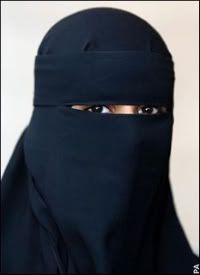
I put on my niqab, my face veil, each day before I leave the house, without a second thought. I drape it over my face, tie the ribbons at the back and adjust the opening over my eyes to make sure my peripheral vision is not affected.

Had I a full-length mirror next to the front door, I would be able to see what others see: a woman of average height and build, covered in several layers of fabric, a niqab, a jilbab, sometimes an abayah, sometimes all black, other times blue or brown. A Muslim woman in 'full veil'. A niqabi.

But is that truly how people see me? When I walk through the park with my little ones in tow, when I reverse my car into a parking space, when I browse the shelves in the frozen section, when I ask how to best cook asparagus at a market stall, what do people see? An oppressed woman? A nameless, voiceless individual? A criminal?

Well, if Mr Sarkozy and others like him have their way, I suppose I will be a criminal, won't I? Never mind that "it's a free country"; never mind that I made this choice from my own free will, as did the vast majority of covered women of my generation; never mind that I am, in every other respect, an upstanding citizen who works hard as a mother, author and magazine publisher, spends responsibly, recycles and tries to eat seasonally and buy local produce!

Yes, I cover my face, but I am still of this society. And, as crazy as it might sound, I am human, a human being with my own thoughts, feelings and opinions. I refuse to allow those who cannot know my reality to paint me as a cardboard cut-out, an oppressed, submissive, silenced relic of the Dark Ages. I am not a stereotype and, God willing, I never will be.

But where are those who will listen? At the end of the day, Muslim women have been saying for years that the hijab et al are not oppressive, that we cover as an act of faith, that this is a bonafide spiritual lifestyle choice. But the debate rages on, ironically, largely to the exclusion of the women who actually do cover their faces.

The focus on the niqab is, in my opinion, utterly misplaced. Don't the French have anything better to do than tell Muslim women how to dress? Don't our societies have bigger problems than a relative handful of women choosing to cover their faces out of religious conviction? The "burka issue" has become a red herring: there are issues that Muslim women face that are more pressing, more wide-reaching and, essentially, more relevant than whether or not they should be covering with a niqab, burqa or hijab. Niqabi, interrupted >>> Naima B. Robert | Friday, June 26, 2009
Sharia Law in the United Kingdom

Archbishop or Archdhimmi? Sharia Law in UK Is 'Unavoidable'

Papst will Krise durch Regulierung überwinden: Enzyklika «Caritas in veritate» in Rom vorgestellt

NZZ Online: Am Tag vor dem G-8-Gipfel in Aquila hat Papst Benedikt XVI. seine dritte Enzyklika vorgestellt. Das Oberhaupt der römisch-katholischen Kirche mahnt darin die Regierungen, die nationalen Ökonomien stärker zu regulieren, um die weltweite Finanz- und Wirtschaftskrise zu überwinden

Benedikt XVI. hat ungezügeltem Kapitalismus und unregulierten Marktkräften eine Absage erteilt. In der am Dienstag veröffentlichten Sozialenzyklika «Caritas in veritate» (Liebe in Wahrheit) fordert der Papst die Ausrichtung wirtschaftlichen Handelns an ethischen Zielen.

Das Oberhaupt der römisch-katholischen Kirche mahnt die Regierungen, die nationalen Ökonomien stärker zu regulieren, um die weltweite Finanz- und Wirtschaftskrise zu überwinden und ihre Wiederholung zu vermeiden. Die Krise wie auch die Globalisierung sollten als Chance genutzt werden, eine Welt in Gerechtigkeit und Solidarität zu bauen. >>> sda/dpa/Reuters/ap | Dienstag, 07. Juli 2009

«Caritas in veritate»:

In English >>>

En français >>>
Barack Obama Tells Russia to Respect Borders


THE TELEGRAPH: Barack Obama tells Russia to respect borders of Georgia and Ukraine: US President Barack Obama has told Russia's leaders they must respect the sovereignty of their neighbours Georgia and Ukraine in a major speech in Moscow >>> | Telegraph’s Foreign Staff and Agencies | Tuesday, July 07, 2009

TIMES ONLINE: Obama to Russia: stop Iranian nuclear weapon and US will scrap missile defence >>> Tony Halpin in Moscow | Tuesday, July 07, 2009
Obama’s ‘Transparent’ Presidency Not Looking Quite So Transparent Anymore


Hat tip: Always On Watch >>>
Obama Urges End to U.S.-Russia Strains

REUTERS: NOVO OGARYOVO, Russia - Visiting U.S. President Barack Obama on Tuesday praised Russia's most powerful politician, Prime Minister Vladimir Putin, as the two leaders met for the first time, saying there was an excellent opportunity to improve U.S.-Russia relations.

Visibly awkward, the two men exchanged pleasantries at the start of a meeting at Putin's forest residence outside Moscow overshadowed by Obama's criticism of Putin last week in a pre-trip interview as a man with one foot stuck in the past.

"I am aware of not only the extraordinary work that you've done on behalf of the Russian people in your previous role as prime minis-, uh, as president, but in your current role as prime minister," Obama said.

Putin, looking down and mostly avoiding eye contact with Obama, said there had been periods of greyish mood and confrontation in U.S.-Russia relations but added:

"We link hopes for development of our relationship with your name." >>> Jeff Mason, (Writing by Michael Stott; editing by Jon Boyle) | Tuesday, July 07, 2009

LE MONDE: Barack Obama appelle à la fin de l'antagonisme entre les Etats-Unis et la Russie

Dans un grand discours devant les étudiants de la Nouvelle Ecole économique de Moscou sur les relations américano-russes, le président Barack Obama affirme, mardi 7 juillet, que les Etats-Unis veulent une Russie "forte, pacifique et prospère".

Dans ce discours présentant sa vision des futures relations entre les deux pays aux relations compliquées, M. Obama a exposé la multitude des intérêts communs et des domaines de coopération possible."Ces défis réclament un partenariat mondial, et ce partenariat sera plus fort si la Russie occupe le rang de grande puissance qui doit être le sien", a-t-il dit. Il a opposé cette vision à celle du vingtième siècle, dans laquelle "les Etats-Unis et la Russie [étaient] voués à être des antagonistes", ou celle du dix-neuvième siècle, dans laquelle ils étaient condamnés "à rivaliser pour des sphères d'influence et où les grandes puissances [devaient] forger des blocs concurrents pour se contre-balancer l'un l'autre". "Malheureusement, on a parfois l'impression que les vieux présupposés doivent prévaloir, une conception de l'exercice du pouvoir enracinée dans le passé plutôt que le présent", a-t-il déploré. Mais "le temps où des empires pouvaient manipuler des Etats souverains comme les pièces d'un jeu d'échec sont révolus", a-t-il dit. >>> LEMONDE.FR avec AFP et Reuters | Mardi 07 Juillet 2009

WELT ONLINE: Ende des Misstrauens: Obama will von Putin Abschied von Kaltem Krieg

Barack Obama hat am zweiten Tag seines Russland-Besuchs in einer Grundsatzrede zur Überwindung des gegenseitigen Misstrauens beider Länder aufgerufen. „Amerika wünscht sich ein starkes, friedliches und wohlhabendes Russland", sagte der US-Präsident. Trotzdem stellte Obama auch klare Forderungen an Premier Putin.

Wenn die alten Klassenfeinde Amerika und Russland aufeinandertreffen, ist viel von Ideologie die Rede. So auch beim ersten Besuch von US-Präsident Barack Obama beim russischen Premierminister Wladimir Putin.

Allein versuchte Obama von den alten Streitereien der Vergangenheit Abstand zu nehmen. Stattdessen sprach er Russland indirekt eine größere Rolle in der internationalen Gemeinschaft zu. Er forderte das Land auf, gemeinsam mit den USA Verantwortung im Kampf gegen die Ausbreitung nuklearer Waffen und bei der Lösung der Weltwirtschaftskrise zu übernehmen. Die Welt brauche Russland als eine moderne Großmacht, die vom Denken in alten Kategorien des Kalten Krieges Abschied nehme, betonte Obama in seiner mit Spannung erwarteten Grundsatzrede vor der „Neuen Ökonomischen Schule“ in Moskau. „Amerika wünscht sich ein starkes, friedliches und wohlhabendes Russland“, sagte Obama. >>> AP/dpa/AFP/Reuters/cn | Dienstag, 07. Juli 2009
In England, Girls Vulnerable to Islamic Law

BRUSSELS JOURNAL: In March of last year a severely autistic man with the mental age of three married a woman in Bangladesh, via the telephone. Three of Britain’s most senior judges intervened, ruling the marriage could not be legal under English law, as the man was unable to give his consent.

This marriage, said Lord Justice Thorpe, was “sufficiently offensive to the conscience of the English court that the court should refuse to recognise it and should refuse to give effect to the law of Bangladesh and sharia law.”

Only six months later, sharia courts that had formerly operated illegally in Britain were reclassified as “tribunals” under the Arbitration Act, allowing them to pass effectively legally binding judgments in many civil matters.

However, with sharia law incompatible with English law and modern human rights norms, concerns were rightly raised that the sharia court system in Britain would grow into a parallel legal system. The disparity between English and sharia law was highlighted only a month later, as the House of Lords passed judgment in the case of a Lebanese woman who had claimed the right to remain in the UK with her son. An earlier Lebanese court decision, under sharia law, meant that, despite a history of abuse, her former husband would get automatic custody of the child when he turned seven.

Lord Hope of Craighead observed that under the sharia judgment, “[…] there is a real risk of a flagrant denial of their article 8 rights [of the European Convention on Human Rights] if the appellant and her child were to be returned to Lebanon.” Lord Bingham of Cornhill added, rather triumphantly, that her case was supported “[…] by JUSTICE and Liberty.”

Justice and liberty, Lord Cornhill appeared to say, are not supported by sharia. Not even in civil cases. For, in sharia, the rights of the man supersede the rights of the woman and children, Muslims are privileged over non-Muslims, and – where sharia is the dominant or sole form of law – cruel punishments, including death by stoning, hanging, etc., are meted out for adultery, homosexuality, apostasy, etc.

Although it has generally been thought that five sharia courts were operating in Britain, just over a week ago Civitas revealed that there are now at least 85 sharia courts operating across the country.

Troublingly, Civitas says that some sharia rulings it looked at, “[…] advise illegal actions and others that transgress human rights standards as they are applied by British courts,” and that, “[…] for many Muslims, sharia courts are in practice part of an institutionalised atmosphere of intimidation, backed by the ultimate sanction of a death threat.” >>> A. Millar | Tuesday, July 07, 2009
Tote Ägypterin: Islamisten fordern Vergeltung für Mord im Gericht

WELT ONLINE: Der Mord an der Apothekerin Marwa S. (32) im Dresdner Landgericht empört Muslime weltweit. In arabischen Medien wird offen Kritik an Deutschland geäußert. In den einschlägigen Internetforen drohen Islamisten mit Vergeltung: "Das Blut unserer Schwester Marwa wird nicht umsonst geflossen sein."

Photobucket
Marwas Vater trauert am Sarg. Bild: Welt Online

Am Anfang stand ein Beleidigungsfall. Doch dann geschah ein Aufsehen erregender Mord, der nun in vielen muslimischen Ländern emotionale Reaktionen hervorruft und von gewaltbereiten Islamisten für ihre Zwecke instrumentalisiert wird.

Es geht um den Tod der Apothekerin Marwa S. (32) im Dresdner Landgericht. Islamisten nutzen die Bluttat, um Aggressionen gegen die Deutschen zu schüren. In den Dschihad-Internetforen der Terrororganisation al-Qaida werden Meldungen wie „Mord an einer Muslima in deutschem Gerichtssaal“ oder „Deutscher Extremist tötet ägyptische Frau“ dahingehend kommentiert, dass der deutsche Rechtsstaat die muslimische Frau nicht ausreichend vor ihrem Mörder geschützt habe. In einschlägigen Videos wird gar zur Vergeltung aufgerufen.

Solche Meldungen und Kommentare bleiben in der arabische Welt nicht wirkungslos. Dies zeigte sich in der ägyptischen Stadt Alexandria. Mehr als 1000 Menschen schlossen sich dem Trauerzug für die Getötete an, der dann aber schnell den Charakter einer Protestdemonstration trug. Einige der Trauergäste riefen „Nieder mit Deutschland!“ und „Wir wollen Vergeltung“. >>> Von G. Lachmann und F. Flade | Montag, 06. Juli 2009

Monday, July 06, 2009

Egypt Mourns 'Headscarf Martyr'

BBC: The body of a Muslim woman, killed in a German courtroom by a man convicted of insulting her religion, has been taken back to her native Egypt for burial.

Photobucket
Marwa Sherbini is being hailed as the shahida, or martyr, of the Hijab. Photo: BBC

Marwa Sherbini, 31, was stabbed 18 times by Axel W, who is now under arrest in Dresden for suspected murder.

Husband Elwi Okaz is also in a critical condition in hospital, after being injured as he tried to save his wife.

Ms Sherbini had sued her killer after he called her a "terrorist" because of her headscarf.

The case has attracted much attention in Egypt and the Muslim world.

German prosecutors have said the 28-year-old attacker, identified only as Axel W, was driven by a deep hatred of foreigners and Muslims. >>> | Monday, July 06, 2009
French Anger as Iran Holds Woman

BBC: France has demanded the release of a French academic who it says has been detained in Iran since 1 July, accused of spying.

The French foreign ministry condemned the arrest of the unnamed woman and said the allegations of spying did not stand up to examination.

The French news agency AFP says the woman is an academic in Isfahan.

She had been in Iran for five months, and was arrested at Tehran airport as she was about to depart for Beirut.

"We call on the Iranian authorities to free our compatriot immediately and allow her to leave Iran for France," the French foreign ministry said in a statement.

The ministry said the Iranian ambassador in Paris had been summoned for an explanation. >>> | Monday, July 06, 2009
Sarkozy und Brown beim Thema Iran einig: Bilaterale Gespräche in Evian

NZZ Online: Die Regierungen von Frankreich und Grossbritannien vertreten eine ähnlich Haltung gegenüber Iran. Teheran hatte London zuletzt vehement kritisiert und Grossbritannien vorgeworfen, die Proteste im Iran nach der umstrittenen Präsidentenwahl gezielt anzufachen.

Der französische Präsident Nicolas Sarkozy und der britische Premierminister Gordon Brown haben Geschlossenheit im Konflikt mit Iran betont.

«Das iranische Regime muss sich darüber im klaren sein, dass wir zusammen mit unseren europäischen Partnern handeln werden», sagte Brown nach bilateralen Gesprächen in Evian am Genfer See. Sarkozy betonte, Grossbritannien könne in dieser Frage auf die «totale Solidarität» Frankreichs zählen. >>> ap | Montag, 06. Juli 2009
Iran : des médecins dénoncent la terreur dans les hôpitaux

LE FIGARO: De passage à Paris, ils dénoncent le climat de terreur qui sévit dans les hôpitaux où ont été transportés, ces dernières semaines, les blessés des manifestations anti-Ahmadinejad.

Ils en ont trop vu. Par peur de représailles, ils ont gardé le silence. Mais de passage en France pour quelques jours, ils veulent briser le mur de la peur. À tout prix. «À Téhéran, nous sommes les témoins impuissants de véritables crimes contre l'humanité», s'insurge un des deux médecins iraniens, rencontrés ce week-end à Paris, et qui préfère garder l'anonymat pour des raisons de sécurité. «Depuis le début des manifestations anti-Ahmadinejad, dit-il, des miliciens et des agents de la sécurité en civil ont instauré une politique de la terreur dans les hôpitaux. Ils y mènent une traque sans merci contre les blessés.»«Tout a débuté le samedi 13 juin - le premier jour de la contestation contre les résultats de l'élection. Ils ont commencé à demander la liste des admis à la réception des hôpitaux qui étaient situés à proximité des manifestations», raconte le médecin. Objectif à peine voilé : «identifier les protestataires blessés, pour pouvoir ensuite les poursuivre en justice, en les accusant d'avoir perturbé l'ordre public», précise-t-il. >>> Delphine Minoui | Lundi 06 Juillet 2009
Justice, Islam-style!

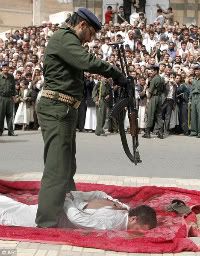
MAIL Online: A barber has been publicly executed in Yemen after he was found guilty of raping and killing an 11-year-old boy who came to his shop for a haircut.

Pictures of the execution Monday in the capital of San'a showed hundreds of people gathered around as Yehya Hussein was killed.

The images showed the barber lying face down on a large piece of red cloth, his hands bound behind him, as Yemeni police official stood over him with what appeared to be a machine gun.

According to the news agency, SAB'A, the barber was arrested in December 2008 and confessed during a January trial to raping the boy inside his salon, killing him and cutting his body to pieces before dumping it outside San'a.

Elsewhere in the country, a court sentenced seven rebels from a Shia Muslim sect to be executed after convicting them of causing deaths in clashes with army in 2008.

Hundreds of people died in the conflict and thousands fled their homes in battles between government forces and the rebels in the north, which have raged on and off since 2004.

The state security court also jailed for terms of 12-15 years another five of the rebels accused of seeking to install Shi'ite Islamic rule in the country, which borders the world's biggest oil exporter Saudi Arabia. Justice Yemen-style: Paedophile who raped boy, 11, shot in the head in front of hundreds of spectators >>> | Monday, July 06, 2009
Iran's Defiant Alcohol Smugglers


Iran’s Cultural Revolution: On the 30th anniversary of the Islamic revolution, Tehran Correspondent Jon Leyne, looks at the new cultural revolution in Iran >>> | Sunday, February 8, 2009
Nazanin on Sharia Law in Iran

Reverend Robert West Interview with BNPtv

L'Islam en France: Le rituel, les obligations, la prière

Wilders Makes Half of Dutch Muslims Want to Emigrate

EXPATICA: More than half of the people with Turkish and Moroccan backgrounds in the Netherlands say they would consider leaving the country due to the growing popularity of anti-Islam politician Geert Wilders. A third say they would definitely like to emigrate.

The figures emerge from a survey by research bureau Motivaction for public service broadcaster NCRV’s current affairs programme Netwerk. The programme commissioned the survey in response to the success of Mr Wilders' rightwing Freedom Party in the recent European parliamentary elections. Since March this year, leading pollster Maurice de Hond's Peil.nl has measured support for the populist Freedom Party at more than 30 percent, which would theoretically make it the largest party in the Dutch parliament if there were an election.


Discrimination


Although three quarters of the Turkish and Moroccan Dutch people questioned in the Motivaction survey said they felt at home in the Netherlands, 57 percent said they now felt less comfortable in the country due to the growing popularity of the Freedom Party. Two out of five said they felt they were now discriminated against more often, and almost a quarter said they regularly experienced discrimination. Nearly three quarters said they thought Mr Wilders had intensified negative feelings towards Muslims among the Dutch public.


Nearly twenty percent said they agreed with Mr Wilders on some points and could appreciate why people would vote for him. However, half of the respondents said the growing support for Mr Wilders made them feel angry and disappointed, and 22 percent said he aroused feelings of fear and hatred. Ninety per cent said they thought a Wilders government would be a fiasco, and only 4 percent thought he would be able to offer any solutions to the country's problems.


The survey asked respondents what they saw as the best strategy to counter Mr Wilders. Forty percent thought the best policy was simply to ignore the Freedom Party. Thirty-five percent favoured entering into debate with Mr Wilders and his supporters. Twenty five percent saw vociferous protest as the answer, and 11 percent wanted to see a Muslim political party established to represent their interests. >>> | Monday, July 06, 2009
Obama / Medvedev News Conference

Watch BBC live video: US President Obama and Russian President Medvedev hold a joint news conference after meeting to discuss relations between their countries and arms control issues >>>