Tuesday, July 07, 2009
NZZ Online: Am Tag vor dem G-8-Gipfel in Aquila hat Papst Benedikt XVI. seine dritte Enzyklika vorgestellt. Das Oberhaupt der römisch-katholischen Kirche mahnt darin die Regierungen, die nationalen Ökonomien stärker zu regulieren, um die weltweite Finanz- und Wirtschaftskrise zu überwinden
Benedikt XVI. hat ungezügeltem Kapitalismus und unregulierten Marktkräften eine Absage erteilt. In der am Dienstag veröffentlichten Sozialenzyklika «Caritas in veritate» (Liebe in Wahrheit) fordert der Papst die Ausrichtung wirtschaftlichen Handelns an ethischen Zielen.
Das Oberhaupt der römisch-katholischen Kirche mahnt die Regierungen, die nationalen Ökonomien stärker zu regulieren, um die weltweite Finanz- und Wirtschaftskrise zu überwinden und ihre Wiederholung zu vermeiden. Die Krise wie auch die Globalisierung sollten als Chance genutzt werden, eine Welt in Gerechtigkeit und Solidarität zu bauen. >>> sda/dpa/Reuters/ap | Dienstag, 07. Juli 2009
«Caritas in veritate»:
In English >>>
En français >>>

THE TELEGRAPH: Barack Obama tells Russia to respect borders of Georgia and Ukraine: US President Barack Obama has told Russia's leaders they must respect the sovereignty of their neighbours Georgia and Ukraine in a major speech in Moscow >>> | Telegraph’s Foreign Staff and Agencies | Tuesday, July 07, 2009
TIMES ONLINE: Obama to Russia: stop Iranian nuclear weapon and US will scrap missile defence >>> Tony Halpin in Moscow | Tuesday, July 07, 2009
Hat tip: Always On Watch >>>
REUTERS: NOVO OGARYOVO, Russia - Visiting U.S. President Barack Obama on Tuesday praised Russia's most powerful politician, Prime Minister Vladimir Putin, as the two leaders met for the first time, saying there was an excellent opportunity to improve U.S.-Russia relations.
Visibly awkward, the two men exchanged pleasantries at the start of a meeting at Putin's forest residence outside Moscow overshadowed by Obama's criticism of Putin last week in a pre-trip interview as a man with one foot stuck in the past.
"I am aware of not only the extraordinary work that you've done on behalf of the Russian people in your previous role as prime minis-, uh, as president, but in your current role as prime minister," Obama said.
Putin, looking down and mostly avoiding eye contact with Obama, said there had been periods of greyish mood and confrontation in U.S.-Russia relations but added:
"We link hopes for development of our relationship with your name." >>> Jeff Mason, (Writing by Michael Stott; editing by Jon Boyle) | Tuesday, July 07, 2009
LE MONDE: Barack Obama appelle à la fin de l'antagonisme entre les Etats-Unis et la Russie
Dans un grand discours devant les étudiants de la Nouvelle Ecole économique de Moscou sur les relations américano-russes, le président Barack Obama affirme, mardi 7 juillet, que les Etats-Unis veulent une Russie "forte, pacifique et prospère".
Dans ce discours présentant sa vision des futures relations entre les deux pays aux relations compliquées, M. Obama a exposé la multitude des intérêts communs et des domaines de coopération possible."Ces défis réclament un partenariat mondial, et ce partenariat sera plus fort si la Russie occupe le rang de grande puissance qui doit être le sien", a-t-il dit. Il a opposé cette vision à celle du vingtième siècle, dans laquelle "les Etats-Unis et la Russie [étaient] voués à être des antagonistes", ou celle du dix-neuvième siècle, dans laquelle ils étaient condamnés "à rivaliser pour des sphères d'influence et où les grandes puissances [devaient] forger des blocs concurrents pour se contre-balancer l'un l'autre". "Malheureusement, on a parfois l'impression que les vieux présupposés doivent prévaloir, une conception de l'exercice du pouvoir enracinée dans le passé plutôt que le présent", a-t-il déploré. Mais "le temps où des empires pouvaient manipuler des Etats souverains comme les pièces d'un jeu d'échec sont révolus", a-t-il dit. >>> LEMONDE.FR avec AFP et Reuters | Mardi 07 Juillet 2009
WELT ONLINE: Ende des Misstrauens: Obama will von Putin Abschied von Kaltem Krieg
Barack Obama hat am zweiten Tag seines Russland-Besuchs in einer Grundsatzrede zur Überwindung des gegenseitigen Misstrauens beider Länder aufgerufen. „Amerika wünscht sich ein starkes, friedliches und wohlhabendes Russland", sagte der US-Präsident. Trotzdem stellte Obama auch klare Forderungen an Premier Putin.
Wenn die alten Klassenfeinde Amerika und Russland aufeinandertreffen, ist viel von Ideologie die Rede. So auch beim ersten Besuch von US-Präsident Barack Obama beim russischen Premierminister Wladimir Putin.
Allein versuchte Obama von den alten Streitereien der Vergangenheit Abstand zu nehmen. Stattdessen sprach er Russland indirekt eine größere Rolle in der internationalen Gemeinschaft zu. Er forderte das Land auf, gemeinsam mit den USA Verantwortung im Kampf gegen die Ausbreitung nuklearer Waffen und bei der Lösung der Weltwirtschaftskrise zu übernehmen. Die Welt brauche Russland als eine moderne Großmacht, die vom Denken in alten Kategorien des Kalten Krieges Abschied nehme, betonte Obama in seiner mit Spannung erwarteten Grundsatzrede vor der „Neuen Ökonomischen Schule“ in Moskau. „Amerika wünscht sich ein starkes, friedliches und wohlhabendes Russland“, sagte Obama. >>> AP/dpa/AFP/Reuters/cn | Dienstag, 07. Juli 2009
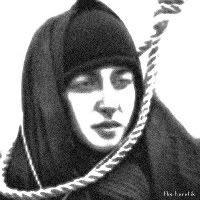
BRUSSELS JOURNAL: In March of last year a severely autistic man with the mental age of three married a woman in Bangladesh, via the telephone. Three of Britain’s most senior judges intervened, ruling the marriage could not be legal under English law, as the man was unable to give his consent.
This marriage, said Lord Justice Thorpe, was “sufficiently offensive to the conscience of the English court that the court should refuse to recognise it and should refuse to give effect to the law of Bangladesh and sharia law.”
Only six months later, sharia courts that had formerly operated illegally in Britain were reclassified as “tribunals” under the Arbitration Act, allowing them to pass effectively legally binding judgments in many civil matters.
However, with sharia law incompatible with English law and modern human rights norms, concerns were rightly raised that the sharia court system in Britain would grow into a parallel legal system. The disparity between English and sharia law was highlighted only a month later, as the House of Lords passed judgment in the case of a Lebanese woman who had claimed the right to remain in the UK with her son. An earlier Lebanese court decision, under sharia law, meant that, despite a history of abuse, her former husband would get automatic custody of the child when he turned seven.
Lord Hope of Craighead observed that under the sharia judgment, “[…] there is a real risk of a flagrant denial of their article 8 rights [of the European Convention on Human Rights] if the appellant and her child were to be returned to Lebanon.” Lord Bingham of Cornhill added, rather triumphantly, that her case was supported “[…] by JUSTICE and Liberty.”
Justice and liberty, Lord Cornhill appeared to say, are not supported by sharia. Not even in civil cases. For, in sharia, the rights of the man supersede the rights of the woman and children, Muslims are privileged over non-Muslims, and – where sharia is the dominant or sole form of law – cruel punishments, including death by stoning, hanging, etc., are meted out for adultery, homosexuality, apostasy, etc.
Although it has generally been thought that five sharia courts were operating in Britain, just over a week ago Civitas revealed that there are now at least 85 sharia courts operating across the country.
Troublingly, Civitas says that some sharia rulings it looked at, “[…] advise illegal actions and others that transgress human rights standards as they are applied by British courts,” and that, “[…] for many Muslims, sharia courts are in practice part of an institutionalised atmosphere of intimidation, backed by the ultimate sanction of a death threat.” >>> A. Millar | Tuesday, July 07, 2009
WELT ONLINE: Der Mord an der Apothekerin Marwa S. (32) im Dresdner Landgericht empört Muslime weltweit. In arabischen Medien wird offen Kritik an Deutschland geäußert. In den einschlägigen Internetforen drohen Islamisten mit Vergeltung: "Das Blut unserer Schwester Marwa wird nicht umsonst geflossen sein."

Am Anfang stand ein Beleidigungsfall. Doch dann geschah ein Aufsehen erregender Mord, der nun in vielen muslimischen Ländern emotionale Reaktionen hervorruft und von gewaltbereiten Islamisten für ihre Zwecke instrumentalisiert wird.
Es geht um den Tod der Apothekerin Marwa S. (32) im Dresdner Landgericht. Islamisten nutzen die Bluttat, um Aggressionen gegen die Deutschen zu schüren. In den Dschihad-Internetforen der Terrororganisation al-Qaida werden Meldungen wie „Mord an einer Muslima in deutschem Gerichtssaal“ oder „Deutscher Extremist tötet ägyptische Frau“ dahingehend kommentiert, dass der deutsche Rechtsstaat die muslimische Frau nicht ausreichend vor ihrem Mörder geschützt habe. In einschlägigen Videos wird gar zur Vergeltung aufgerufen.
Solche Meldungen und Kommentare bleiben in der arabische Welt nicht wirkungslos. Dies zeigte sich in der ägyptischen Stadt Alexandria. Mehr als 1000 Menschen schlossen sich dem Trauerzug für die Getötete an, der dann aber schnell den Charakter einer Protestdemonstration trug. Einige der Trauergäste riefen „Nieder mit Deutschland!“ und „Wir wollen Vergeltung“. >>> Von G. Lachmann und F. Flade | Montag, 06. Juli 2009
Monday, July 06, 2009
BBC: The body of a Muslim woman, killed in a German courtroom by a man convicted of insulting her religion, has been taken back to her native Egypt for burial.

Marwa Sherbini, 31, was stabbed 18 times by Axel W, who is now under arrest in Dresden for suspected murder.
Husband Elwi Okaz is also in a critical condition in hospital, after being injured as he tried to save his wife.
Ms Sherbini had sued her killer after he called her a "terrorist" because of her headscarf.
The case has attracted much attention in Egypt and the Muslim world.
German prosecutors have said the 28-year-old attacker, identified only as Axel W, was driven by a deep hatred of foreigners and Muslims. >>> | Monday, July 06, 2009

BBC: France has demanded the release of a French academic who it says has been detained in Iran since 1 July, accused of spying.
The French foreign ministry condemned the arrest of the unnamed woman and said the allegations of spying did not stand up to examination.
The French news agency AFP says the woman is an academic in Isfahan.
She had been in Iran for five months, and was arrested at Tehran airport as she was about to depart for Beirut.
"We call on the Iranian authorities to free our compatriot immediately and allow her to leave Iran for France," the French foreign ministry said in a statement.
The ministry said the Iranian ambassador in Paris had been summoned for an explanation. >>> | Monday, July 06, 2009
NZZ Online: Die Regierungen von Frankreich und Grossbritannien vertreten eine ähnlich Haltung gegenüber Iran. Teheran hatte London zuletzt vehement kritisiert und Grossbritannien vorgeworfen, die Proteste im Iran nach der umstrittenen Präsidentenwahl gezielt anzufachen.
Der französische Präsident Nicolas Sarkozy und der britische Premierminister Gordon Brown haben Geschlossenheit im Konflikt mit Iran betont.
«Das iranische Regime muss sich darüber im klaren sein, dass wir zusammen mit unseren europäischen Partnern handeln werden», sagte Brown nach bilateralen Gesprächen in Evian am Genfer See. Sarkozy betonte, Grossbritannien könne in dieser Frage auf die «totale Solidarität» Frankreichs zählen. >>> ap | Montag, 06. Juli 2009

LE FIGARO: De passage à Paris, ils dénoncent le climat de terreur qui sévit dans les hôpitaux où ont été transportés, ces dernières semaines, les blessés des manifestations anti-Ahmadinejad.
Ils en ont trop vu. Par peur de représailles, ils ont gardé le silence. Mais de passage en France pour quelques jours, ils veulent briser le mur de la peur. À tout prix. «À Téhéran, nous sommes les témoins impuissants de véritables crimes contre l'humanité», s'insurge un des deux médecins iraniens, rencontrés ce week-end à Paris, et qui préfère garder l'anonymat pour des raisons de sécurité. «Depuis le début des manifestations anti-Ahmadinejad, dit-il, des miliciens et des agents de la sécurité en civil ont instauré une politique de la terreur dans les hôpitaux. Ils y mènent une traque sans merci contre les blessés.»«Tout a débuté le samedi 13 juin - le premier jour de la contestation contre les résultats de l'élection. Ils ont commencé à demander la liste des admis à la réception des hôpitaux qui étaient situés à proximité des manifestations», raconte le médecin. Objectif à peine voilé : «identifier les protestataires blessés, pour pouvoir ensuite les poursuivre en justice, en les accusant d'avoir perturbé l'ordre public», précise-t-il. >>> Delphine Minoui | Lundi 06 Juillet 2009
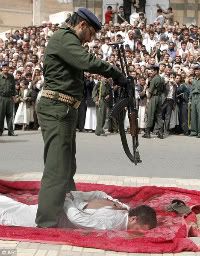
MAIL Online: A barber has been publicly executed in Yemen after he was found guilty of raping and killing an 11-year-old boy who came to his shop for a haircut.
Pictures of the execution Monday in the capital of San'a showed hundreds of people gathered around as Yehya Hussein was killed.
The images showed the barber lying face down on a large piece of red cloth, his hands bound behind him, as Yemeni police official stood over him with what appeared to be a machine gun.
According to the news agency, SAB'A, the barber was arrested in December 2008 and confessed during a January trial to raping the boy inside his salon, killing him and cutting his body to pieces before dumping it outside San'a.
Elsewhere in the country, a court sentenced seven rebels from a Shia Muslim sect to be executed after convicting them of causing deaths in clashes with army in 2008.
Hundreds of people died in the conflict and thousands fled their homes in battles between government forces and the rebels in the north, which have raged on and off since 2004.
The state security court also jailed for terms of 12-15 years another five of the rebels accused of seeking to install Shi'ite Islamic rule in the country, which borders the world's biggest oil exporter Saudi Arabia. Justice Yemen-style: Paedophile who raped boy, 11, shot in the head in front of hundreds of spectators >>> | Monday, July 06, 2009
Iran’s Cultural Revolution: On the 30th anniversary of the Islamic revolution, Tehran Correspondent Jon Leyne, looks at the new cultural revolution in Iran >>> | Sunday, February 8, 2009

EXPATICA: More than half of the people with Turkish and Moroccan backgrounds in the Netherlands say they would consider leaving the country due to the growing popularity of anti-Islam politician Geert Wilders. A third say they would definitely like to emigrate.
The figures emerge from a survey by research bureau Motivaction for public service broadcaster NCRV’s current affairs programme Netwerk. The programme commissioned the survey in response to the success of Mr Wilders' rightwing Freedom Party in the recent European parliamentary elections. Since March this year, leading pollster Maurice de Hond's Peil.nl has measured support for the populist Freedom Party at more than 30 percent, which would theoretically make it the largest party in the Dutch parliament if there were an election.
Discrimination
Although three quarters of the Turkish and Moroccan Dutch people questioned in the Motivaction survey said they felt at home in the Netherlands, 57 percent said they now felt less comfortable in the country due to the growing popularity of the Freedom Party. Two out of five said they felt they were now discriminated against more often, and almost a quarter said they regularly experienced discrimination. Nearly three quarters said they thought Mr Wilders had intensified negative feelings towards Muslims among the Dutch public.
Nearly twenty percent said they agreed with Mr Wilders on some points and could appreciate why people would vote for him. However, half of the respondents said the growing support for Mr Wilders made them feel angry and disappointed, and 22 percent said he aroused feelings of fear and hatred. Ninety per cent said they thought a Wilders government would be a fiasco, and only 4 percent thought he would be able to offer any solutions to the country's problems.
The survey asked respondents what they saw as the best strategy to counter Mr Wilders. Forty percent thought the best policy was simply to ignore the Freedom Party. Thirty-five percent favoured entering into debate with Mr Wilders and his supporters. Twenty five percent saw vociferous protest as the answer, and 11 percent wanted to see a Muslim political party established to represent their interests. >>> | Monday, July 06, 2009
Watch BBC live video: US President Obama and Russian President Medvedev hold a joint news conference after meeting to discuss relations between their countries and arms control issues >>>

BERLINER ZEITUNG: Washington/Jerusalem - Die USA würden sich nach den Worten von Vizepräsident Joe Biden einem israelischen Militärangriff gegen den Iran nicht in den Weg stellen.
Die USA könnten «einer anderen souveränen Nation nicht diktieren, was sie tun und was sie nicht tun kann», sagte Biden dem US-Sender ABC. Nur die Israelis könnten bestimmen, ob sie durch das iranische Atomprogramm «existenziell bedroht sind».
Die israelische Regierung wollte die Äußerungen am Montag zunächst nicht kommentieren. Allerdings berichtete die Zeitung «Israel Hajom» unter Berufung auf einen namentlich nicht genannten Regierungsvertreter in Jerusalem, es gebe «geheime Absprachen zwischen Israel und der US-Regierung über die Optionen, die Israel in der Iran-Frage hat». Bidens Äußerungen seien ein Zeichen dafür, dass Washington angesichts der iranischen Raketentests und den Versuchen Teherans, einem Dialog auszuweichen, die Geduld verliere. «Die Worte Bidens zu diesem Zeitpunkt sollen den Iranern signalisieren, dass die US-Regierung die Nase voll hat und dass sie nicht ewig auf sie warten will.» >>> © dpa | Montag, 06. Juli 2009
STERN: Besuch in Moskau: Obama sucht die Nähe zu Russland
Subscribe to:
Posts (Atom)