Saturday, June 27, 2009

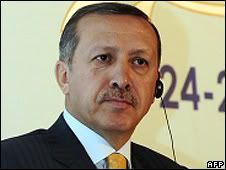
BBC: Turkey has urged France and Germany to back its bid to join the EU, rejecting calls for a special partnership rather than full membership.
"We will never give up," Turkish Prime Minister Recep Tayyip Erdogan told reporters in Brussels.
Turkey's EU accession talks are going at a glacial pace and risk suspension if Ankara fails to open its ports and airports to Cyprus this year.
France and Germany want to give Turkey a "privileged partnership" with the EU.
But Mr Erdogan insisted "our goal is full membership".
He also said it was "populist and wrong" to use Turkey's bid as an election issue.
Some right-wing parties opposed to Turkey's bid made gains in the recent European Parliament elections. >>> | Friday, June 26, 2009

EURONEWS: In Brussels, Mahinur Ozdemir, 26, has become the first deputy wearing a Muslim headscarf to be sworn into the regional parliament.
Coming the day after French President Nicolas Sarkozy said the burqa was not welcome in France, Ozdemir’s colleagues said it was about personal choice.
After the ceremony, Ozdemir, from the Democrat Humanist Centre, said she wanted to be recognised for her achievements and not her headwear.
“Unfortunately, I have been reduced to nothing more than this scarf, and frankly it is hard to remove yourself from it,” she said. “Underneath this veil there is a personality, there is someone who is engaged, who wants things to change, who wants to move forward and execute lots of projects for the people of Brussels.”
During her election campaign, Ozdemir was targeted by hardline activists due to her headscarf. She served as a member of the municipal council in Shaerbeek, which is known as the “Turkish neighbourhood” of Brussels. [Source: euronews] | Wednesday, June 24, 2009
NZZ Online: Belgien wieder voll im Kopftuch-Dilemma: Streit um Antwerpener Schulen und eine Abgeordnete mit dem Hijab
In Belgien ist die Diskussion um das Kopftuch muslimischer Frauen wieder voll entbrannt. Während in Antwerpen Muslime gegen das Kopftuchverbot an einer Schule protestierten, legte im Brüsseler Regionalparlament die erste Abgeordnete im Kopftuch ihren Eid ab.
Zwei Ereignisse haben in Belgien die Diskussionen um das Kopftuchtragen muslimischer Frauen wieder voll entbrennen lassen. Im Brüsseler Regionalparlament legte die türkischstämmige Christlichsoziale Mahinur Özdemir ihren Eid als Abgeordnete im Hijab ab – eine absolute Premiere in Belgien. Dies rief natürlich in Teilen der politischen Landschaft Widerspruch hervor; die französischsprachigen Liberalen vom Mouvement réformateur (MR) wollten gar die Möglichkeit prüfen, mit einem Vorstoss das Tragen von «religiösen und philosophischen Symbolen» in den Sitzungen aller belgischen Parlamente zu verbieten. Die flämischen Liberalen wiederum fanden, das Parlament sei keine Amtsstelle, und nahmen deshalb am Kopftuch der Abgeordneten Özdemir keinen Anstoss. >>> win. Brüssel | Thursday, June 25, 2009
TIMES ONLINE: A hardline cleric close to the Iranian regime demanded the execution of leading demonstrators yesterday as the opposition ended the week in disarray.
In a televised sermon at Friday prayers in Tehran, Ayatollah Ahmad Khatami called on the judiciary to “punish leading rioters firmly and without showing any mercy to teach everyone a lesson”. He said that those leaders were backed by the United States and Israel. They should be treated as mohareb — people who wage war against God — and deserved execution.
In a clear warning to all other dissenters, he declared: “Anybody who fights against the Islamic system or the leader of Islamic society, fight him until complete destruction.” Leading demonstrators must be executed, Ayatollah Khatami demands >>> Martin Fletcher | Saturday, June 27, 2009
Friday, June 26, 2009
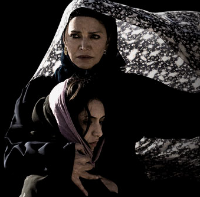
LOS ANGELES TIMES: 'The Stoning of Soraya M.' vividly depicts the violent execution of a woman condemned by religion distorted.
"The Stoning of Soraya M." lives up to its title quite literally -- and rightly so, for it is important to understand just how cruel and drawn-out this ancient form of execution is and how prevalent it remains, not just in Iran, the film's setting, but in countries throughout the Middle East and sub-Saharan Africa that follow Islamic Sharia law.
The timing of the film's release is apt, for it serves as a metaphor for the current protests in Iran against the long-standing oppressiveness of the Islamic Republic.
Based on a true story recounted in the late Freidoune Sahebjam's book, "The Stoning of Soraya M." was filmed in a remote mountain village in an undisclosed Middle Eastern country. Jim Caviezel is cast as Sahebjam, an eminent Iranian journalist based in France who is passing through the village when he is accosted by a distraught woman, Zahra (Shohreh Aghdashloo), who prevails upon him to tape the terrible story she has to tell.
Only the day before, her niece Soraya (Mozhan Marnò) was executed in the town square by stoning. Her husband, Ali (Navid Negahban), who has the village leaders in his thrall, had concocted a flimsy and completely false charge of adultery against Soraya, the mother of their four children, so that he can be free to marry a 14-year-old girl; Soraya had refused to divorce Ali because she had no other means of support. >>> Kevin Thomas | Friday, June 26, 2009
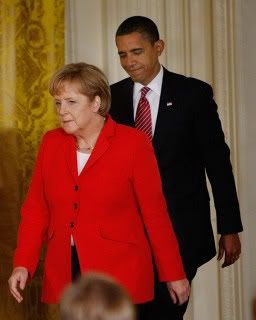
WELT ONLINE: US-Präsident Barack Obama hat Deutschland als unverzichtbaren Partner für sein Land bezeichnet. Gemeinsam mit Kanzlerin Merkel bekundete er im Weißen Haus den Willen, die Probleme der Welt anzugehen – von der Lage im Iran bis zum Klimaschutz. Und die Kanzlerin bekam ein ganz persönliches Lob zu hören.
Bundeskanzlerin Angela Merkel (CDU) und US-Präsident Barack Obama haben bei ihrem Treffen in Washington eine enge Abstimmung in internationalen Fragen vereinbart.
Unter den goldenen Kandelabern des East Rooms im Weißen Haus stellte ein sichtlich erschöpfter Obama klar, dass an den Gerüchten über gegenseitige Antipathien zwischen ihm und der deutschen Bundeskanzlerin nichts dran sei.
Er betrachte Deutschland als „einen unserer engsten Verbündeten und als unverzichtbaren Partner“, sagte Obama nach dem Vier-Augen-Gespräch mit Merkel. Die Bundeskanzlerin sagte bei dem gemeinsamen Presseauftritt, sie wolle gemeinsam mit den USA Probleme lösen, „die nicht von einem allein zu bewältigen sind“. Unter anderem wolle man die Friedensbemühungen im Nahost-Konflikt, den Klimaschutz und die Wirtschaftskrise angehen.
Während der Pressekonferenz betonten Merkel und der amerikanische Präsident ihre Einigkeit speziell in Sachen Iran. Auf die Frage, ob er der Forderung des iranischen Präsidenten nach einer Entschuldigung nachkommen werde, erklärte Obama: "Ich nehme Präsident Ahmadinedschad nicht besonders ernst. Er sollte sich vor allem fragen, was er seinem eigenen Volk schuldet“.
Angela Merkel erklärte, man werde sehr genau nach den inhaftierten Demonstranten fragen. Aus ihrer Zeit in der DDR erinnere sie sich sehr genau, wie wichtig es sei, dass die Welt Anteil nehme. >>> Von Mariam Lau | Freitag, 26. Juni 2009
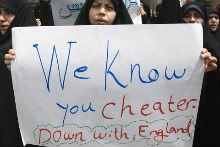
WELT ONLINE: Schuld an den Unruhen sind die Briten – diese simple Behauptung verbreiten die Machthaber in Teheran gern und oft. Sie wurzelt in einer tiefen Feindschaft gegenüber der einstigen De-facto-Kolonialmacht. Die langen Versuche Londons, sich den Iran als Einflusssphäre zu sichern, bieten den Mullahs eine Steilvorlage.
Kein Mittel verstehen die Machthaber in Teheran besser einzusetzen als das tief in der nationalen Psyche verankerte Vorurteil, hinter den Unruhen im Iran stecke nichts weiter als die bekannte Hand der Briten, die sich permanent in die iranischen Angelegenheiten einmischen und eingemischt haben. Das beherrscht die Köpfe der Regierenden in Teheran geradezu wie eine Paranoia.
Den Ursprung des England-Hasses muss man im 19. Jahrhundert ansiedeln, als Persien zur Trophäe wurde im „Großen Spiel“ zwischen dem zaristischen Russland und dem britischen Weltreich um das Herzland Eurasien: Afghanistan, Kaukasus, Persien. >>> Von Thomas Kielinger | Freitag, 26. Juni 2009

TIMES ONLINE: Silvio Berlusconi faced mounting pressure to come clean about his private life yesterday after revelations that he entertained about 20 women, including two lesbian escort girls, until dawn during a private party at his house in Rome.
Patrizia D’Addario, the Bari prostitute who claims to have recorded footage that proves her encounters with the Prime Minister, gave more details of her first meeting with Mr Berlusconi, saying: “It felt like a harem. And there was only one sheikh. Him.”
She also spoke of the “strange burglary” in which her underwear, computer and the dress she wore to the party were allegedly stolen from her home days after she told a friend of the secret recordings.
It is understood that the video recordings, taken on her mobile phone, show Ms D’Addario in the Prime Minister’s bedroom. She claims that the four-poster bed with white drapes and duvets were given to him as a present by his friend Vladimir Putin, the Russian Prime Minister. A Kremlin spokesman denied that Mr Putin had ever given the Italian leader a bed. >>> Lucy Bannerman in Bari | Friday, June 26, 2009
TIMES ONLINE: Senior Roman Catholic Bishop Calls for Silvio Berlusconi to Resign
A Roman Catholic bishop called for the resignation of Silvio Berlusconi, the first time that such a senior figure of the Church has done so, adding to a growing sense that the crisis over the beleaguered Italian Prime Minister’s private life is out of control.
Monsignor Domenico Mogavero, Bishop of Mazara del Vallo in Sicily and a former senior official in the Italian Bishops' Conference, said that Mr Berlusconi should “consider whether it is opportune to resign in the interests of the country”.
The Prime Minister was further criticised by the Church when Archbishop Angelo Bagnasco of Genoa, head of the Conference, warned against “men drunk on a delirium of their own greatness, who touch the illusion of omnipotence and distort moral values”. >>> Richard Owen in Rome | Friday, June 26, 2009
THE NEW YORK TIMES: Around the country and the world Friday, legions of grief-stricken fans of the King of Pop mourned the sudden death of Michael Jackson with spontaneous flower-laden memorials and emotional tributes, as the autopsy to determine the cause of his mysterious death was scheduled to begin in Los Angeles.
The autopsy would take several hours Friday, but toxicology results could take six to eight weeks, the Los Angeles County assistant chief coroner Lt. Ed Winter told reporters.
Mr. Jackson’s brother Jermaine said on Thursday that the preliminary cause of death was cardiac arrest. The singer, 50, had been rushed to the hospital, a six-minute drive from the rented Bel-Air home where he was living, shortly after noon local time by paramedics for the Los Angeles Fire Department. He was pronounced dead at 2:26 pm.
The Los Angeles Police Department opened an investigation, as a formality and because of Mr. Jackson’s enormous celebrity, a police spokesman said, and detectives began their search of Mr. Jackson’s house Thursday.
Brian Oxman, a former lawyer of Mr. Jackson’s and a family friend, gave interviews expressing his concerns about Mr. Jackson’s health, and saying that prescription drugs might have been a factor in his death Thursday. >>> Sharon Otterman and Liz Robbins | Friday, June 26, 2009
THE TELEGRAPH: Michael Jackson's Family Feared Morphine Overdose
THE TELEGRAPH:
Michael Jackson 'Converts to Islam and Changes Name to Mikaeel' >>> Graham Tibbetts | Friday, November 21, 2008
TIMES ONLINE: Michael Jackson: Martin Bashir Interview Damaged Him Deeply

When Michael Jackson agreed to give the television journalist Martin Bashir unprecedented access to his personal life, he believed that it would help him win public sympathy and repair a reputation that had become heavily tarnished over the years.
It had, after all, worked with Diana, Princess of Wales, a figure with whom Jackson identified closely and who had scored a momentous public relations coup with her Panorama interview with Bashir in 1995.
It was to prove a calamitous error of judgement on Jackson’s part.
The admissions he made in the interview about sleeping with children at his Neverland ranch in California would eventually lead to criminal charges and a trial which, despite his acquittal, would cause him a level of damage from which he would never recover.
Jackson was initially persuaded to let Bashir become part of his entourage for eight months by his friend Uri Geller, who said: “Michael liked Martin and he was happy to have him around. I said to him, ‘Michael, maybe it’s time to open up to the world.’”
Jackson did exactly that; and the world did not like what it heard. >>> Valentine Low | Friday, June 26, 2009
YOUTUBE: Thriller
YOUTUBE: Moon Walk
YOUTUBE: Dirty Diana
YOUTUBE: Billy Jean
YOUTUBE: Bad >>>
YOUTUBE: Black or White >>>
YOUTUBE: Don't Stop 'Til You Get Enough >>>
YOUTUBE: Off the Wall >>>
YOUTUBE: In the Closet >>>
YOUTUBE: Dangerous >>>
YOUTUBE: Liberian Girl >>>
LOS ANGELES TIMES: Obama is making the same mistake as other presidents -- the only answer is regime change.
Since Iran's controversial and disputed election, President Obama has been noticeably restrained in his reaction. He has flashed his empathy, saying on Tuesday that he was "appalled and outraged" by the regime's brutality, but he has been equally emphatic about not being perceived as meddling in Iran's internal affairs. Despite increasing political heat, even from Democrats and the usually adulatory U.S. media, Obama persists in his low-key approach, clinging to emotive generalizations.
But it is the president's underlying policies that are wrong, not just his rhetoric. Saying that he does not want the "debate" inside Iran to be about the United States is disingenuous at best. Obama's real objective is to launch negotiations with Iran over its nuclear program, in the belief that he can talk Iran out of its 20-year effort to acquire deliverable nuclear weapons. He said it during the 2008 campaign, during his inaugural address and repeatedly thereafter.
Viewed in the light of this near-religious obsession with negotiation, Obama's reticence is entirely understandable: He does not want to jeopardize the chance to sit with the likes of Iranian supreme leader Ayatollah Ali Khamenei, President Mahmoud Ahmadinejad or the Islamic Revolutionary Guard.
In fact, everything we know about the regime indicates that Iran, and the Revolutionary Guard in particular, will never voluntarily give up its nuclear program, so Obama's policy is doomed to failure. (Inevitably, of course, if negotiations start, Obama would change the definition of success to include accepting a "peaceful" Iranian uranium- enrichment program, which means Tehran would retain its "breakout" capability to quickly produce nuclear weapons -- but exploring this further Obama failure has to wait for another day.)
Accordingly, it is Obama's policy errors, not his rhetorical ones, that should be opposed. Rhetoric itself is not policy but only the adjunct of policy, albeit often an important one. Obama's reticence reflects his larger misjudgment -- the dangerous misconception that there is a negotiated solution to Iran's nuclear threat that can satisfy both Iran and the United States.
Pursuing that objective is perilous for America, its allies and its friends -- in Europe, Israel and the Arab world alike. Moreover, Obama rarely mentions Iran's continuing role as the world's central banker for terrorist groups such as Hamas and Hezbollah, yet this is another threat that negotiation will not eliminate.
Obama's policy, and that of the United States, should be the overthrow of the Islamic revolution of 1979. The massive resistance to the June 12 elections is just another fact supporting that conclusion. >>> John R. Bolton | Friday, June 26, 2009
John R. Bolton, former U.S. ambassador to the United Nations, is a senior fellow at the American Enterprise Institute and the author of "Surrender Is Not an Option."

TIMES ONLINE: A hardline cleric seen as a mouthpiece of the Iranian regime today demanded that opposition demonstrators be punished “without mercy”.
Even as Ayatollah Ahmad Khatami delivered his uncompromising message at Tehran’s Friday prayers, foreign ministers of the world’s leading industrialised nations issued a statement deploring the regime’s violent crackdown on the protestors and demanded it “stop immediately”.
Mr Khatami’s televised sermon came at the end of a week in which the regime has brutally suppressed all streets protests and rounded up hundreds of opponents for daring to question President Ahmadinejad’s re-election. It conveyed the unmistakable message that no dissent would be tolerated, and that the crackdown would, if anything, intensify.
“I want the judiciary to ... punish leading rioters firmly and without showing any mercy to teach everyone a lesson,” Mr Khatami told worshippers at Tehran university.
He said the judiciary should treat the leading “rioters” as “mohareb” - people who wage war against God. “Based on Islamic law, whoever confronts the Islamic state ... should be convicted as mohareb,” he said. “They should be punished ruthlessly and savagely" to deter others. Hardliner says Iran protesters should be punished 'without mercy' >>> Martin Fletcher | Friday, June 26, 2009

THE WALL STREET JOURNAL: Unrest in Iran has opened a theological rift within the Shiite sect of Islam, undermining the Iranian regime's founding dogma that is shared by millions of fellow Shiites across the Middle East.
The concept, known as wilayat al-faqih -- literally "guardianship by a jurist" -- holds that, in an Islamic state, a divinely anointed scholar of Islamic law must exercise unquestioned authority over elected officials and the rest of the government.
Iran's current such incumbent, Supreme Leader Ayatollah Ali Khamenei, isn't just the top arbiter of the country's affairs. He also serves as the marjaa, or spiritual guide, for many Shiites outside Iran. Mr. Khamenei's image graces billboards in south Beirut, mosques in Shiite shantytowns of eastern Saudi Arabia and Bahrain, and the walls of Shiite lawmakers' offices in Kuwait.
But, in recent weeks, this moral authority -- and the wilayat al-faqih ideology that underpins it -- has been shaken by Ayatollah Khamenei's handling of Iran's disputed June 12 presidential elections.
The Shiites, a minority sect of Islam, split from majority Sunnis some 14 centuries ago. Iran has long been the world's leading Shiite power; 90% of its 66 million people follow the Shiite faith.
With his open support of President Mahmoud Ahmadinejad, Ayatollah Khamenei has departed from his traditional role as a neutral arbiter and consensus-builder. While opposition candidates have alleged fraud during the vote, Ayatollah Khamenei has hailed Mr. Ahmadinejad's re-election as a "divine assessment" and ordered an end to protests. >>> Yaroslav Trofimov in Istanbul and Gina Chon in Najaf, Iraq | Friday, June 16, 2009
PRINCETON UNIVERSITY:
Wilayat al-Faqih (Supreme Jurist Leadership) >>>
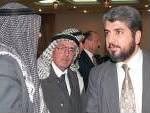
LePARISIEN.fr: Le chef en exil du Hamas palestinien, Khaled Mechaal, s'est déclaré jeudi favorable à un «dialogue direct et sans condition» avec les Etats-Unis. Il a annoncé la reprise «dans deux jours» des discussions interpalestiniennes au Caire.
«Nous saluons le nouveau discours de Barack Obama à l'égard du Hamas, il s'agit d'un premier pas vers un dialogue direct et sans condition» entre Washington et le mouvement palestinien, a déclaré Khaled Mechaal lors d'un discours attendu à Damas, où il réside.
«Le Hamas ne se fait pas d'illusions face aux discours», a-t-il toutefois ajouté, tout en précisant: «Nous aspirons à un changement sur le terrain qui mette fin à l'occupation» israélienne.
Dans un discours au Caire le 4 juin, le président américain a pressé l'Etat hébreu de cesser la colonisation dans les territoires palestiniens et exprimé son engagement en faveur d'un Etat palestinien aux côtés d'Israël. >>> Leparisien.fr | Jeudi 25 Juin 2009
BERLINER ZEITUNG: Paris - Die arabischen Länder wollen mit einer arabischen Strategie gegen islamische Terroristen vorgehen. Insbesondere sollen die Geldströme der Terroristen schärfer ins Visier genommen werden, teilte das Sekretariat des Rats der Innenminister der Arabischen Liga in Tunis mit.
Dazu sei am Freitag eine «arabische Strategie des Kampfes gegen die Geldwäsche und die Finanzierung des Terrorismus» beschlossen worden. Die arabischen Länder wollen insbesondere Geldtransfers über das Internet schärfer kontrollieren und Schenkungen und Stiftungen für angeblich karitative Organisationen besser überwachen. Auch auf die Internetkriminalität soll dabei ein schärferes Auge geworfen werden. >>> © dpa | Freitag, 26. Juni 2009

BERLINER ZEITUNG: Berlin - Die DDR wird von einer Mehrheit der Ostdeutschen heute positiv beurteilt. Dies habe eine repräsentative Umfrage des Emnid-Institutes im Auftrag der Bundesregierung ergeben, berichtet die «Berliner Zeitung».
49 Prozent vertreten demnach die Auffassung, die DDR habe «mehr gute als schlechte Seiten» gehabt. Weitere acht Prozent meinen, man habe damals dort glücklicher und besser gelebt als heute.
Von den befragten Westdeutschen wurde die DDR dagegen mit deutlicher Mehrheit negativ beurteilt. Befragt worden seien 1208 Menschen. Die Entwicklung seit dem Mauerfall werde im Osten eher negativ, im Westen dagegen eher positiv[.] [Quelle: BerlinerZeitung] © dpa | Freitag, 26. Juni 2009
Subscribe to:
Posts (Atom)