Friday, March 18, 2011

AL JAZEERA ENGLISH: King Abdullah expected to announce government reshuffle and anti-corruption measures in address to the nation.
Saudi Arabia's monarch will announce a government reshuffle, an anti-corruption drive and a promise to increase food subsidies to combat rising prices in an address to the nation, diplomats have said.
King Abdullah's speech - his first address since unrest began sweeping the Arab world - is expected after midday Muslim prayers on Friday, the state news agency reported.
The speech by the ailing 86-year-old monarch comes after several small demonstrations in the oil-rich kingdom. The monarchy could be worried about protests escalating into more intense gatherings.
Saudi diplomats, speaking to the Associated Press news agency on condition of anonymity, said the king plans to replace the ministers of defence, higher education and religious affairs.
The defence minister is ailing, while intellectuals have criticised the minister of higher education for dumping billions on expensive projects that they said produced few results.
The diplomats said the king would not replace the head of the all-important oil ministry. Many Saudis have seen little benefit from their country's oil wealth. » | Source: Agencies | Friday, March 18, 2011


THE DAILY TELEGRAPH: Bahrain’s police rounded up opposition leaders at gunpoint and took over a major hospital as it continued a violent crackdown on a protest movement despite international calls for restraint.
Security forces again clashed with Shia demonstrators as the Sunni monarchy sought to quell the month-long protest movement, which is calling for constitutional reform. The Bahraini capital Manama was tense but calm as troops in armoured vehicles funnelled traffic into checkpoints at key bridges and junctions.
Security forces took control of Salmaniya medical centre, Manama’s main hospital. Doctors and opposition figures alleged that wounded Shia protesters were denied treatment and staff were harassed.
Seven opposition figures were rounded up in raids including Hassan Mushaima, the leading Shia dissident, who had recently returned from exile in London.
They have been accused of contacting foreign states and inciting murder and vandalism, according to a statement from the island state’s military officials. » | Ben Farmer, Manama | Thursday, March 17, 2011
THE DAILY TELEGRAPH: Washington’s U-turn is as swift as the reversal in Col Gaddafi’s fortunes.
Eighteen days ago, it seemed that the colonel’s 42-year rule in Libya was close to collapse. When David Cameron then suggested a no-fly zone, it was to protect the Libyan people from a last, vengeful exercise of force. The full weight of the American military establishment dismissed the idea as premature.
Then, suddenly, the White House came down on the side of even tougher action than Mr Cameron proposed. But the Libyan army’s swift advance on Benghazi means that the strategic purpose of a no-fly zone has changed dramatically. Even if Benghazi holds out longer than the other towns of the northern coast, the West and its allies will be coming to the aid of an enclave, not a population.
The ultimate purpose must be to drive Col Gaddafi out of power. » | Richard Spencer, Tripoli | Thursday, March 17, 2011

THE DAILY TELEGRAPH: Celebratory gunfire rang out across the rebel-held city of Benghazi on Thursday night after the United Nations Security Council voted to authorise air strikes against the forces of Libyan leader Col Muammar Gaddafi.
As imams at mosques in the coastal city took to loudspeakers shouting “God is greatest, God is greatest”, tracer bullets streaked across the night sky like fireworks and anti-aircraft fire punctuated the sound of cars honking their horns.
With the government’s forces closing in, the rebels had begged for military protection. Their pleas were only answered after a change of heart by the Barack Obama administration, which had opposed a no-fly zone for weeks but agreed to support the British and French initiative as opposition towns fell rapidly to the Libyan leader.
The decision at the UN appeared to have an immediate impact on Col Gaddafi’s thinking. Saif al-Islam, one of his sons, said there had been a change of tactics and that as a “humanitarian gesture” the Libyan army no longer intended to march on Benghazi, the rebels’ last major stronghold.
“He said that the army is not going to go into Benghazi. It’s going to take up positions around the stronghold,” said Nic Robertson, a CNN reporter who was telephoned by the son.
“The reason is they expect a humanitarian exodus. They expect people will be afraid of what’s going to happen, and he said the army will be there to help them get out.”
Earlier on state television, Col Gaddafi had promised a ruthless assault on the city.
“We will chase the traitors from Benghazi,” he told his troops. “Destroy their fortifications. Show them no mercy. The world needs to see Benghazi free.” » | Damien McElroy, Tripoli, Alex Spillius in Washington and Bruno Waterfield in Brussels | Friday, March 18, 2011
THE DAILY TELEGRAPH: Western forces could launch bombing raids against the Libyan regime as early as Friday after the UN backed international military action.
Colonel Gaddafi threatened retaliatory attacks on passenger aircraft in the Mediterranean last night if foreign countries launched air strikes against Libya.
“Any foreign military act” would expose “all air and maritime traffic in the Mediterranean Sea” as targets for a counter attack, the Libyan regime said.
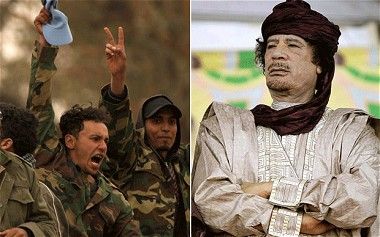 The warning was issued after America formally backed a joint British and French initiative for a no-fly zone over Libya and other military action against Col Gaddafi’s regime.
Amid growing international concern at the deteriorating situation in the country, the first bombing raids, possibly by unmanned drones, could happen as early as today. There were reports last night that the first attacks would be unilateral actions by British and French air forces with logistical support from Arab states.
The United Nations was meeting to discuss the plan as Col Gaddafi’s troops massed on the outskirts of Benghazi, the last stronghold of rebel fighters.
Hillary Clinton, the US Secretary of State, said that a no-fly zone would involve bombing ground targets. » | Robert Winnett,, Deputy Political Editor, Jon Swaine in New York and Richard Spencer in Tripoli | Friday, March 18, 2011
Thursday, March 17, 2011
THE GUARDIAN: UN security council expected to pass resolution calling for states to protect Libyan civilians as Gaddafi threatens counterattack
British, French and US military aircraft are preparing to defend the Libyan rebel stronghold of Benghazi after Washington said it was ready to support a no-fly zone and air strikes against Muammar Gaddafi's forces.
Jets could take off from French military bases if a no-fly zone is approved in a fresh United Nations security council resolution authorising "all necessary measures short of an occupation force" to protect civilians.
France, which has led the calls for a no-fly zone along with Britain, has offered the use of military bases on its Mediterranean coast about 750 miles from the Libyan coast. Several Arab countries would join the operation.
The finalising of military preparations came as Gaddafi's forces closed in on Benghazi and warned that they would target all maritime traffic in the Mediterranean if they are targeted by foreign forces. In a statement broadcast on Libyan television, the defence ministry said: "Any foreign military act against Libya will expose all air and maritime traffic in the Mediterranean sea to danger and civilian and military [facilities] will become targets of Libya's counterattack." "The Mediterranean basin will face danger not just in the short-term, but also in the long-term."
Gaddafi has warned Libyan rebels that his forces will invade Benghazi and show no mercy to fighters who resisted them. "No more fear, no more hesitation, the moment of truth has come," the Libyan leader declared, as he warned Benghazi residents that soldiers would search every house in the city and people who had no arms had no reason to fear. "There will be no mercy. Our troops will be coming to Benghazi tonight." » | Ewen MacAskill in Washington, Nicholas Watt, Ian Black in Tripoli, Ed Pilkington in New York and Luke Harding in Berlin | Thursday, March 17, 2011
VOICE OF RUSSIA: Interview with Guido Steinberg , expert with the German Institute for International and Security Affairs.
In the case of the US, the main interest is stability of oil and gas, not from Bahrain, I do not think it is exporting at all any more, but from Saudi Arabia, from the region in general, and that is why Bahrain is crucial. Secondly the US is interested in the NATO base in Bahrain which is important for them. Saudi Arabia sees Bahrain as kind of protectorate, and its interest is mainly defensive I would argue, it wants to keep Bahrain from falling under Shiite control, because it considers that the Shiite majority in Bahrain has been kind of the fifth column, and the fifth column of the Iranians. I do not think that this is necessarily correct, but if they keep on suppressing, discriminating against the Shia in Saudi Arabia and in Bahrain in the way they have been doing it in recent years, I think they might become Iranian fifth column. Bahrain itself is mainly interested in survival, it is a Sunni family, the royal family is the Sunni family, it is extremely corrupt, like all these ruling families in the Gulf, the state is a dictatorship, and of course the Shiites in the country want a different kind of government. And then Iran: and Iran is I think the most problematic question, they aim at building an Iranian hegemony in the region, in the region meaning in the Gulf region, but at the same time they have not been terribly active in recent years. I would argue that for the time being they are very much preoccupied with the domestic situation in Iran, but they keep an eye on what is going on in the Gulf, and as soon as they will have stabilized the situation in the country, as soon as the Americans have left Iraq, they will react to what is going on in Bahrain right now, because it is a Saudi step with the aim of deterring the Iranians to a certain extent. (+ audio) » | Kudashkina Ekaterina | Thursday, March 17, 2011
Global Voices »
AL JAZEERA ENGLISH: Air strikes were reported from the rebel stronghold of Benghazi, and fierce clashes elsewhere, as forces loyal to Libyan leader Muammar Gaddafi continued their offensive against opposition forces. » Source:
Al Jazeera and agencies | Thursday, March 17, 2011
THE DAILY TELEGRAPH: As nuclear panic began to spread around the world, supermarkets and pharmacies thousands of miles from Japan ran out of anything and everything rumoured to prevent radiation poisoning.
Russia saw a run on red wine and seaweed; in China people were buying massive amounts of salt, and chemists as far away as Bulgaria reported shortages of iodine tablets.
No matter how many scientists were wheeled out to reassure people that radiation levels outside Japan would not pose a threat to health, widespread distrust of official advice meant thousands placed more faith in rumours and old wives’ tales.
In China, the government called for calm after shoppers bought up huge quantities of salt in the mistaken belief that it contains enough iodine to block radiation.
Potassium iodide tablets, which prevent the body from absorbing radiation, have been handed out in Japan to those living near the stricken Fukushima power plant, and in China iodine is added to salt to help prevent iodine deficiency disorders.
The mere mention of the word iodine was enough to prompt panic-buying of salt amid fears that a change in the wind direction could blow a radioactive cloud across China from its near neighbour.
“We are entirely sold out of salt, and shoppers are now buying salt substitutes such as soy sauce, even though there is no connection,” said an exasperated supermarket worker in Shanghai. » | Gordon Rayner, Chief Reporter | Thursday, March 17, 2011

WELT ONLINE: Diktator Gaddafi scheint die angekündigte "entscheidende Schlacht" gelungen zu sein. Dem Staatsfernsehen zufolge eroberten Gaddafi-Truppen Misrata.
Die Truppen des libyschen Machthabers Muammar al-Gaddafi haben nach Angaben des Staatsfernsehens die Kontrolle über die bislang von Rebellen gehaltene Stadt Misrata errungen. Die Stadt werde jetzt von Rebellen „gesäubert“, hieß es im Fernsehen. Dies wurde aber von einem Sprecher der Aufständischen gegenüber der Nachrichtenagentur AFP kurz darauf dementiert. Ihm zufolge gab es bei den Kämpfen um Misrata am Mittwoch 18 Tote. Die rund 200 Kilometer östlich von der Hauptstadt Tripolis entfernte Stadt war eine der letzten Bastionen der Aufständischen. » | Reuters/AFP/dpa/ks | Donnerstag, 17. März 2011
 DIE PRESSE: Gaddafi-Truppen bombardieren den Flughafen von Bengasi. Das Staatsfernsehen berichtet, die Soldaten stünden bereits vor den Toren der Stadt.
Die Truppen des libyschen Diktators Muammar al-Gaddafi könnten bis zur Rebellenhochburg Bengasi im Osten des Landes vorgedrungen sein. Das libysche Fernsehen berichtete am Donnerstag, die Truppen stünden "vor den Toren von Bengasi". Die Aufständischen erklärten, die Stadt sei aus der Luft angegriffen worden.
Die libysche Armee forderte die Bewohner Bengasis auf, sich von potenziellen Kampfgebieten fernzuhalten. Die Armee sei auf dem Weg, die Stadt von "bewaffneten Banden" zu säubern, meldete der Sender Al-Libya.
Das Internationale Rote Kreuz hat wegen des Vormarschs der Regierungstruppen bereits seine Mitarbeiter aus Bengasi abgezogen. » | Ag./Red. | Donnerstag, 17. März 2011
YNET NEWS: Meanwhile Swedish official says low concentration of radioactive particles to reach US soon
The Foreign Ministry issued a travel warning on Thursday for Israelis traveling in Japan, recommending that they leave the quake-stricken country immediately due to possible radiation leaks.
Meanwhile, a Swedish official says low concentrations of radioactive particles are heading eastwards from Japan's disaster-hit nuclear power plant and are set to reach North America in days.
"Israelis are advised to leave Tokyo towards the south and even to consider departing from the country entirely," the Foreign Ministry stated. Citizens were also advised to refrain from traveling to Japan "until the situation becomes clear".
The embassy in Tokyo remains open, however, and Israelis who remain in the country are being advised to stay in touch with it. » | Ronen Medzini | Thursday, March 17, 2011
THE GUARDIAN: Military's 'sock puppet' software creates fake online identities to spread pro-American propaganda
The US military is developing software that will let it secretly manipulate social media using fake online personas designed to influence internet conversations and spread pro-American propaganda.
A Californian corporation has been awarded a contract with the US Central Command (Centcom) to develop what is described as an "online persona management service" that will allow one serviceman or woman to control up to 10 separate identities at once.
The contract stipulates each persona must have a convincing background, history and supporting details, and that up to 50 controllers must be able to operate false identities from their workstations "without fear of being discovered by sophisticated adversaries".
The project has been likened by web experts to China's attempts to control and restrict free speech on the internet. » | Nick Fielding and Ian Cobain | Thursday, March 17, 2011
THE GUARDIAN: America's absurd stab at systematising sock puppetry: The US has a chance to move on from a history of clandestine foreign policy – instead it acts like a clumsy spammer » | Jeff Jarvis | Thursday, March 17, 2011
BBC: Forces loyal to Libyan leader Muammar Gaddafi have launched their first bombing raids on the main rebel-held city of Benghazi.
BBC correspondents in the city heard the sound of low-flying aircraft and explosions on the outskirts of the second city, which has a population of a million.
Reports say the targets included the city's airport at Benina.
A UN Security Council vote on action in Libya could be held later on Thursday.
Western countries want a no-fly zone to halt the advance of government forces.
Official Libyan news agency Jana is reporting that Libyan government forces will cease military operations from midnight on Sunday to give rebels the opportunity to hand over their weapons and "benefit from the decision on general amnesty". » | Thursday, March 17, 2011
BBC: The UN human rights chief has condemned the "shocking" use of force by security forces against protesters in Bahrain.
Navi Pillay said reports of a military takeover of hospitals was a blatant violation of international law.
She urged the authorities to rein in their forces, citing reports of people being beaten and detained or killed.
At least six opposition figures have reportedly been detained in overnight raids in Bahrain, and soldiers are back on the streets of the capital, Manama.
A crackdown on anti-government protesters in the city's centre left at least three civilians and three police officers dead on Wednesday.
Riot police sealed off Manama's main hospital and some smaller health centres, and rights activists said medics were being beaten as they tried to help the wounded in the streets.
"There are reports of arbitrary arrests, killings, beatings of protesters and of medical personnel, and of the takeover of hospitals and medical centres by various security forces," Ms Pillay, the UN High Commissioner for Human Rights, wrote in a statement released on Thursday.
"This is shocking and illegal conduct."
Earlier, the government said it had taken over the hospital because it had become a stronghold of the opposition. (+ video) » | Thursday, March 17, 2011
 LE FIGARO: Petit-fils du roi Idriss Ier, renversé par le colonel Kadhafi en 1968, le prince héritier Mohammed al-Sanusi vit à Londres depuis 1988.
«Quand j'ai vu le drapeau de la monarchie brandi par les insurgés de Libye, je me suis senti immensément heureux et fier.» Ce drapeau rouge, noir et vert frappé de l'étoile et du croissant, c'est le sien. Mohammed al-Sanusi est l'héritier du trône libyen. Petit-fils du roi Idriss Ier, renversé par le colonel Kadhafi en 1968, il vit en exil à Londres depuis 1988. Il veut toutefois garder la tête froide: «Ces drapeaux sont d'abord les emblèmes de la liberté. Les gens avaient caché ces drapeaux pendant quarante ans; ils les ressortent pour montrer qu'ils veulent renouer avec leur histoire.» Et avec le roi? «Les Libyens choisiront, répond-il prudemment. Ce que je crois, c'est que la Libye est promise à un brillant avenir, avec ou sans la monarchie.»
Mais les nouvelles sont mauvaises, et on n'en est pas là: «Aujourd'hui j'ai un seul message à faire passer. Il faut envoyer de l'aide humanitaire, instituer immédiatement une zone d'exclusion aérienne et bombarder les forces spéciales de Kadhafi, qui terrorisent la population.» Les camps des forces de sécurité, épine dorsale du régime, «doivent être frappés», insiste-t-il avec l'obstination du désespoir. Il se dit prêt à aller en Chine convaincre Pékin et ne comprend pas la «lenteur de la communauté internationale» à l'exception du président français, qui a reconnu le Conseil national de Benghazi comme seul représentant de la Libye: «Jamais nous n'oublierons ce que le président Sarkozy a fait.» » | Par Pierre Prier | Mercredi 16 Mars 2011
Vidéo et liens en relation avec cet article »
THE ECONOMIST: Pro-finance, pro-immigration and hungry for investment, London and its politicians have developed an ideology of their own
ONCE the world’s largest port, London’s docklands had become so desolate by the 1980s that Stanley Kubrick used them as a backdrop for his Vietnam war film “Full Metal Jacket”. Thanks to government investment and private enterprise, the area is now a shimmering success story. Canary Wharf, a skyscraper cluster, hosts bankers from around the world. City Airport, opened in 1987, is the easy option for business travel to the continent. The Docklands Light Railway and an extension of the Tube have connected the area to the heart of the capital. The once-derided Millennium Dome is now the busiest music venue in the world.
The docklands are a monument to what could be called Londonism. Since the creation of the capital’s mayoralty in 2000, a distinct ideology has congealed around that office. Some of it is recognisably right-wing: it embraces high finance, even during the banker-bashing furore. Some of it is conventionally left-wing: Londonism calls for state spending on infrastructure and a liberal line on immigration. Essentially, it is a commitment to relentless growth and openness. The city long ago made the transition from mere capital to global hub. Now it has a political philosophy to match.
The two men who have held the mayoralty so far—who are also the main candidates for the mayoral election next year—have been Londonists. Labour’s “Red” Ken Livingstone, who ran the city until 2008, was actually pragmatic about capitalism. He approved private developments and enjoyed surprisingly good relations with the City. At the same time, he used his bully pulpit to ask Whitehall for infrastructure money and an open immigration policy. » | © The Economist | Thursday, February 03, 2011
THE ECONOMIST: Sectarian tensions colour Bahrain's protests, says analyst Jane Kinninmont. But will they become a proxy for a broader regional power struggle?
THE JERUSALEM POST: Human rights group calls for political prisoners to be released after 30 are arrested at peaceful protests in Damascus and Aleppo.
BEIRUT - Human rights group Amnesty International condemned a violent crackdown by Syrian security forces against a peaceful protest held in Damascus by people calling for the release of political prisoners.
Wednesday's silent protest in which about 150 people had raised pictures of their missing friends and relatives had barely started before plainclothes security forces charged the demonstrators with batons and beat them.
Witnesses told the rights group at least 30 people were arrested, some of whom included family members of political prisoners and human rights activists, and taken to unknown locations. They said security forces beat children, women and the elderly.
"The Syrian authorities must immediately release all those arrested in the last two days for merely attending peaceful protests, and stop these attacks on freedom of expression and assembly," said Philip Luther, Amnesty International's deputy director for the Middle East and North Africa. » | Reuters | Thursday, March 17, 2011
 THE GUARDIAN: The Saudi intervention has sectarianised the conflict even more, and thus may well have sealed the Bahrain regime's fate
While much of the world has been preoccupied with questions about a no-fly zone over Libya, Arab Gulf states have been busy establishing what might be called a "no-protest zone" in the Arabian peninsula.
Last week Saudi Arabia took an uncompromising stand against demonstrations on its own territory, declaring them both illegal and un-Islamic. Then, on Monday, it sent troops into Bahrain to assist the regime in quelling protesters there. The Saudis justified their action under a security agreement dating back to the Iran-Iraq war of the 1980s and known as Peninsula Shield.
This agreement, which involves the six Gulf Co-operation Council (GCC) countries (Saudi Arabia, Bahrain, the UAE, Oman, Kuwait and Qatar), resulted in the creation of a joint military force intended to protect its members against external threats. As a communique from the GCC interior ministers put it in 1982: "Any aggression on a member state is aggression against the other states, and facing aggression is considered a joint responsibility."
The statement added: "Interference from any entity in the internal affairs of one of the member states is interference in the internal affairs of all the nations of the council."
There was no suggestion at the time that Peninsula Shield forces would be used to protect unrepresentative Gulf regimes from "aggression" or "interference" by their own citizens – and yet this is what has now happened. Continue reading and comment » | Brian Whitaker | Thursday, March 17, 2011
 THE DAILY TELEGRAPH: Flurries of transactions at Tokyo bank machines abruptly shut thousands of ATMs as the Japanese government warned of major power blackouts, almost a week after a massive earthquake and tsunami.
As authorities struggle to avert catastrophe at a crippled nuclear-power complex 150 miles to the north, Tokyo faced a test of nerves.
Some residents are leaving, some are applying for passports or hoarding what they can - from food to cash and gold, a safe haven during times of crisis.
At the second-floor office of the Tokyo Passport Centre in the city's Yurakucho district, queues snaked to the first floor.
"We don't know the reason but suddenly since yesterday we have had 1.5 times more people than usual coming to apply for a passport or to enquire about getting one," said Shigeaki Ohashi, an official at the passport centre.
Areas usually packed with office workers crammed into sushi restaurants and noodle shops have gone quiet. Many schools are closed. Companies have allowed workers to stay home and voluntarily cut power usage, submerging parts of the typically neon-lit city in darkness. » | Thursday, March 17, 2011
THE GUARDIAN: Washington's ambassador to the UN, Susan Rice, says new resolution would authorise aerial bombing of Gaddafi's tanks
The US is pushing the UN to authorise not just a no-fly zone over Libya, but also the use of air strikes to stop the advance of forces loyal to Muammar Gaddafi.
Washington's ambassador to the UN, Susan Rice, said on Wednesday that a no-fly zone would have only a limited use, and that the Obama administration was working "very hard" to pass a new resolution, which would authorise the use of aerial bombing of Libyan tanks and heavy artillery.
The UN security council is planning to vote on the resolution late on Thursday.
After a day of intensive negotiation in New York, Rice told reporters: "We need to be prepared to contemplate steps that include, but perhaps go beyond, a no-fly zone at this point, as the situation on the ground has evolved, and as a no-fly zone has inherent limitations in terms of protection of civilians at immediate risk." » | Ewen MacAskill in Washington and agencies | Thursday, March 17, 2011
 THE DAILY TELEGRAPH: Karen Buck, the shadow work and pensions minister, has launched an outspoken attack on the Government, claiming that Tories do not want Muslims in central London.
The Labour frontbencher said controversial plans to cut housing benefit were designed to force “black women, ethnic minority women and Muslim women” out into the capital’s poorer suburbs.
Her comments immediately prompted calls for her dismissal. Baroness Warsi, Conservative Party Chairman and Britain's first Muslim Cabinet minister, described them as “deeply offensive”.
Ms Buck, who was speaking at a public meeting in Islington, north London, also accused the Tories of being “deeply hostile” to the idea of lower income families having children, according to the Independent.
In comments that will raise alarm within the Labour leadership, she said: "(The Government) do not want lower-income women, families, children and, above all, let us be very clear – because we also know where the impact is hitting – they don't want black women, they don't want ethnic minority women and they don't want Muslim women living in central London.
“They just don't. They want people to be moving out of anywhere that is a more prosperous area into the fringes of London and into places like Barking and Newham. I have nothing against Barking and Newham. The problem is they are already full of people who are quite poor." » | Victoria Ward | Thursday, March 17, 2011
THE DAILY TELEGRAPH: Karen Buck profile: former council worker who rose to Labour front bench – Karen Buck was elected to parliament in 1997 through a controversial all-woman shortlist. » | Victoria Ward | Thursday, March 17, 2011
REUTERS: Analysis: Japan heading back into recession – Japan's economy seems to be in a state of almost suspended animation as its nuclear crisis shows no sign of ending, sorely testing analysts' hopes for a swift rebound led by reconstruction efforts. » | Wayne Cole | SYDNEY | Thursday, March 17, 2011

REUTERS: Four journalists covering the fighting in Libya for the New York Times are missing, the newspaper said Wednesday.
The New York Times said the journalists, who included two-time Pulitzer Prize winner Anthony Shadid, were last in contact with their editors Tuesday morning from the town of Ajdabiya.
Also missing were Stephen Farrell -- a reporter and videographer who was kidnapped by the Taliban in 2009 and rescued by British commandos -- and two photographers, Tyler Hicks and Lynsey Addario, the newspaper said. » | Reporting by Michelle Nichols; editing by Mohammad Zargham | NEW YORK | Wednesday, March 16, 2011
Related »
THE GUARDIAN: If Egyptians can build a genuinely popular democratic system, all the dominoes in the region will eventually fall
Barely two months since the triumphant overthrow of the Tunisian dictator that detonated the Arab revolution, a western view is taking hold that it's already gone horribly wrong. In January and February, TV screens across the world were filled with exhilarating images of hundreds of thousands of peaceful demonstrators, women and men, braving Hosni Mubarak's goons in Cairo's Tahrir square while Muslims and Christians stood guard over each other as they prayed.
A few weeks on and reports from the region are dominated by the relentless advance of Colonel Gaddafi's forces across Libya, as one rebel stronghold after another is crushed. Meanwhile Arab dictators are falling over each other to beat and shoot protesters, while Saudi troops have occupied Bahrain to break the popular pressure for an elected government. In Egypt itself, 11 people were killed in sectarian clashes between Christians and Muslims last week and women protesters were assaulted by misogynist thugs in Tahrir Square.
Increasingly, US and European politicians and media hawks are insisting it's all because the west has shamefully failed to intervene militarily in support of the Libyan opposition. The Times on Wednesday blamed Barack Obama for snuffing out a "dawn of hope" by havering over whether to impose a no-fly zone in Libya.
But Saudi Arabia's dangerous quasi-invasion of Bahrain is a reminder that Libya is very far from being the only place where hopes are being stifled. The west's closest Arab ally, which has declared protest un-Islamic, bans political parties and holds an estimated 8,000 political prisoners, has sent troops to bolster the Bahraini autocracy's bloody resistance to democratic reform. » | Seumas Milne | Wednesday, March 16, 2011
Islam: The Enemy of Democracy and Freedom » | Mark Alexander | Friday, April 20, 2007
 THE DAILY TELEGRAPH: America fears that a revolution in Libya could open the door to Islamist terrorism, writes David Frum.
Would President Obama prefer a Gaddafi victory? If that sounds implausible, then just look at the record. On March 3, Obama announced that Gaddafi "must go". Two weeks have passed since then – and more than a month since the uprising began on February 15. In the interim, the tide of war has turned in Gaddafi's favour. Yet Obama has done nothing to make his own words reality.
Every proposal – from the no-fly zone and aid to rebels, to recognition of a provisional government – has somehow become bogged down.
The administration never rejected the proposals out of hand, but it never accepted them either. And now time, so very unfortunately, has run out. Admittedly, the American government moves slowly. But it does not move this slowly.
The Obama administration may not care to admit it, but it did make a decision, and one of benefit to Gaddafi. Why? One factor was surely Obama's preference for a less activist foreign policy in general.
But there were special considerations in Libya, and they were clearly stated in a piece by General Wesley Clark for the Washington Post last Friday. The former US commander in Kosovo and a 2004 Democratic presidential candidate wrote: "We don't have a clearly stated objective, legal authority, committed international support or adequate on-the-scene military capabilities, and Libya's politics hardly foreshadow a clear outcome." Read on and comment » | David Frum | Wednesday, March 16, 2011
 THE GUARDIAN: EU expert says Fukushima is out of control as UK and France advise their citizens to leave Tokyo because of radiation fears
International concern that Japan has lost control over the nuclear crisis is escalating as Britain, France and other countries advised their citizens to "consider" leaving Tokyo because of heightened radiation levels.
Yukiya Amano, head of the International Atomic Energy Agency, said he would visit the Japanese capital to gather information about the "very serious" situation at the Fukushima plant.
Conflicting reports from the damaged nuclear plant have deepened alarm over Japan's management of the crisis, leading to charges that the authorities are actually making the situation worse.
Gregory Jaczko, who heads the US nuclear regulator, said Japan had failed to order a big enough evacuation. He told Congress the public should get at least 50 miles away from the stricken plant. The Japanese cleared a radius of 12 miles.
He raised further fears by saying that all the water had evaporated from one of the spent fuel pools at the nuclear plant, so there was nothing to stop the fuel rods from getting hotter.
Jaczko said officials believe radiation levels are extremely high, which could affect workers' ability to stop temperatures rising.
The EU's energy chief, Günther Oettinger, told the European parliament the situation was out of control. "We are somewhere between a disaster and a major disaster," he said. "There could be further catastrophic events, which could pose a threat to the lives of people on the island." He said it was impossible to "exclude the worst", adding: "There is talk of an apocalypse and I think the word is particularly well chosen." » | Suzanne Goldenberg, US environment correspondent, and Miriam Elder in Moscow | Thursday, March 17, 2011
Japan Emergency Appeal: Make a donation now »
BBC: The UK Foreign Office (FCO) has urged Britons to leave Bahrain on Thursday, as violence and protests continue.
The government has organised charter flights to Dubai, to supplement the number of commercial flights available.
The FCO advised UK nationals without a "pressing reason" to stay to leave via the international airport on 17 March on commercial or UK-chartered flights.
Security forces with tanks have moved in on anti-government protesters, in the Gulf state's capital Manama.
The protesters have been camped in a square in the city for weeks.
Foreign Secretary William Hague has spoken to his Bahraini counterpart to express "serious concern" at the situation on the ground.
At least three civilians were reportedly killed after police fired on mainly Shia protesters. Officials said three police also died.
Troops have taken over a hospital treating the wounded. Officials have imposed a curfew and banned protests.
The country's Sunni rulers on Tuesday called in Saudi troops to keep order.
Bahrain's health minister, himself a Shia, has resigned in protest against the government's use of force, and the BBC's Caroline Hawley in Manama says Shia judges have resigned en masse. » | Thursday, March 17, 2011
THE DAILY TELEGRAPH: Government tells Britons to flee Bahrain: Britain will send charter planes to help its citizens leave Bahrain as soon as possible, officials said on Wednesday, with an uprising and deadly clashes surging in the kingdom. » | Wednesday, March 16, 2011
Wednesday, March 16, 2011
THE DAILY TELEGRAPH: Minutes before Emperor Akihito made his first-ever television address to his people, the Japanese public broadcaster NHK instructed its editors to cut into the speech if important news on the unfolding nuclear crisis broke.
In a country where the Emperor is treated with a reverence verging on the worshipful, both the public speech and the orders to show discourtesy to it if need be illustrate just how deep the cultural impact of Japan's earthquake and tsunami has been.
Dressed in a dark suit, and seated against a backdrop designed to evoke the appearance of a traditional paper screens, Emperor Akihito spoke in mannered but modern Japanese – not the formal courtly language which is incomprehensible to many of the country’s residents.
He expressed hope that the nuclear crisis would be resolved, and that lives could be saved. “I hope things will take a turn for the better,” Japan’s monarch said.
Akihito’s nuclear-crisis speech has a grim historical precedent. In 1945, it fell to his father, Hirohito, to announce to Japan’s people its surrender to the allies. He attributed the surrender, among other things, to “a new and most cruel bomb, the power of which to do damage is, indeed, incalculable, taking the toll of many innocent lives.”
The Emperor was referring to the bombing of Hiroshima and Nagasaki, which killed up to 246,000 people, the dawn of the nuclear age. (+ video) » | Praveen Swami, Diplomatic Editor | Wednesday, March 16, 2011
 THE DAILY TELEGRAPH: The Gaddafi regime on Wednesday taunted the West over its failure to impose a no-fly zone over Libya and said it would "finish the job" of defeating the insurrection against its rule by Friday.
As Col Muammar Gaddafi's troops advanced towards the rebel capital, Benghazi, Saif al-Islam, his son, told "traitors and mercenaries" to flee the country or face the consequences.
"We don't want to kill, we don't want revenge, but you, traitors, mercenaries, you have committed crimes against the Libyan people," he said, in an interview. "Leave, go in peace to Egypt." Asked about continuing British and French attempts to persuade the United Nations Security Council to impose a no-fly zone, he answered: "Military operations are over. Within 48 hours everything will be finished. Our forces are almost in Benghazi. Whatever the decision, it will be too late."
The failure on Tuesday by the G8 group of nations to agree military intervention in Libya is said to have "perplexed" Downing Street. An immediate decision was opposed by China and Russia but even the United States failed to come out in support of the idea.
At Prime Minister's Questions, David Cameron told MPs: "Every world leader has said that Gaddafi should go, that his regime is illegitimate and if at the end of this he is in place that will send a terrible message not just to people in Libya but to others across the region who want to see greater democracy, greater openness in their societies."
Britain has tabled its own resolution at the Security Council along with France and Lebanon, as a representative of the Arab world. But with that unlikely to be passed any time soon, William Hague also said Britain could support military action, including a no-fly zone, even without a resolution.
The White House is said to be exploring "other options", such as using sequestered Libyan assets to fund the opposition. Hillary Clinton, the US secretary of state, said she was hopeful the UN Security Council would take a vote on a Libya resolution no later than Thursday. » | Richard Spencer, Tripoli, Rob Crilly in Benghazi, Nabila Ramdani in Paris and Andrew Porter, Political Editor | Wednesday, March 16, 2011
Saif ul Islam al Qadhafi makes Barack Hussein Obama look so, so weak! The president of the USA just isn’t up to the job of dealing with the rough dynamics of the current geo-political scene. Maybe, he should have stuck with community organizing! – © Mark
REUTERS: Secretary of State Hillary Clinton said on Wednesday Bahrain was "on the wrong track," but the United States may have little leverage as the Gulf kingdom presses a deadly security crackdown.
The United States has responded cautiously to the turmoil in Bahrain, saying this week it understood why the country's Sunni Muslim rulers called in reinforcements from Saudi Arabia as they face spreading anti-government protests by the country's Shi'ite Muslim majority.
But Clinton's tougher comments, made in TV interviews in Cairo while on a trip to the region, reflected what analysts said was growing U.S. concern that the situation could boil over into a full-blown confrontation between Sunni Gulf Arab states and Shi'ite-ruled Iran.
"We find what's happening in Bahrain alarming. We think that there is no security answer to the aspirations and demands of the demonstrators," Clinton told CBS, urging Bahrain to negotiate a political agreement with demonstrators.
"They're on the wrong track and we think that the wrong track is going to really affect adversely the ability of the Bahraini government to bring about the political reform that everyone says is needed," she told NBC. » | Andrew Quinn | WASHINGTON | Wednesday, March 16, 2011
THE NEW YORK TIMES: WASHINGTON — The chairman of the United States Nuclear Regulatory Commission gave a significantly bleaker appraisal of the threat posed by Japan’s nuclear crisis than the Japanese government, saying on Wednesday that the damage at one crippled reactor was much more serious than Japanese officials had acknowledged and advising to [sic] Americans to evacuate a wider area around the plant than the perimeter established by Japan.
The announcement marked a new and ominous chapter in the five-day long effort by Japanese engineers to bring four side-by-side reactors under control after their cooling systems were knocked out by an earthquake and tsunami last Friday. It also suggested a serious split between Washington and Tokyo, after American officials concluded that the Japanese warnings were insufficient, and that, deliberately or not, they had understated the potential threat of what is taking place inside the nuclear facility. » | David E. Sanger and Matthew L. Wald | Wednesday, March 16, 2011
THE DAILY TELEGRAPH: Japan earthquake: live »
FRANKFURTER ALLGEMEINE: Wenn der Kaiser spricht, steht es wirklich schlecht: Am Mittwoch hat sich Kaiser Akihito zum ersten Mal in der Geschichte mit einer Fernsehansprache an das japanische Volk gewandt. Damit müsste allen klar sein, wie dramatisch die Lage ist. Bloß nicht den Oppositionsparteien: Sie streiten und spinnen Intrigen, als wäre nichts geschehen. » | Von Petra Kolonko, Seoul | Mittwoch, 16. März 2011
THE DAILY TELEGRAPH: The Libyan army has told people in Benghazi to lay down their arms as its troops advanced closer to the rebel stronghold for what could be the decisive battle in the uprising against Muammar Gaddafi.
Gaddafi's son Saif al-Islam, speaking to French-based TV channel Euronews, said his troops were near Benghazi and "everything will be over in 48 hours".
The town of Ajbadiyah, 150 km (90 miles) south of Benghazi on the Gulf of Sirte, was firmly in government hands after most of its rebel defenders retreated under fire from a withering artillery barrage on Tuesday. Those who stayed had now handed over their guns, a rebel officer said.
In Benghazi, seat of the insurgents' provisional national council, the mood was a mixture of defiance and nervousness, with some citizens predicting a bloodbath and others confident the rebels would still snatch victory against the government offensive.
Forces loyal to Gaddafi have retaken a string of coastal towns in the past 11 days, reversing gains made by the rebel army early in the uprising against his 41-year-rule of the North African country. Important oil industry facilities are now mostly back under government control.
An armed forces statement read on state television described the offensive as a humanitarian operation to save the people of "beloved Benhgazi" and said troops would not take revenge on them if they surrendered.
"Advise your duped sons to hand over their weapons to the armed forces or the People's Leadership and they will be covered by an amnesty requested by the Commander (Gaddafi), which will be valid for any person who hands over his weapon to the armed forces and refrains from resistance and subversion," it said.
Benghazi residents said they had found leaflets scatttered in the streets also telling them they would not be punished if they gave up the fight. » | Wednesday, March 16, 2011
EURONEWS: ‘That clown Sarkozy’: see the exclusive euronews interview with Saif Al-Islam Gaddafi the son of Libyan leader Muammer Gaddafi. Coming up on euronews today.
With troops loyal to Gaddafi advancing on the rebels in the east of the country, the Libyan leader’s son Saif al-Islam has given a defiant exclusive interview to euronews.
Reporter Riad Muasses asked him what he will do with those who have fought against the regime.
Saif al-Islam said: “Firstly, they’ve left. You know that at the borders there are crowds who want to return to Egypt. And we with our army and the people we say leave a safe passage for these traitors and the militias. And those who contacted America, Britain and France and those who have asked for the British forces and US army to come back, then those and their families are leaving for Egypt.
“We don’t want to kill, we don’t want revenge, but you, traitors, mercenaries, you have committed crimes against the Libyan people: leave, go in peace to Egypt.” (+ video) » | © euronews | Wednesday, March 16, 2011
En français »
Auf deutsch »
عربي »
THE GUARDIAN: From Libya to Turkey the will of the people has revived a sense of common destiny. This is now our region
The wave of revolutions in the Arab world was spontaneous. But it also had to happen. They were necessary in order to restore the natural flow of history. In our region – west Asia and the south Mediterranean – there were two abnormalities in the last century: first, colonialism in the 1930s, 40s and 50s that divided the region into colonial entities, and severed the natural links between peoples and communities. For example, Syria was a French colony and Iraq a British one, so the historical and economic links between Damascus and Baghdad were cut.
The second abnormality was the cold war, which added a further division: countries that had lived together for centuries became enemies, like Turkey and Syria. We were in Nato; Syria was pro-Soviet. Our border became not a border between two nation states, but the border between two blocs. Yemen was likewise divided.
Now it is time to naturalise the flow of history. I see all these revolutions as a delayed process that should have happened in the late 80s and 90s as in eastern Europe. It did not because some argued that Arab societies didn't deserve democracy, and needed authoritarian regimes to preserve the status quo and prevent Islamist radicalism. Some countries and leaders who were proud of their own democracy, insisted that democracy in the Middle East would threaten security in our region.
Now we are saying all together: no. An ordinary Turk, an ordinary Arab, an ordinary Tunisian can change history. We believe that democracy is good, and that our people deserve it. This is a natural flow of history. Everybody must respect this will of the people.
If we fail to understand that there is a need to reconnect societies, communities, tribes and ethnicities in our region, we will lose the momentum of history. Our future is our sense of common destiny. All of us in the region have a common destiny. » | Ahmet Davutoglu | Tuesday, March 15, 2011
 FRANKFURTER ALLGEMEINE: Einen Tag nach Ausrufung des Notstands in Bahrein gehen Sicherheitskräfte mit Gewalt gegen den Protest der Regierungsgegner vor. Nach Angaben der schiitischen Opposition hat es dabei auch Tote gegeben.
Einen Tag nach Ausrufung des Notstands in Bahrein sind Soldaten und Sicherheitskräfte am Mittwoch gegen Hunderte Regierungsgegner vorgegangen. Vertreter der Opposition sprechen angesichts des harten Vorgehens gegen Demonstranten von einem „Vernichtungskrieg“.
Bei einem Einsatz der Truppen seien allein am Mittwoch fünf Menschen getötet und Hunderte verletzte worden, sagte ein hochrangiger Vertreter der schiitischen Opposition, Abdel Dschalil Chalil, der Nachrichtenagentur Reuters. Er gehört der größten Schiiten-Partei des Landes an, der Wefak. » | FAZ.NET mit Reuters | Mittwoch, 16. März 2011
LE FIGARO: La perception qu'ont les Français du Japon, celle d'un pays riche contrairement à Haïti, ne faciliterait pas la collecte de dons, s'inquiètent les associations humanitaires.
Alors qu'un bilan de 3373 morts et 6476 disparus a été confirmé mardi par la police japonaise, les appels aux dons pour secourir les victimes du séisme et du tsunami qui ont frappé l'archipel ont débuté en France. Dès vendredi, le Secours populaire avait lancé un appel d'urgence à la générosité du public. Il a été rejoint lundi par d'autres organisations comme la Fondation de France et la Croix-Rouge française.
Pourtant, alors qu'aux Etats-Unis, 22 millions de dollars d'aide avaient déjà été recueillis lundi soir, la générosité des Français ne semble pas s'emballer pour les victimes de la catastrophe. Selon nos informations, le Secours populaire avait collecté mardi après-midi 44.600 euros. De son côté, la Croix-Rouge française annonçait environ 100.000 euros provenant de particuliers. A comparer avec les deux millions d'euros qu'elle avait recueillie en trois jours lors du séisme à Haïti, en janvier 2010… » | Par Louis Haushalter | Mardi 15 Mars 2011
CROIX-ROUGE FRANÇAISE – Catastrophe Japon 2011: Faire un don »
LE FIGARO: Le terme "fuite nucléaire" était aujourd'hui censuré sur le principal site de micro-blogging en Chine, vraisemblablement pour freiner la propagation des craintes et des rumeurs liées aux rejets radioactifs de la centrale japonaise de Fukushima.
Sur le site de sina.com, principal équivalent chinois de Twitter (lui-même censuré en Chine), une requête avec les mots "fuite nucléaire" déclenchait la réponse suivante: "Selon les lois en vigueur, le résultat de votre recherche ne peut être communiqué".
L'aggravation de la crise nucléaire dans la région frappée vendredi par un séisme suivi d'un tsunami alarme les Chinois, voisins du Japon, alimentant les rumeurs propagées sur l'Internet et par SMS. » | AFP | Mercredi 16 Mars 2011
 THE VANCOUVER SUN: At least 200 people were shot and wounded on Tuesday in a Shiite village south of the Bahraini capital, a medic said, as the king imposed a state of emergency after bringing in Saudi and Emirati troops to help quell anti-regime protests.
As violence escalated, close ally the United States warned that there was "no military solution" to political upheaval in Bahrain and that any violence against peacefully expressed political demands "should be stopped." U.S. Secretary of State Hillary Clinton said Bahrainis must "take steps now" toward a political resolution of the crisis.
"More than 200 people we received today had been shot with buckshot," a hospital medic in the village of Sitra, south of the capital, said by telephone. The medic, who asked not to be identified, said the hospital was under siege by armed gangs and security forces targeting Shiites -the backbone of anti-regime protests that have raged for a month. The medic said villagers "confronted the gangs when they arrived in the village," only to discover that they were carrying guns.
Helicopters were hovering over the area, the medic said, adding that the total number of injured people rises to more than 400 when those admitted for inhaling tear gas are included.
Neighbouring Iran condemned Monday's intervention by Saudi-led Gulf country troops to help put down the protests, prompting Manama to recall its ambassador. » | REUTERS | Wednesday, March 16, 2011
Subscribe to:
Posts (Atom)