Sunday, May 02, 2010

George Papaconstantinou
Le ministre grec des Finances, Georges Papaconstantinou. La Grèce, au bord du gouffre financier, a annoncé un nouveau plan d'austérité prévoyant une réduction de son déficit budgétaire de 30 milliards d'euros sur trois ans en échange de l'octroi d'une aide massive de l'Union européenne et du Fonds monétaire international.

Grèce: le détail du nouveau plan d'austérité

L’EXPRESS.fr: L'Union européenne et le FMI devraient verser à la Grèce une aide de 120 milliards d'euros sur trois ans. En contrepartie, le pays va devoir consentir à d'importants et "durs sacrifices".

30 milliards d'euros. La barre de réduction des déficits est haute pour la Grèce. Mais c'est le prix à payer si elle veut sortir du gouffre financier. Le pays a annoncé un nouveau plan d'austérité prévoyant une réduction de son déficit budgétaire de 30 milliards d'euros sur trois ans en échange de l'octroi d'une aide massive de l'Union européenne et du Fonds monétaire international.

L'aide internationale à la Grèce, qui devrait se monter à 120 milliards d'euros sur trois ans, représente le premier sauvetage d'un membre de la zone euro et vise à empêcher que d'autres pays utilisant la monnaie unique ne soient attaqués sur les marchés et se retrouvent en difficulté.

Pour atteindre le montant de 30 milliards d'euros d'économies annoncé par le ministre grec des Finances Georges Papaconstantinou, les Grecs vont devoir consentir d'importants sacrifices en matière de revenus et accepter un alourdissement de la fiscalité sur la consommation. >>> Par Reuters | Dimanche 02 Mai 2010
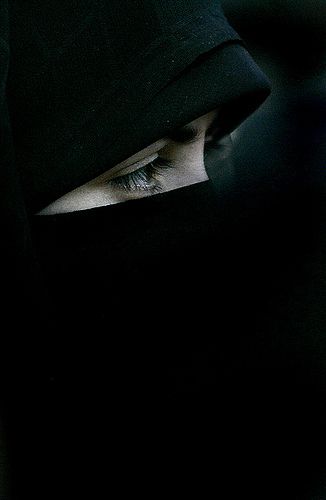
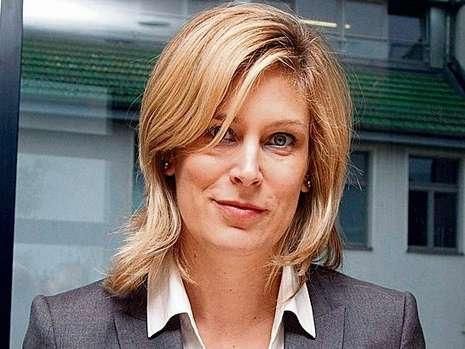
Une députée veut interdire la burqa au sein de l’UE

20MINUTES.ch: Une vice-présidente du Parlement européen, chef de file des libéraux (FDP) allemands, a appelé dimanche à l'interdiction du port du voile islamique intégral dans l'Union européenne.

«J'aimerais que l'Allemagne -- et toute l'Europe -- interdisent le port de la burqa sous toutes ses formes», a affirmé Silvana Koch-Mehrin dans une tribune libre publiée par le journal Bild am Sonntag.

En Belgique, les députés ont déjà entrepris d'interdire le port du voile intégral islamique dans les lieux publics, mais l'adoption définitive du projet de loi risque d'être remise en cause par la chute du gouvernement. 


En France, le gouvernement entend lui aussi bientôt présenter un projet de loi en ce sens. >>> afp | Dimanche 02 Mai 2010

Die Burka gehört in Europa verboten

BILD am SONNTAG: Als erste Volksvertretung hat das belgische Parlament ein Vermummungsverbot und damit auch ein Verbot der Vollverschleierung muslimischer Frauen beschlossen – und zwar ohne eine einzige Gegenstimme. Auch andere EU-Länder denken darüber ernsthaft nach.

Ich begrüße diesen Beschluss ganz ausdrücklich.

Ich wünsche mir, dass auch in Deutschland – und in ganz Europa – das Tragen aller Formen der Burka verboten wird.

Wer Frauen verhüllt, nimmt ihnen das Gesicht und damit ihre Persönlichkeit. Die Burka ist ein massiver Angriff auf die Rechte der Frau, sie ist ein mobiles Gefängnis. >>> Von Silvana Koch-Mehrin | Sonntag, 02. Mai 2010
General Election 2010: Islamists in Phil Woolas Slur

SUNDAY EXPRESS: IMMIGRATION Minister Phil Woolas has launched a desperate attempt to save his seat by distributing 45,000 leaflets saying he has had death threats and that he is being targeted by an Islamic group.

He has placed concerns over forms of Islam at the centre of the campaign in Oldham East and Saddleworth, which is becoming the dirtiest of the general election.


The leaflets are in the form of a hard-hitting eight-page newspaper whose front page has a picture of Mr Woolas caught in a rifle’s crosshairs.


They say the Islamic group, which cannot be named for legal reasons, is swamping the constituency with its own leaflets that brand Mr Woolas and his supporters as “bum kissers”.


One leaflet by a smaller group offered a hamper for anyone devising the “most creative” death threat against him, Mr Woolas said. 


He is reporting those threats to the police.

He told the Sunday Express last night: “Mainstream Muslims will be sickened by these people who are giving Islam a bad name. We’ve got to stand up to them.”


The minister, whose majority is about 3,600, believes his Lib Dem challenger Elwyn Watkins, 46, will be the beneficiary of the group’s smear campaign.


Mr Watkins spent the bulk of his business career as a “personal adviser” to a wealthy Saudi sheikh. >>> Ted Jeory, Whitehall Editor | Sunday, May 02, 2010
French Indignant Over Government Plan to Raise Retirement Age

LOS ANGELES TIMES: Despite the uproar, France is not alone in considering such a step. Countries from Britain to Greece are also grappling with declining populations, ballooning government debt and longer life spans.

Reporting from Amiens, France
Didier Remy has spent his life so intent on retiring on his 55th birthday that he and his wife even planned their children accordingly, wanting them to be grown by the time he stopped working.

So pardon a little indignant hand-waving as he ponders the prospect of Nicolas Sarkozy fouling everything up. If the French president has his way, Remy will find it tough to retire with his full state pension in 2015, as he carefully plotted 20 years ago.

"My life was organized around the idea that I'm going to leave work at that age," said Remy, a lifelong employee of France's state-owned railway, whose benefits are the envy of other Frenchmen, never mind long-slogging Americans. "It's my goal. But it rests with the powers that be."

True to form in this protest-rife land, Sarkozy's announcement that he intends to raise the national retirement age sometime this summer sent thousands of demonstrators spilling into the streets last month in opposition. But this time the French are part of a larger tide of anger and anxiety surging across Europe.

With budget deficits ballooning across the continent, and a huge bailout of debt-ridden Greece on the verge of taking place, officials across Europe say they have no choice but to boost retirement ages if they are to tackle a monumental economic problem compounded by declining populations and longer life spans.

But few issues are as sensitive in a region where the right to retire at a decent age, and retire well, is considered almost an inalienable social right. For many here, it's one of the defining elements of their identity as Europeans, part of what they feel makes them different — more reasonable, more humane — from overworked, overstressed Americans. >>> Henry Chu, Los Angeles Times | Saturday, May 01, 2010
Undermining the Faith

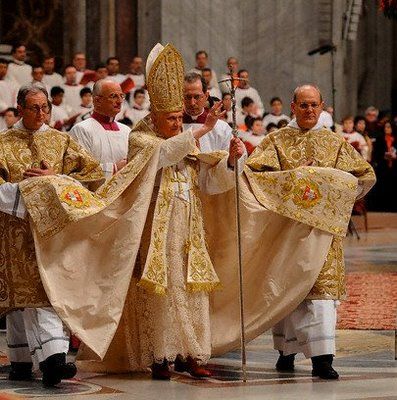
LOS ANGELES TIMES: Catholic bashers like to refer to priests as ‘men in dresses.’ It’s just another in a growing number of media cheap shots directed at Pope Benedict XVI.

"Men in dresses." That's who columnist Maureen Dowd blames for decay in "our religious kingdom."

Which men in dresses is she referring too? The ballerinas-in-drag of Les Ballets Trockadero? The Marilyn Monroe lookalikes marching in gay pride parades? Nope. She's talking about Catholic priests.

Lately Dowd, along with half the other columnists in America, has been speculating about what Pope Benedict XVI knew or didn't know concerning clerical abuse of minors back when he was Josef Ratzinger, acting as archbishop of Munich or as head of the Vatican's Congregation for the Doctrine of the Faith. And she and her gang seem to find it hilarious that Catholic priests and bishops often wear cassocks or other long traditional robes, especially on formal religious occasions and when celebrating Mass.

It's odd that no one ever uses the word "dresses" to describe the ankle-length liturgical garments worn by Episcopal priests. Nor are Protestant ministers or Jewish rabbis derided as cross-dressers when they don long robes for religious services. Has anyone ever called the Dalai Lama "a man in a dress"? Or Genghis Khan? Not unless you wanted to see your ribcage sliced into salami by a scimitar.

For most of human history long robes on men — whether the togas of Roman senators, the kimonos of Japanese samurai or the black gowns worn by judges and academics today — have been associated with status, dignity and, in the case of the clergy, the sacral separation of religious ritual from the ordinary activities of daily life. Indeed, so redolent of masculinity are those garments that when women enter the professions for which they are worn, they often soften and feminize them. Supreme Court Justice Ruth Bader Ginsburg, for example, wears lace collars with her judicial robes[.] >>> Charlotte Allen | Sunday, May 02, 2010
Times Square Car Bomb Was Act of Terrorism

THE SUNDAY TELEGRAPH: American officials declared that the failed car bomb that forced the evacuation of New York's Times Square was an "act of terrorism."


"Luckily, no one is hurt, and now the full attention of city, state and federal law enforcement will be turned to bringing the guilty party to justice in this act of terrorism," New York Governor David Paterson said.

The bomb, which failed to detonate, was left in a sport utility vehicle close to a Broadway theatre where a production of The Lion King was showing. >>> Nick Allen | Sunday, May 02, 2010

Times Square: "Un acte de terrorisme"

leJDD.fr: David Paterson, gouverneur de l'Etat de New-York, a estimé dimanche que la présence d'une voiture pleine d'explosifs à Times Square relevait d"un "acte de terrorisme". Le quartier est très fréquenté, en particulier le samedi soir, et très prisé des touristes et des amateurs de théâtre. [Source: leJDD.fr] | Dimanche 02 Mai 2010

Related:

THE NEW YORK TIMES: Police Discover Car Bomb in Times Square and Clear Area >>> Al Baker and Karin Henry | Saturday, May 01, 2010
Grèce: Besoin de 60 milliards d'euros par an

leJDD.fr: La Grèce a besoin d'emprunter 60 milliards d'euros par an, a estimé dimanche le président George Papandréou. Le chef de l'État grec, qui vient de conclure un accord avec l'Union européenne et le Fonds monétaire international, a déclaré que "les sacrifices seront difficiles mais nécessaires pour éviter une faillite de l'État grec". Les mesures d'austérité décidées affecteront les employés du secteur public mais aussi les retraités. [Source: leJDD.fr] | Dimanche 02 Mai 2010
Rising Tory Star Philippa Stroud Ran Prayer Sessions to 'Cure' Gay People

THE OBSERVER: Conservative high-flyer Philippa Stroud founded a church that tried to 'cure' homosexuals by driving out their 'demons

A high-flying prospective Conservative MP, credited with shaping many of the party's social policies, founded a church that tried to "cure" homosexuals by driving out their "demons" through prayer.

Philippa Stroud, who is likely to win the Sutton and Cheam seat on Thursday and is head of the Centre for Social Justice, the thinktank set up by the former Tory leader Iain Duncan Smith, has heavily influenced David Cameron's beliefs on subjects such as the family. A popular and energetic Tory, she is seen as one of the party's rising stars.

The CSJ reportedly claims to have formulated as many as 70 of the party's policies. Stroud has spoken of how her Christian faith has motivated her to help the poor and of her time spent working with the destitute in Hong Kong. On her return to Britain, in 1989, she founded a church and night shelter in Bedford, the King's Arms Project, that helped drug addicts and alcoholics. It also counselled gay, lesbian and transsexual people.

Abi, a teenage girl with transsexual issues, was sent to the church by her parents, who were evangelical Christians. "Convinced I was demonically possessed, my parents made the decision to move to Bedford, because of this woman [Stroud] who had come back from Hong Kong and had the power to set me free," Abi told the Observer.

"She wanted me to know all my thinking was wrong, I was wrong and the so-called demons inside me were wrong. The session ended with her and others praying over me, calling out the demons. She really believed things like homosexuality, transsexualism and addiction could be fixed just by prayer, all in the name of Jesus." >>> Jamie Doward, Cal Flyn and Richard Rogers | Sunday, May 02, 2010
Andrew M Brown: Why Does Tony Blair Look So Old and Frail?

Tony Blair
Clearly in need of some advice from the Clinique consultant, Tony Blair has visibly aged in a short time. – Mark | Photo: The Telegraph

THE TELEGRAPH – BLOG: Look at this recent photograph of Tony Blair, taken as he returns to campaign for Labour in the election. The former Prime Minister appears to have aged markedly. He looks elderly, frail and wizened. In fact he reminds me of no one so much as dear old Bill Deedes when he was in his eighties. Mr Blair is still only 56 and yet he seems a pale shadow of the vital young man who bounded into Downing Street 13 years ago. Read on and comment >>> Andrew M Brown | Saturday, May 01, 2010
Nick Clegg Is the Candidate of Change

THE OBSERVER – Editorial: The Liberal Democrats offer a prospect of renewal which has been denied them by a grossly unfair voting system

The rotten parliament is dissolved; this week a new one will be elected. Scores of incumbents who fiddled their expenses will be evicted. Many who did not are standing down anyway, too defeated by the public's loathing of politicians to face the campaign trail.

So change is inevitable. Parliament will be full of novice MPs. It might also, if current opinion polls are borne out, be hung.

The Conservatives have spent much energy campaigning against that outcome. They have publicised their irritation that voters could deprive David Cameron of a majority much better than they have explained why he deserves one in the first place.

Mr Cameron warns portentously that a coalition might lead to instability, economic jeopardy and "more of the old politics". Perversely, he also rejects the need to change the current voting system, which has, he says, the merit of delivering clear results. Except this time it might not. What then? Mr Cameron's view is that the system would work fine, if only everyone voted Conservative. This is sophistry draped in hypocrisy. He backs first past the post, while agitating against one of the outcomes that is hard-wired into it. He is campaigning against the voters instead of pitching for their support. He defines change in politics as the old system preserved – but run by the Tories.

The expenses scandal signalled the need for more radical reform. This newspaper has consistently argued that the most effective change would be to introduce a fairer voting system. The current model contains a huge bias towards Labour and the Conservatives, giving them hundreds of safe seats where MPs can complacently ignore voters. Parties then divert money and skew policy towards a handful of tactically important constituencies. Awarding seats in parliament in proportion to votes cast would extend the franchise to millions of people who feel their voices have gone unheard. Deep unfairness radiates out of our voting system and corrupts our politics. This can only be fixed with electoral reform.

If a different system yields more coalition governments, so be it. Mr Cameron ought to appreciate how like coalitions the current political parties already are. Conservative policy expresses the party's agonies in recent years as different factions have competed to graft their priorities on to the leader's mutating creed. >>> Observer Editorial | Saturday, May 01, 2010
The Only Choice for Britain

THE SUNDAY TELEGRAPH – Editorial: The country needs a Conservative government with a strong majority in order to tackle the enormous challenges it faces, says The Sunday Telegraph

The general election this week offers the country the most significant choice for a generation. Ever since the financial crisis began, it has been clear that Britain faces enormous challenges over the next few years. The new government must stabilise the economy, reinvigorate the private sector and deal with a burden of debt and over-spending that could cripple the public finances. Yet the challenges are not just economic. As our poll today shows, voters are also worried about the consequences of immigration on an unprecedented scale, the state of their schools and hospitals, the weakening of civic society, our military involvement in Afghanistan, and the increasing tide of regulation from Brussels. Such problems demand a strong and vigorous government to tackle them. The question is, which of the parties is best suited to such a task?

Despite the parties' attempts to capture the all-important middle ground, the differences between them are clear. Labour believes that only the state can solve the country's economic and social problems. The Conservatives, by contrast, believe that the growth of the central state is the cause of the problem, not its solution, and want to call upon the invigorating power of citizens and communities. The Liberal Democrats seem to hover uneasily between those two positions: one of the difficulties that Nick Clegg has faced has been to explain exactly where he stands on the critical question of whether we need more or less government intervention in the economy and in our lives.

If you examine the Government's record, there is no doubt that the top-down, target-driven, statist approach has reached a dead end. Since 1997, Labour has added more than a million people to the payroll. Spending has increased by 3.2 per cent per annum, in real terms. Gordon Brown now talks of Tory efficiency savings as irresponsible cuts which will "shrink" or "take money out of" the economy. As David Cameron has rightly pointed out, this is to confuse the economy with the state. Usually, people are better at spending their own money than are officials: it is a basic conservative principle that they should retain as much of it as possible. This also helps stimulate the economy, which is why one of the most convincing Tory victories of the campaign has been their opposition – alongside much of the business community – to the tax on jobs represented by Labour's planned rises in National Insurance.

In defending this position, Mr Cameron has frequently pointed out that there is an enormous amount of waste in government spending that could be cut instead. He is absolutely correct. But efficiency savings, on their own, will not be anything like enough to deal with our abysmal fiscal situation. Mr Brown's reputation for prudence, for making the right decisions on economic issues, has been destroyed by his profligate spending. As a result of the shocking state of our public finances, we face a bleaker economic future than other, similar nations. >>> Sunday Telegraph View | Saturday, May 01, 2010

Related: More endorsements
America's Disappointing Reaction to South Park Censorship

THE TELEGRAPH: America's failure to rise up against the intimidation of cartoonist Molly Norris and South Park animators is a sad sign, says Alex Spillius.

Photobucket
South Park featured an episode where all the founders of the major world religions including Mohammed appeared as a group of crime fighters called the Super Best Friends. Cartoon: The Telegraph

The trouble with terror is that it can be terrifying. Just ask Molly Norris, a cartoonist from Seattle.

As far as we know, she hasn't been explicitly threatened by Islamic extremists, but evidently she feared she might be.

Her error was to post on her website an illustration with many different household objects with speech bubbles all claiming to be the likeness of Mohammed, including a tea cup, a domino and a box of pasta. It was part of a mock campaign to dedicate May 20 as "Everybody Draw Mohammed Day!"

Ms Norris pinged her cartoon to a few bloggers and talked to local radio, saying she [sic] it was "a cartoonist's job to be non-PC."

Quite reasonably, the radio man asked her "are you sure you want to do this?"

Bold as you like, she replied: "Yeah, I want to water down the targets ..."

Ms Norris had launched her pretend promotion in response to the treatment by Comedy Central of Trey Parker and Matt Stone, the creators of South Park, the satirical animated show.

Its 200th anniversary episode featured a parade of celebrities and religious figures it had parodied over the years. Aware of the offence that depicting Mohammed could cause to Muslims, the show's characters debated how to represent the prophet, eventually deciding to hide him in a bear costume.

That prompted a New York-based website, RevolutionMuslim.com, to warn Parker and Stone that "what they are doing is stupid and they will probably wind up like Theo Van Gogh". >>> Alex Spillius in Washington | Saturday, May 01, 2010
Revolution from Greece's Ruins as Crisis Deepens

THE TELEGRAPH: As Greeks face changing their way of life, rioters in Athens clash with police at the start of a very long, painful summer for the country.


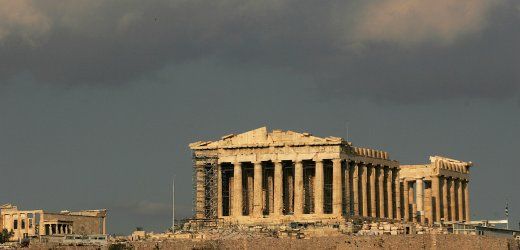
The week was already going badly enough for mild-mannered Greek prime minister George Papandreou. After months of insisting that his country would be able to claw its own way out of decades of mismanagement and corruption, his belated SOS to the International Monetary Fund (IMF) ensured that Greece's world famous ruins are now financial, not archaeological.

But then things got worse. Even as Mr Papandreou likened himself to Homer's great survivor, Odysseus, his country's fortunes were being sunk between a modern Scylla and Charybdis: German intransigence over a financial bailout on one side, and market jitters that downgraded Greek bonds to junk status on the other.

On Sunday, however, as the details of an economic life raft from the EU and IMF are due to be announced, Mr Papandreou will be forced to survey not simply the wreckage of the Greek economy, but the beginnings of "cultural revolution" that analysts say his homeland's crisis is set to unleash across the continent of Europe. >>> Harry de Quetteville and Paul Anast in Athens | Saturday, May 01, 2010
Anglican Bishops in Secret Vatican Summit

THE TELEGRAPH: Leading traditionalist bishops in the Anglican Church have secretly told senior Vatican officials that they are ready to defect to Rome, taking clergy with them.

In a move likely to raise tensions between the two Churches, a group of Church of England bishops met last week with advisers of Pope Benedict XVI to set in motion steps that would allow priests to convert to Catholicism en masse.

They are set to resign their orders in opposition to the introduction of women bishops and to lead an exodus of Anglican clerics to the Catholic Church despite Dr Rowan Williams, the Archbishop of Canterbury, urging them not to leave.

It would be the first time for nearly 20 years that large numbers of priests have crossed from the Church of England to Rome, and comes only weeks ahead of a crucial General Synod debate on making women bishops. >>> Jonathan Wynne-Jones, Religious Affairs Correspondent | Saturday, May 01, 2010
Police Discover Car Bomb in Times Square and Clear Area

Photobucket
The scene at Times Square on Saturday night. Photograph: The New York Times

THE NEW YORK TIMES: The police discovered a car bomb in a smoking Nissan Pathfinder in the heart of Times Square, prompting the evacuation of thousands of tourists and theatergoers from the area on a warm and busy Saturday evening.

There was no explosion.

“It appears to be a car bomb left in a Pathfinder between Seventh and Eighth” Avenues on 45th Street, said Deputy Commissioner Paul J. Browne, the Police Department’s chief spokesman.

The device, he said, contained “explosive elements” that included “propane tanks, some kind of powder, gasoline and a timing device.”

“This is very much an active investigation,” he said.

Mr. Browne, speaking shortly before 1 a.m. Sunday, said that no one was in custody. “We haven’t identified any kind of a motive,” he said. “It appears to be a car bomb, but we haven’t attached a motive to it."

Mr. Browne said the police were checking security cameras after reports that someone had fled from the car. >>> Al Baker and Karin Henry | Saturday, May 01, 2010

Saturday, May 01, 2010

Violent May Day Protests in Athens

LOS ANGELES TIMES: The rioting signals growing social unrest as the Greek government prepares to announce additional austerity measures to secure rescue loans from the EU and International Monetary Fund.

Photobucket
Demonstrators clash with police outside the Greek Parliament during a massive May Day demonstration by leftist groups to protest austerity measures instituted by the government. Photo: Los Angeles Times

Reporting from Athens

Wielding red flags and hurling crude gas bombs, dozens of militant youths clashed with riot police in central Athens on Saturday, signaling swelling social unrest as the cash-strapped Greek government prepares to announce additional austerity measures required to win rescue loans from the European Union and the International Monetary Fund.

The clashes came during massive May Day protests called by Greece's powerful trade unions and left-wing political parties in a desperate bid to block the plans for additional wage cuts, tax hikes and pension reductions.

"The bill should go to those who looted this country for decades, not to the workers," said Spiros Papaspirou, head of Greece's powerful Adedy civil servants union. "This is the most savage, unjust and unprovoked attack workers have ever faced."

Saturday's protests drew nearly 20,000 workers to the streets of the capital, bringing traffic and trade to a standstill as demonstrators filed by the Finance Ministry building chanting slogans against the government, the EU and the IMF. >>> Anthee Carassava, Special to the Los Angeles Times | Saturday, May 01,2010
Kadhafi compare la Suisse à al-Qaïda

20MINUTES.ch: Le colonel Mouammar Kadhafi continue sa guerre verbale contre la Suisse.

Dans cet entretien diffusé samedi sur la Toile, Mouammar Kadhafi qualifie la Suisse de «bande, d'Etat en dehors de la communauté internationale». L'arrestation de son fils Hannibal à Genève en juillet 2008 était un «acte de terrorisme»; al-Qaïda procède de la même façon avec ses victimes, ajoute-t-il.

Le dirigeant africain s'en prend aussi à l'aide au suicide, autorisée sur le territoire helvétique. Selon lui, de nombreux candidats au suicide seraient tués à dessein.

Le gouvernement suisse pratiquerait en outre «le blanchiment d'argent à large échelle», et prétendrait se situer au-dessus du droit international. «Cela fait de lui une mafia», estime-t-il, ajoutant: «J'en appelle dès lors au démantèlement de l'Etat helvétique».

Le colonel Kadhafi est remonté contre la Suisse depuis l'arrestation à Genève de son fils Hannibal, accusé ainsi que son épouse de mauvais traitements par ses domestiques. Une réputation bien établie >>> ats | Samedi 01 Mai 2010
Athens’ Tense May Day

Clegg’s Wife’s Style


Rioting Greeks Throw Petrol Bombs at Police

THE TELEGRAPH: Greek protesters have clashed with riot police in Athens as anger about financial reform boils over.

Several hundred protesters waving red flags and wearing red bandannas confronted the police in the Greek capital on Saturday morning.

Two petrol bombs were hurled at the police lines, and armed police fired tear gas to dispel the crowd.

Thousands more demonstrators were due to gather in Athens for a rally called by trade unions and left-wing parties against government austerity plans.

Union leaders are hopeful that the May Day protests will highlight Greek resistance to the wage cuts, tax rises and pension reductions expected to be implemented.

But there were fears that violent anarchist and hard-left factions were intent on wreaking as much havoc as possible. >>> | Saturday, May 01, 2010
Newspapers Desert Labour

STRAIGHTS TIMES: LONDON - BRITISH Prime Minister Gordon Brown's Labour party on Friday lost the endorsement of two leading newspapers, in a further blow to his already dwindling hopes of re-election just six days before polling day.

The Times said it was backing David Cameron's Conservatives for the first time in 18 years, saying Mr Brown was a 'danger' to the economy as it struggles to emerge from a deep recession.

'Mr Brown's pitch at this election is that voters should not risk the recovery by backing the Conservatives. He does not seem to realise that the greatest threat is more of the same,' it says.

'Yes, the economy is in peril. Mr Brown is the danger.' The editorial condemned Labour as 'tired, defensive' and said Cameron 'has shown the fortitude, judgment and character to lead this country back to a healthier, stronger future. It is time, once again, to vote Conservative'.

In a further blow, the traditionally Labour-supporting Guardian newspaper switched its allegiance to the Liberal Democrats, who have enjoyed a huge boost in support thanks to leader Nick Clegg's star turn in TV debates.

'If the Guardian had a vote in the 2010 general election it would be cast enthusiastically for the Liberal Democrats,' the paper said, noting in particular their support for reforming Britain's electoral system. [Source: Straights Times] AFP | Saturday, May 01, 2010

General Election 2010: The Liberal Moment Has Come

THE GUARDIAN – Editorial: If the Guardian had a vote it would be cast enthusiastically for the Liberal Democrats. But under our discredited electoral system some people may – hopefully for the last time – be forced to vote tactically

Citizens have votes. Newspapers do not. However, if the Guardian had a vote in the 2010 general election it would be cast enthusiastically for the Liberal Democrats. It would be cast in the knowledge that not all the consequences are predictable, and that some in particular should be avoided. The vote would be cast with some important reservations and frustrations. Yet it would be cast for one great reason of principle above all.

After the campaign that the Liberal Democrats have waged over this past month, for which considerable personal credit goes to Nick Clegg, the election presents the British people with a huge opportunity: the reform of the electoral system itself. Though Labour has enjoyed a deathbed conversion to aspects of the cause of reform, it is the Liberal Democrats who have most consistently argued that cause in the round and who, after the exhaustion of the old politics, reflect and lead an overwhelming national mood for real change.

Proportional representation – while not a panacea – would at last give this country what it has lacked for so long: a parliament that is a true mirror of this pluralist nation, not an increasingly unrepresentative two-party distortion of it. The Guardian has supported proportional representation for more than a century. In all that time there has never been a better opportunity than now to put this subject firmly among the nation's priorities. Only the Liberal Democrats grasp this fully, and only they can be trusted to keep up the pressure to deliver, though others in all parties, large and small, do and should support the cause. That has been true in past elections too, of course. But this time is different. The conjuncture in 2010 of a Labour party that has lost so much public confidence and a Conservative party that has not yet won it has enabled Mr Clegg to take his party close to the threshold of real influence for the first time in nearly 90 years.

This time – with the important caveat set out below – the more people who vote Liberal Democrat on 6 May, the greater the chance that this will be Britain's last general election under a first-past-the-post electoral system which is wholly unsuited to the political needs of a grown-up 21st-century democracy. >>> Editorial | Friday, April 30, 201

Vote of Confidence

TIMES ONLINE – Editorial: The Conservatives offer an optimistic vision for the renewal of Britain. The electorate has made a call for change and they deserve the chance to answer it

The Times has not endorsed the Conservative Party at a general election for 18 years. For far too much of that time, the Conservative Party turned inward and vacated the ground on which British electoral victory is won — a commitment to the prosperity and liberty fostered in a free-market economy and a sense of justice in an open and tolerant society. Tony Blair’s Labour Party took up the promise of modernity, through its commitment to enterprise and the courage to stand tall in the world. Sadly, over the past 13 years that promise has faded. We all know that Britain can do better: it is surely time to regain our optimism.

This election offers a fundamental choice about the future of this country. It offers a moment to put old-fashioned tribal loyalties, class prejudices and social habits aside. We must choose. Either we are to be a country that has lost confidence in the ingenuity and potential of its people, and concludes that the State must continue to grow to protect us from ourselves. Or we can be a country that cares for the needy but reins in the ever-growing appetite of government and frees up people to grow their businesses, nurture their families and pursue their own hopes and happiness.

At an acutely difficult moment in our history, The Times puts its faith in the people rather than the government. It chooses a strong society, more enterprise and a smaller State. It chooses real, radical change. It chooses renewal. >>> Editorial | Saturday, May 01, 2010