Wednesday, February 02, 2011

One Last Chance to Leave Homes, Anna Bligh Tells Queenslanders in Cyclone Yasi's Path

THE AUSTRALIAN: FAR-NORTH Queenslanders in low-lying areas have been warned to leave their homes immediately, as Cyclone Yasi bears down on the region.

Premier Anna Bligh told residents there was a closing window of opportunity for people to get out of the coastal, low-lying areas.

"There is still an opportunity for you to move to a place of safety," she said, after a disaster management meeting this morning.

"I cannot say in the strongest possible terms, you have to take this opportunity now. It will close in the next three hours."

Army personnel are door-knocking areas in Queensland's northern capital of Townsville, where the latest modelling shows an increased storm surge from the category five cyclone.

"The next 24 hours is going to be, frankly, a very terrifying 24 hours for many people," she said.

"Now is the time for people to prepare themselves and their families and their children mentally for what they are about to experience."

She urged people to prepare for very loud wind noise, torrential rain and a loss of power and phone access. >>> Roseanne Barrett | Wednesday, February 02, 2011


WA TODAY: Yasi already causing damage in Innisfail >>> Staff reporters | Wednesday, February 02, 2011
LENIN-MAUSOLEUM: Laut Umfrage sind 69 Prozent für Umbettung nach St. Petersburg

In Moskau hat sich in einer Umfrage die Mehrheit der Teilnehmer für eine Umbettung Lenins vom Roten Platz in ein Grab in St. Petersburg ausgesprochen.

Muslim Brotherhood a Threat to Take Power?

Why worst-case scenario in Egypt could mean big problems for the Middle East


POLITICS DAILY: After Egypt's Mubarak: The Muslim Brotherhood – After President Hosni Mubarak leaves office, Egypt plunges into an uncharted future. There is no clear path for new leadership, no political mechanisms to channel the energy of the streets, and no experience of political action in the decades the country has been under emergency rule. >>> David Wood, Chief Military Correspondent | Tuesday, February 01, 2011
Tony Blair Describes Mubarak as 'Immensely Courageous and a Force for Good'

THE GUARDIAN: The former British prime minister praised Mubarak over his role in the negotiations and also warned against a rush to elections that could bring the Muslim Brotherhood to power

Tony Blair has described Hosni Mubarak, the beleaguered Egyptian leader, as "immensely courageous and a force for good" and warned against a rush to elections that could bring the Muslim Brotherhood to power.

The former British prime minister, who is now an envoy to the Israeli-Palestinian peace process, praised Mubarak over his role in the negotiations and said the west was right to back him despite his authoritarian regime because he had maintained peace with Israel.

But that view is likely to anger many Egyptians who believe they have had to endure decades of dictatorship because the US put Israel's interests ahead of their freedom.

Speaking to Piers Morgan on CNN, Blair defended his backing for Mubarak. >>> Chris McGreal in Washington | Wednesday, February 02, 2011
Has Egypt Learned from Iran’s Mistakes?

EU: Baroness Ashton in Political Correctness Row over Word 'Christian'

THE DAILY TELEGRAPH: Baroness Ashton is under fire after the EU failed to agree on a statement condemning attacks on religious minorities in the Islamic world because it is not politically correct to use the word "Christian".

A meeting of EU foreign ministers failed to agree on a condemnation of sectarian attacks over the Christmas period that targeted Christians in Egypt and Iraq.

Talks ended angrily when Italy accused Lady Ashton, the EU's foreign minister, of "excessive" political correctness because she refused to name any specific religious group as a victim of attacks.

Franco Frattini, the Italian foreign minister, demanded an EU response on the persecution of Christians after a New Year suicide bombing at a Coptic church in northern Egypt in which 23 people were killed.

The Egyptian bombing followed attacks in Baghdad and fears, expressed by the Vatican, of persecution leading to a Christian exodus from the Middle East.

Mr Frattini, backed by France, said it [was] pointless to issue statements defending religious tolerance without any references to the specific minority, Christians, that was under attack[.] >>> Bruno Waterfield, Brussels | Tuesday, February 01, 2011

What a stupid woman Ashton is! – Mark
IMF Raises Spectre of Civil Wars as Global Inequalities Worsen

THE DAILY TELEGRAPH: The International Monetary Fund (IMF) has warned that "dangerous" imbalances have emerged that threaten to derail global recovery and stoke tensions that may ultimately set off civil wars in deeply unequal countries.

Dominique Strauss-Kahn, the IMF's chief, said the economic rebound across the world is built on unstable foundations, with many rich nations still strapped in job slumps while the rising powers of China, India and Brazil already facing the threat of overheating. "It is not the recovery we wanted. It is a recovery beset by tensions and strain, which could even sow the seeds of the next crisis," he said.

"Global unemployment remains at record highs, with widening income inequality adding to social strains," he said, citing turmoil in North Africa as a prelude to what may happen as 400m youths join the workforce over the next decade. "We could see rising social and political instability within nations – even war," he said.

The IMF has published a paper entitled Inequality, Leverage and Crisis arguing that the extreme gap between rich and poor – with echoes of the US in the late 1920s – was an underlying cause of the Great Recession from 2008-2009.

The paper, by the Fund's modelling unit, warned of "disastrous consequences" for the world economy unless workers regain their "bargaining power" against rentiers. It suggests radical changes to the tax system and debt relief for workers. >>> Ambrose Evans-Pritchard | Tuesday, February 01, 2011

This blog has been warning of the possibility of civil war for several years. It has also been warning of a return to socialism because of the deep inequalities that exist today. The future does not look bright; in fact, it looks bleak indeed. – © Mark

Tuesday, February 01, 2011

ElBaradei Outraged by Mubarak’s Speech

Moussa Reacts to Mubarak’s Announcement

How US Is Perceived in Egypt

Crowd Angry Over Mubarak’s Announcement


THE TIMES: Mubarak announces he will stand down at the next election: President Mubarak announced last night that he would not seek a sixth term in September in a desperate attempt to prevent himself being unceremoniously deposed from power in Egypt in the coming days. >>> Martin Fletcher, James Hider, Cairo | Wednesday, February 02, 2011 [£]
Hosni Mubarak Vows to Stand Down at Next Election – But Not Now

THE GUARDIAN: Egyptian President Hosni Mubarak's announcement that he will serve out remaining term immediately rejected by angry crowds

Egypt's embattled president Hosni Mubarak has bowed to the pressure of millions of people massing on the streets, pledging to step down at the next election and pave the way for a new leader of the Arab world's largest country.

Mubarak, effectively abandoned by the US in a day of fast moving developments, said he would not be a candidate for a seventh term but would remain in power to oversee reform and guarantee stability — a position that was immediately rejected by angry crowds and promised yet more drama in Egypt's extraordinary crisis.

"In the few months remaining in my current term I will work towards ensuring a peaceful transition of power," Mubarak said. "I have exhausted my life in serving Egypt and my people. I will die on the soil of Egypt and be judged by history" – a clear reference to the fate of Tunisia's president who fled into exile last month.

Looking grave as he spoke on state TV in front of the presidential seal, Mubarak attacked those responsible for protests that had been "manipulated by political forces," caused mayhem and chaos and endangered the "stability of the nation."

In a defiant, finger-wagging performance the 82-year-old said he was always going to quit in September – a position he had never made public until now. >>> Jack Shenker and Peter Beaumont in Cairo and Ian Black | Tuesday, February 01, 2011
Die gefährliche Ideologie der Muslimbrüder

WELT ONLINE: Husni Mubarak hat die Muslimbrüder bislang mit aller Macht bekämpft. Stürzt er, könnte die islamistische Organisation an der Regierung beteiligt werden.

Bei dem sich abzeichnenden Umbruch in Ägypten ist die künftige Rolle der Muslimbruderschaft derzeit völlig unklar. Erst spät haben sich die Brüder an den Protesten gegen die Regierung von Präsident Husni Mubarak beteiligt. Wie schon vor den Parlamentswahlen im Herbst vergangenen Jahres unterstützen sie dabei den Hoffnungsträger der Demonstranten, Mohammed al-Baradei.

„Die Revolte jetzt hat die Muslimbrüder von ihrem Sockel geholt“, sagt der stellvertretende Chefredakteur der regierungsnahen Zeitung „Al Ahram“, Abdel Athim Hamad. Bisher habe er sich nur die Islamisten als Aufrührer eines solchen Volksaufstandes vorstellen können.

Anders als er beobachten die koptischen Christen in Ägypten diese Entwicklung mit Sorge. „Die Muslimbrüder verstärken jetzt massiv ihre Propaganda, und sie bereiten sich intensiv auf die Zeit nach Mubarak vor“, sagt die leitende Redakteurin der Kairoer Wochenzeitung „Watani International“, Samia Sidhom. „Wir fürchten, dass die Bruderschaft an die Schalthebel der Macht in Kairo gelangen könnte.“

Ganz offen mahnt die US-Regierung al-Baradei schon jetzt vor einem Bündnis mit den Islamisten. Sie wünsche sich eine Regierung „echter Demokraten“, sagt US-Außenministerin Hillary Clinton.

Seit Jahrzehnten sucht die Bruderschaft den Weg zur Macht. Sie strebt eine islamische Gesellschaft an, die nach dem Recht der Scharia lebt. Erreicht hat Bruderschaft dieses Ziel in ihrer 82-jährigen Geschichte nie. Über Jahrzehnte wurden ihre Mitglieder verfolgt und mussten um ihr Leben bangen. >>> Autor: Günther Lachmann | Dienstag, 01. Februar 2011
Jordan's King Abdullah Appoints New Prime Minister as Egypt Unrest Spreads

THE GUARDIAN: New Jordanian prime minister Marouf Bakhit to preside over 'real political reform', says royal palace

Jordan's prime minister has been replaced as the political shockwaves from Egypt continue to reverberate across the Arab world. King Abdullah asked Marouf Bakhit to form a new government following the resignation of Samir al-Rifai after weeks of protests by Jordanians calling on him to step down.

Bakhit was asked to take "practical, swift and tangible steps to launch a real political reform process, in line with the king's vision of comprehensive reform, modernisation and development", said a statement from the royal palace.

But the opposition Islamic Action Front quickly attacked the appointment as "inappropriate", blaming Bakhit for presiding over corruption, electoral fraud and mismanagement during what spokesman Zaki Bani Rashid described as the "bitter experience" of Bakhit's first term in an interview with the Ammanet website.

Abdullah has dismissed prime ministers in the past but the background of protests at home and the intense focus on Egypt gives added significance to this move, which was immediately seen as an extension of spreading regional unrest. >>> Ian Black, Middle East editor | Tuesday, February 01, 2011

Related >>>

Too little, too late to save his kingdom? >>>
Thousands Escape Egypt Prisons

Egypt's anti-government uprising has also seen lawlessness and looting in several cities. As the police abandoned their posts, thousands of prisoners were set free across the country, in a series of mass jailbreaks. More in this report from the Abu Zaabal prison, on the outskirts of Cairo

WikiLeaks Files Reveal 'Cold, Callous and Brutal' Behaviour of Ministers

THE DAILY TELEGRAPH: A mother who lost her daughter in the Lockerbie attack has condemned the “cold, callous and brutal” behaviour of British ministers after WikiLeaks documents revealed how they secretly advised Libya on securing the successful early release of the bomber.

Documents obtained by the Daily Telegraph show that a Foreign Office minister sent Libyan officials detailed legal advice on how to use Abdelbaset al-Megrahi’s cancer diagnosis to ensure he was released from a Scottish prison on compassionate grounds.

The Duke of York is also said to have played a behind-the-scenes role in encouraging the terrorist’s release.

Susan Cohen, whose only daughter Theodora, 20, was one of 35 students from Syracuse University who died, said: “I am not surprised by this latest news but I am glad it is out there.

“I almost feel like laughing. This confirms everything that we have been saying, that business and oil deals were being done behind the scenes.”

Mrs Cohen attacked the Scottish Government's request for families of the victims to contribute in the lead-up to the decision, noting that the new documents suggest ministers had already made up their mind to approve Megrahi's return home.

“How cruel that was to put the families through that,” she added. “It shows how cold, callous and brutal this whole affair has been. >>> Auslan Cramb, Christopher Hope and Robert Winnett | Tuesday, February 01, 2011
Netanyahu Must Prepare for a New Regional Order

HAARETZ – EDITORIAL: Until now, Israel viewed itself as a Western outpost and displayed no interest in the language, culture and public opinion of its immediate surroundings.

Prime Minister Benjamin Netanyahu responded to the ongoing events in Egypt by urging that "regional stability and security" be preserved. Israel even asked Western governments to work to save the regime of President Hosni Mubarak.

Netanyahu's concern for his Egyptian friend and ally is touching. It also reflects his fear of what will happen if regime change occurs in Egypt and Mubarak is replaced by opponents of the peace with Israel.

But above all, Netanyahu's stance reflects his clinging to the status quo and his instinctive aversion to any change in the Middle East. Israeli foreign policy views the reigning regional order, one of tyrants who remain in power for years, as the lesser evil. Israeli leaders have always preferred to do business with Mubarak and his ilk, on the assumption that they would "preserve stability" and forcibly repress the radical forces seeking change in the region.

This view led Israel to disregard the citizens of neighboring countries, viewing them as devoid of political influence in the best case and as hostile Israel-haters in the worst case. Israel viewed itself as a Western outpost and displayed no interest in the language, culture and public opinion of its immediate surroundings. Integration into the Middle East seemed like a trivial, if not a downright harmful, fantasy. As a result, Israel never prepared for the changes that were occurring behind the sclerotic facade of these countries' rulers. >>> Haaretz Editorial | Tuesday, February 01, 2011
Tunisia Synagogue Set Alight by Arsonists Overnight

HAARETZ: Mainly Muslim Tunisia has one of the largest Jewish communities in North Africa, but attacks are rare.

A synagogue was set on fire by arsonists in the Tunisian city of Ghabes overnight, a spokesman for the Jewish community said on Tuesday.

"I condemn this action and I believe those who did it want to create divisions between Jews and Muslims in Tunisia who have lived for decades in peace," Peres Trabelsi told Reuters. >>> Reuters | Tuesday, February 01, 2011
Inside Story - Ready for Change?

Mubarak: A Leader on the Brink

THE INDEPENDENT: The world watches and waits to see how the 30-year reign of Egypt's corrupt, incompetent President will end – whether the man who has reduced his country to a political slum will fight or take flight. Patrick Cockburn studies the lessons of his past

Will he or won't he go? And if he goes in what circumstances will he do so? Never has there been such acute interest in Egypt and the rest of the world about what goes on inside the head of President Hosni Mubarak.

Almost everybody is agreed from street protesters in central Cairo to US Secretary of State Hillary Clinton in Washington that Mubarak is going to lose power in the short or medium term. His 30-year regime has long been notorious for its corruption, incompetence, authoritarianism and brutality, and it now appears to be losing the monopoly of force which alone guaranteed its survival. The riot police fled the streets at the weekend and the tank commanders who replaced them are pictured fraternising with demonstrators.

But the uncontested transition to a democratically elected government, largely preserving the political status quo, which the US and Britain would like to see, will not happen easily. First of all, Mubarak shows no signs yet of departing, though he is unlikely to advertise his travel plans.

His appointment of a new government led by Omar Suleiman, the chief of intelligence, might open the door for Mubarak to step down, but it might also mean that he believes he is not finished yet.

For all Mubarak's three decades as president of Egypt it is difficult to read his mind or his likely reactions, particularly as he faces an unprecedented crisis. Egyptians have long mocked his bovine appearance and utterances. "La vache qui rit" was the contemptuous phrase used to describe him. But he would not have held power for so long if he did not know how to manipulate political forces inside and outside Egypt. Read on and comment >>> | Tuesday, February 01, 2011
Cairo Protesters to March on the Presidential Palace

Anti-government protesters in Egypt say they will stage a march from the focus point of the recent demonstrations, Tahrir Square. They will head to the presidential palace, and some are even threatening to storm it. Al Jazeera's Alan Fisher reports

Solidarity with Egypt in Tel Aviv

Egypt's 'March of a Million People'

THE DAILY TELEGRAPH: Effigies of President Mubarak have been hung in Cairo's Tahrir Square as tens of thousands of protesters gather for the largest demonstration yet in Egypt.

Watch Telegraph video here, and read on
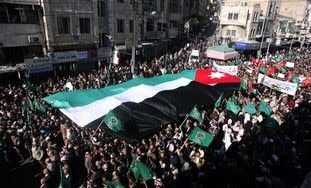
Jordan's King Sacks Cabinet Amid Street Protests

THE JERUSALEM POST: King Adullah nominates ex-army general Marouf al-Bakhit as prime minister after thousands of Jordanians take to the streets and call for the current PM to resign, due to rise in food, fuel prices.

Jordan's Royal Palace said the king has sacked his government in the wake of street protests and has asked an ex-army general to form a new Cabinet.

King Abdullah's move comes after thousands of Jordanians took to the streets — inspired by the regime ouster in Tunisia and the turmoil in Egypt — and called for the resignation of Prime Minister Samir Rifai who is blamed for a rise in fuel and food prices and slowed political reforms.

The Royal Palace says Rifai's Cabinet resigned on Tuesday.

Abdullah also nominated Marouf al-Bakhit as his prime minister-designate. No other details were immediately available. >>> Associated Press | Tuesday, February 01, 2011
Could Syria Be the Next Domino to Fall?

GOBAL POST: Syrians are watching Egypt's popular uprising carefully.

DAMASCUS, Syria -- In one of Old Damascus’ new cafes the text messages buzzed between mobile phones in quick succession, drawing woops of joy and thumbs up from the astonished Syrians.

Suzan Mubarak, wife of the reviled Egyptian president, had flown into exile with her son, so the rumours went, driven out of the country by days of unprecedented protest against the 30-year rule of her husband, President Hosni Mubarak.

The news from Cairo has brought with it a flutter of excitement to this country, founded on principles so similar to Egypt that the two nations were once joined as one.

Like Egypt, Syria has been ruled for decades by a single party, with a security service that maintains an iron grip on its citizens. Both countries have been struggling to reform economies, stifled for generations by central control, in an effort to curb unemployment among a ballooning youth demographic.

Could the domino effect that spread from the streets of Tunis to Cairo soon hit Damascus? >>> Hugh Macleod | Sunday, January 30, 2011
Could US Abandon Israel Too?

YNET NEWS: American response to uprising in Egypt shows Washington has no qualms about 'dropping' long time ally. Is Israel in danger of receiving similar treatment? Experts say 'possibility always exists,' recommend strengthening relations with India, China

The United States sided with protesters over the weekend, threatening to stop aid to Egypt if President Hosni Mubarak does not promote reforms in the country. Washington also added that the Egyptian public's grievances require an immediate response from the government

"The possibility of being abandoned over interests is always possible," says Hebrew University Professor Michal Pomerantz, an expert on international law and US foreign policy.

According to Pomerantz, "The United States is not completely committed to a state, and what happened in Egypt as well as in Iran – with which it had such close relations at one point, that Carter was considering transferring it nuclear technology – proves that it is always possible, especially when there are changes in the administration, as has happened in the United States." >>> Aviel Magnezi | Tuesday, February 01, 2011
Scenes from Tahrir Square

Niall Ferguson: Yes, The US Is Screwed

This is an interview conducted by Business Insider Editor in Chief Henry Blodget In Davos

Niall Ferguson Explains Why Egypt Is More Like Iran Than Berlin

BUSINESS INSIDER: This revolution in Egypt is more likely to result in something like Iran, than it is to be like the fall of communism in Eastern Europe, according to Niall Ferguson.

Speaking to the German daily Handesblatt, Ferguson says that because the forces for democracy in Egypt are not well organized, Islamic fundamentalism will have a chance at success.

Ferguson also says there is a real threat that what happens in Egypt will spread to other countries, including Saudi Arabia.

The most important lesson from this crisis though, according to Ferguson, is that state capitalism, like that conducted by Egypt and China, is not perfect. [Source: Business Insider] | Gregory White | Monday, January 31, 2011

EXCLUSIVE INTERVIEW WITH NIALL FERGUSON: Yes, The US Is Screwed >>> Henry Blodget and Mamta Badkar | Friday, January 28, 2011
Egypt Protesters Use Voice Tweets

BBC: Google and Twitter have launched a service which circumvents the ban on net services in Egypt.

The so-called speak-to-tweet system allows people caught up in the unrest to post messages without any need to use an internet connection.

The service, which is already live, allows people to dial an international telephone number and leave a voicemail message.
The message is then sent out as a tweet with the hashtag #egypt.

People can listen to messages by dialling the same phone numbers (+16504194196 , +390662207294, +97316199855) or going to a special Twitter page. >>> | Tuesday, February 01, 2011
Turkish PM Calls for Mubarak to Stand Down

Recep Erdoğan, the Turkish prime minister, has called on Hosni Mubarak, Egypt's president, to listen to the calls for change from Egyptian people. Al Jazeera's Anita McNaught in Istanbul speaks about the Turkish PM's forceful remarks


NZZ ONLINE: «Es ist eine Frage von Tagen, bis Mubarak aufgibt» : Der Fall Ägypten könnte auf weitere arabische Staaten Einfluss haben >>> | Dienstag, 01. Februar 2011
Giant Protest Kicks Off in Egypt

More than hundred thousand assemble in Cairo for the "million-man-march" aimed at forcing president Mubarak to resign

Benjamin Netanyahu Warns of [sic] Iran-style Regime Could Emerge in Egypt

THE AUSTRALIAN: BENJAMIN Netanyahu has warned of the dangers of an Iranian-style regime led by Islamic extremists arising out of the political chaos sweeping through Egypt.

"In a time of chaos, an organised Islamic group can take over the state. It happened in Iran and it also happened in other places," the Israeli leader said at a press conference with visiting German Chancellor Angela Merkel.

His remarks were made as the Egyptian regime wrestles with a wave of unprecedented anti-government protests, which have pitted hundreds of thousands of demonstrators against the regime of embattled President Hosni Mubarak.

Although it was not extremist elements that provoked the instability in Tunisia or Egypt, the fear was that they could exploit the political vacuum left by the collapse of the ruling power, Netanyahu added, saying he was being updated about developments "every half hour."

"Every one hopes that this will be resolved peacefully, that stability will return and peace will be maintained," he added.

In Iran, mass protests against the Western-backed shah erupted in January 1978 and he was forced out a year later, leaving a power vacuum that was grasped by the exiled Ayatollah Ruhollah Khomeini who returned to set up the Islamic Republic. >>> AFP | Tuesday, February 01, 2011

NZZ ONLINE: «Ägypten könnte ein Erdbeben auslösen» : Harvard-Professor Niall Ferguson im Interview >>> Interview: Marco Metzler | Dienstag, 01. Februar 2011
Al Jazeera Report from Tahrir Square 8:30am, February 1

An Al Jazeera web producer reports from Tahrir Square in central Cairo where protesters have gathered, calling on Hosni Mubarak, the Egyptian president, to step down. The footage is shot on Monday night while the voiced report is from 8:30 local time, on Tuesday morning. Our reporter says protesters have been undeterred by authorities' attempts to completely block internet access and by rumours that the mobile phone network will also be shut down.

Egypt in Crisis: Business Collapse Piles Pressure on Mubarak

THE DAILY TELEGRAPH: Factories are closed, cash machines running dry, and food and petrol shortages feared, but some say it is a price worth paying

The industrial city of Abu Rawash sits in the desert beyond the pyramids. You reach it down a dusty road that seems to lead to nowhere. Then the factories and warehouses begin: Toyota, Hyundai, Mazda and Jeep deserted save for a handful of security guards sitting in front of a vacant parking lot for absent staff.

Outside the gates of the Toyota warehouse Ayman Ibrahim is talking to the gatekeeper. The factories are closed, the man tells Ibrahim, who owns a window business on the same site. They won't reopen until at least mid-week. Perhaps even Friday. No one really knows.

The closures in places such as Abu Rawash have been accompanied by calls from unions for an indefinite general strike. "I'm losing £10,000 pounds a week," says Ibrahim. "But it's worth it, I've been to the protest in Tahrir Square for the past three days with my kids. Mubarak is costing me money, but he has been costing Egypt money for 30 years." >>> Peter Beaumont in Cairo | Monday, January 31, 2011
Egypt under Israel's Spotlight

Israel hopes its three-decade-old peace treaty with Egypt will survive any change

In Pictures: Egypt in Turmoil

Images of the thousands of Egyptian protesters that defied a curfew in the capital Cairo and other cities taken throughout the day

Mid-East Contagion Fears for Saudi Oil Fields

THE DAILY TELEGRAPH: Risk analysts and intelligence agencies fear that Egypt's uprising may set off escalating protests in the tense Shia region of Saudi Arabia, home to the world's richest oilfields.

"Yemen, Sudan, Jordan and Syria all look vulnerable. However, the greatest risk in terms of both probability and severity is in Saudi Arabia," said a report by risk consultants Exclusive Analysis.

While markets have focused on possible disruption to the Suez Canal, conduit for 8pc of global shipping, it is unlikely that Egyptian leaders of any stripe would cut off an income stream worth $5bn (£3.1bn) a year to the Egyptian state.

"I don't think the Egyptians will ever dare to touch it," said Opec chief Abdalla El-Badri, adding that the separate Suez oil pipeline is "very well protected". The canal was blockaded after the Six Days War in 1967.

There has been less focus on the risk of instability spreading to Saudi Arabia's Eastern Province, headquarters of the Saudi oil giant Aramco. The region boasts the vast Safaniya, Shaybah and Ghawar oilfields. "This is potentially far more dangerous," said Faysal Itani, Mid-East strategist at Exclusive.

"The Shia are 10pc of the Saudi population. They are deeply aggrieved and marginalised, and sit on top of the kingdom's oil reserves. There have been frequent confrontations and street fights with the security forces that are very rarely reported in the media," he said.

The Saudi Shia last rose up in mass civil disobedience in the "Intifada" of 1979, inspired by the Khomeini revolution in Iran. Clashes led to 21 deaths. Mr Itani said it is unclear whether the Saudi military could cope with a serious outbreak of protest in the province.

Saudi King Abdullah is clearly alarmed by fast-moving events in Egypt and the Arab world. In a statement published by the Saudi press agency he said agitators had "infiltrated Egypt to destabilise its security and incite malicious sedition". Read on and comment >>> Ambrose Evans-Pritchard | Monday, January 31, 2011

Monday, January 31, 2011

WikiLeaks: Britain Secretly Advised Libya How to Secure Release of Lockerbie Bomber

THE DAILY TELEGRAPH: Ministers secretly advised Muammar Gaddafi’s Libyan regime how to secure the successful early release of the Lockerbie bomber, documents obtained by The Daily Telegraph have disclosed.

Photobucket
Lockerbie bomber Abdelbaset al-Megrahi clasps the hand of Saif al-Islam Gaddafi, the Libyan leader's son, after arriving back in Tripoli. Photograph: The Daily Telegraph

A Foreign Office minister sent Libyan officials detailed legal advice on how to use Abdelbaset al-Megrahi’s cancer diagnosis to ensure he was released from a Scottish prison on compassionate grounds.

The Duke of York is also said to have played a behind-the-scenes role in encouraging the terrorist’s release.

The Libyans closely followed the advice which led to the controversial release of Megrahi – who was convicted of the murder of 270 passengers on Pan Am Flight 103 – within months of the Foreign Office’s secret intervention.

The disclosure seriously undermines British Government claims that is was not complicit in the release of al-Megrahi, and that the decision to free the convicted terrorist was taken by the Scottish Executive alone.

It will also lead to renewed pressure from senior American politicians on David Cameron to release all internal documents detailing Britain’s role in the scandal. Last summer, the Prime Minister pledged to release the relevant information – but the publication has yet to occur sparking fears that a cover-up may have been ordered. >>> Christopher Hope and Robert Winnett | Monday, January 31, 2011

THE DAILY TELEGRAPH: WikiLeaks cables show Government was 'playing false' over Lockerbie bomber: WikiLeaks documents that disclose how British ministers secretly advised Libya on securing the successful early release of the Lockerbie bomber demonstrate that Tony Blair's Government was "playing false" over the issue, Alex Salmond has said. >>> Christopher Hope, and Robert Winnett | Tuesday, February 01, 2011

THE DAILY TELEGRAPH: WikiLeaks: How Libya trade fears forced British ministers to back release of Lockerbie bomber >>> Robert Winnett and Christopher Hope | Monday, January 31, 2011

THE DAILY TELEGRAPH: WikiLeaks: Yvonne Fletcher suspect 'a key player in US-Libya relations' – One of the two men who faces accusations over his role in the shooting of the British policewoman Yvonne Fletcher is now a “key player” in American-Libya relations, the documents show. >>> Christopher Hope | Tuesday, February 01, 2011
Egypt Crisis: President Hosni Mubarak on the Brink as He Offers Concessions to Demonstrators

THE DAILY TELEGRAPH: President Hosni Mubarak of Egypt made a last desperate attempt to cling on to power on Monday night ordering his new vice-president to make concessions to demonstrators.


Omar Suleiman, the long-standing security chief appointed as Mr Mubarak’s deputy on Saturday, went on state television to announce negotiations for constitutional reform.

His move came after the army issued a statement promising it would not fire on demonstrators planning “million-strong marches” in the capital Cairo and Alexandria on Tuesday.

There was no immediate sign that Mr Mubarak was in a mood to concede to the demonstrators’ central demand that he hand over power, despite calls from world leaders, including those of America, Britain and the European Union, for an orderly transition.

He ordered a closure of railway lines and Egypt Air flights to prevent people flocking to join “million-strong marches” planned for Cairo and Alexandria on Tuesday. He also swore in a new cabinet, including a general, Mahmoud Wagdy al-Solaya, to replace the hated interior minister, Habib al-Adly, who was sacked on Friday.

Western diplomats who have talked to officials close to the president earlier said he seemed determined to stay on.

“President Mubarak still regards himself as playing a clear role in the future government of Egypt and he is not persuaded of the need to leave,” commented one diplomat. >>> Colin Freeman, Cairo and Richard Spencer in Cairo and Bruno Waterfield in Brussels | Monday, January 31, 2011
Face to Face: Lauren Booth vs Anjem Choudary


Anjem Blows His Cover on Newsnight

Egypt Crisis: Country Braced for 'March of a Million'

THE DAILY TELEGRAPH: A "march of a million" against the Egyptian regime has been called for Tuesday in Alexandria after one was announced in Cairo and all train services were cancelled, an aide to dissident Mohamed ElBaradei said.

Protest organisers announced earlier that they would stage a mass march from Cairo's Tahrir Square, the epicentre of nationwide protests against President Hosni Mubarak's regime that have been raging for a week, leaving at least 125 people dead.

"We wanted to take part in the march from Tahrir Square tomorrow but given that all the trains have been stopped and there's no other means of transport we have decided to stay and organise a march of a million tomorrow," Abeer Yussef told AFP on Monday by telephone from Alexandria.

Mr Yussef said separate demonstrations would leave different districts of the Mediterranean port at 11:00am (0900 GMT) on Tuesday and congregate on the square in front of the main Masr train station.

Countries around the globe stepped up evacuation of foreign tourists and workers from Egypt on Monday as anti-government protesters applied further pressure to force out beleaguered President Hosni Mubarak.

Britain was advising its nationals to leave flashpoint Egyptian cities, but tour operators stressed there was no need to pull tourists out of popular Red Sea resorts.

"We do want people to take the opportunity if they are able to leave ... but as yet the situation has not reached the stage where we would necessarily be considering chartering planes and getting larger numbers out," Foreign Office minister Alistair Burt told the BBC. >>> | Monday, January 31, 2011

THE TIMES: Mubarak’s hopes vanish as Army refuses to crush uprising >>> Martin Fletcher, Cairo | Monday, January 31, 2011 [£]
Carla Bruni-Sarkozy Confession: 'I No Longer Feel Left Wing'

THE DAILY TELEGRAPH: France's first lady, Carla Bruni-Sarkozy, has confessed to no "longer feeling left-wing" after three years of marriage to the country's conservative president, Nicolas Sarkozy.

The supermodel-turned-singer's reputation as a "luvvie Lefty" has been cited as a major handicap to Mr Sarkozy's re-election, and her political change of heart is an attempt to boost support for her unpopular husband among his core Right-wing electorate.

Only two years ago Mrs Bruni-Sarkozy had claimed that she was "instinctively left-wing" after at one stage supporting her husband's Socialist rival in the 2007 presidential elections. She had also publicly opposed Mr Sarkozy's plan to conduct DNA tests on immigrants.

In 2008, she told the Libération newspaper: "Nobody has to be joined at the hip in politics or with one's husband". A year earlier she told a British newspaper: "I would never vote on the Right."

But in Monday's interview with Le Parisien newspaper, she said her previous political persuasion was only due to her belonging to a "community of artists." "We were bobo (bourgeois bohemians), we were left-wing but at that time I voted in Italy (her native country)." I have never voted for the Left in France and I can tell you, I'm not about to start now. I don't really feel left-wing anymore," she said. >>> Henry Samuel, Paris | Monday, January 31, 2011
Opposition Leader Back in Tunisia

Rachid Ghannouchi, leader of the previously banned al-Nahda party, returns to native Tunisia after 22 years in exile.


CHICAGO TRIBUNE: Tunisians wary as Islamists emerge from hiding: Islamists, long oppressed under the former regime, had little to do with the uprising, but they could benefit from a transition to democracy. The thought unsettles some in this largely secular country. >>> Borzou Daragahi, Los Angeles Times | Sunday, January 30, 2011
Obama Divorces Mideast

YNET NEWS: Op-ed: Obama offers hesitant response while America’s most important Mideast ally collapses

American President Barack Obama has divorced the Middle East, even if it he did not declare it or present the world with the divorce certificate.

US Administration officials are treating the protests in Egypt as a constitutive event in the Mideast and comparing them to the revolution in Europe in the wake of the Berlin Wall’s collapse. However, Obama, loyal to his worldview that the US should not build or ruin foreign regimes, presented the world with a hesitant response over the weekend: He did not support Mubarak, but also did not go all the way to the other end of the spectrum and called for general elections or the replacement of the Egyptian regime.

Obama could have led a revolution in the Middle East: As the leader of the Free World, he could have facilitated peace agreements, if not by coercion then at least by exerting massive pressure. Yet precisely when he chose to take one step back, America’s most important ally in the Middle East, Egypt, collapsed right before his eyes. >>> Orly Azoulay | Sunday, January 30, 2011
Huckabee: Israelis Should Be Able to Live Anywhere in Jewish State

YNET NEWS: Likely US Republican presidential candidate attends cornerstone-laying ceremony in Jewish neighborhood in east Jerusalem, tells MKs 'I don’t see why bedrooms for their children built by Jews on hilltop in Samaria pose threat to world peace'; calls lack of construction in settlements 'irrational'

Israelis should be able to live "anywhere in Israel they wished to live," Iikely US presidential candidate Mike Huckabee said Monday during a visit to the Mount of Olives for a cornerstone-laying ceremony in a Jewish east Jerusalem neighborhood.

"It is inconceivable in many ways that we would have to even argue and debate whether or not Israelis could live in Israel, not just in parts of Israel but anywhere in Israel they wished to live," said Huckabee, who is expected to run against US President Barack Obama in the 2012 elections on behalf of the Republican Party.

"I cannot imagine as an American being told that I could not live in certain places in America because I was Christian, or because I was white, or because I spoke English. I would be outraged if someone told me that in my country, I would be prohibited and forbidden to live in a part of that country, for any reason," the former governor of Arkansas added. >>> Yair Altman | Monday, January31, 2011