Tuesday, July 14, 2009

NZZ Online: Benzin muss Iran für Milliarden Dollar teuer importieren, und die Rohölförderung nimmt jedes Jahr weiter ab, obwohl unter dem Land die drittgrössten Erdölreserven der Welt schlummern. Das Gleiche gilt für Erdgas, wo nur das Riesenreich Russland die iranischen Reserven in den Schatten stellt.
Iran verfügt über die drittgrössten Erdölreserven der Welt. Doch um aus Vorräten eine Ware zu machen, braucht es Fördertechnologien und Einrichtungen zur Weiterverarbeitung der Rohstoffe. Das ist Irans Achillesferse. Hier schmerzen die internationalen Sanktionen – und das Chaos infolge der umstrittenen Präsidentschaftswahl macht alles noch schlimmer.
Für die weitere Wirtschaftsentwicklung ist das pures Gift. «Wenn man die Zeit nach der Wahl betrachtet, mit der jetzt ziemlich sichtbaren tiefen Spaltung innerhalb der regierenden Elite, dann ist es schwierig, sich vorzustellen, wie sich Präsident Mahmud Ahmadinejad nach der Niederschlagung der Proteste auf die Seite der Gewinner schlagen will», sagt Samuel Ciszuk, Nahost-Energie-Spezialist beim Analystendienst IHS Global Insight in London. Statt die kränkelnde Wirtschaft zu sanieren, müsse sich die Regierung nun für mindestens den Rest des Jahres auf die innenpolitischen Spannungen konzentrieren.
Diese Verzögerung kann sich Iran jedoch kaum leisten. Die Sorge um die wirtschaftliche Entwicklung war schon vor der Präsidentenwahl vom 12.–Juni eines der wichtigsten Themen. Oppositionsführer Mir Hossein Moussavi, der sich von Ahmadinejad um den Sieg betrogen sieht, wies bereits im Wahlkampf warnend darauf hin, dass der Hardliner das Land mit seiner Günstlingswirtschaft an den «Rand des Abgrunds» manövriert habe. >>> ap | Dienstag, 14. Juli 2009


LE FIGARO: Le deuxième fils de Khamenei se serait imposé avec discrétion dans la hiérarchie complexe du régime à Téhéran. C'est lui qui aurait notamment facilité les fraudes électorales et dirigé la répression.
Ses apparitions publiques sont rares. Son visage, méconnu du grand public. Agissant discrètement dans l'ombre du pouvoir de son père, le puissant guide suprême iranien, Mojtaba Khamenei serait, en fait, un des principaux chefs d'orchestre de la répression qui sévit aujourd'hui à Téhéran.
C'est lui, selon de nombreux observateurs, qui aurait «ouvert la cage aux lions» en cédant le contrôle de Téhéran aux gardiens de la révolution et en lâchant les bassidjis dans les rues de la capitale iranienne, pour mâter les manifestants qui contestent la victoire d'Ahmadinejad à la présidentielle du 12 juin dernier. Un état de siège qui rappelle les premières années postrévolutionnaires, juste après la mise en place de la République islamique d'Iran, en 1979.
«De lui, on ne sait pas grand-chose, concède Mohsen Sazegara, un ancien membre des gardiens de la révolution, aujourd'hui exilé à Washington. Mais tout laisse à penser qu'il a joué un rôle majeur dans le “coup d'État” et la répression postélectorale. Le guide suprême est connu pour être un homme qui n'a pas le courage de prendre ce genre de décision. On le sait d'ailleurs dépressif. Il est donc fort possible que l'influence de son fils ait pesé dans la balance», dit-il.
Cadet d'une fratrie de six enfants, Mojtaba aurait aujourd'hui 40 ans, à peine. Il est marié à la fille de Gholam-Ali Haddad Adel, ancien président conservateur du Parlement iranien. Après avoir fait des études théologiques au grand séminaire religieux de la ville sainte de Qom, il disposerait du titre de hodjatoleslam (rang intermédiaire dans le clergé chiite). «Mes sources, en Iran, me disent qu'il est de ceux qui ont soutenu Ahmadinejad lors de sa première élection, en 2005, et ont tenu à le garder au pouvoir. Une sorte de reprise en main radicale lui permettant, sur le long terme, de briguer le poste de guide religieux occupé par son père», confie Sazegara. >>> Delphine Minoui | Lundi 13 Juillet 2009

TIMES ONLINE: The British National Party's two MEPs took their seats in the 736 member European Parliament this morning just one row behind David Cameron's new Conservative group.
Nick Griffin, the BNP leader, and his party colleague Andrew Brons were allocated seats 780 and 781 and immediately ran into controversy when Democratic Unionist Party MEP Diane Dodds refused to sit in seat 782 next to them.
After both took part in the election of a new parliamentary President, Mr Griffin showed his unerring ability to generate controversy by hitting back at Baroness Kinnock, the Europe Minister, for refusing to invite the pair to a reception for new MEPs tomorrow.
"I would not want to share a drink with Glenys Kinnock," said Mr Griffin, speaking to The Times outside the chamber.
"She is a political prostitute, simple as that. She and her husband started off their careers as anti-common market and now they are there not just with their noses in the trough, they are in the trough."
Mr Griffin further alleged that civil servants were being told to treat the BNP MEPs differently by denying them access to some information.
"We will test this by applying for information and see what comes back, and take it to court if necessary," he said.
Mr Brons said that they did not plan to boycott the European Parliament, where they sit on the right hand side of the chamber behind Polish members of the European Conservatives and Reformists.
The BNP failed to find enough like-minded MEPs from across Europe to form an official group, which would have brought extra funding and staff, but said they would work informally with neo-fascist parties including Jean-Marie Le Pen's Front National in France and Jobbik, the Hungarian nationalists with their own militia. >>> David Charter, Strasbourg | Tuesday, July 14, 2009
TIMES ONLINE: Osama bin Laden’s Al-Qaeda network has taken up the cause of China’s Muslim Uighur minority with a pledge to attack Chinese workers in northwestern Africa in retaliation for mistreatment by Beijing of its largest Muslim minority.
Al-Qaeda's Algerian-based offshoot, al-Qaeda in the Islamic Maghreb (AQIM), has issued the call for vengeance, according to the South China Morning Post, which quoted an intelligence report from the London-based risk analysis firm Stirling Assynt.
It would be the first time that bin Laden’s organisation has threatened China or its interests — underlying the risks Beijing faces as it expands its economic investments overseas.
The assessment by Sterling Assynt warned that the threat should be taken seriously and said: “Although AQIM appear to be the first arm of al-Qaeda to officially state they will target Chinese interests, others are likely to follow."
The unrest in China’s westernmost Xinjiang region last week in which 184 people died — most of them Han Chinese killed by Uighurs — has elicited sympathy in much of the Muslim world for the minority Uighurs who face tight controls on their religious practices and discrimination in the workplace.
The report said: “The general situation of China's Muslims has resonated amongst the global jihadist community. There is an increasing amount of chatter . . . among jihadists who claim they want to see action against China. Some of these individuals have been actively seeking information on China's interests in the Muslim world, which they could use for targeting purposes."
The report is based on information from people who have seen the instruction from AQIM, the agency said. >>> Jane Macartney in Beijing | Tuesday, July 14, 2009
THE WALL STREET JOURNAL: Thousands of people began returning to Pakistan's Swat Valley after nearly three months of fighting that drove the Taliban from the region and created the country's worst refugee crisis in six decades.
Pakistan earned praise at home and abroad for its offensive in Swat, which began in April after the collapse of a peace deal that handed the valley just 100 miles north of Islamabad, the capital, to militants.
Under the protection of soldiers and helicopter gunships, refugees started coming back Monday. How Pakistan manages the return of the nearly two million people who fled the fighting will go a long way to determining whether it can solidify the army's gains in the strategic valley as it moves to retake more-formidable Taliban strongholds in tribal areas bordering Afghanistan.
In a reminder that the threat facing Pakistan has spread beyond northwestern regions such as Swat and tribal areas, an explosion Monday in the country's east killed at least nine people.
The midmorning blast in a farming village near Mian Channu, in Punjab province, appeared to have been caused by explosives stored in the house of a teacher who had set up a small religious school, a police official said.
He couldn't say why explosives were in the house, but two senior Punjab police officials said there was evidence the building was used as a meeting place for Islamist militants, who in recent months have stepped up attacks in previously peaceful parts of eastern Pakistan.
Separately, 13 suspected al Qaeda militants, including four Kuwaiti and two Saudi nationals, were arrested near Quetta, capital of the southwestern province of Baluchistan, Reuters reported. Security forces also recovered explosive-fitted jackets used for suicide bombing, an official said.
In Swat, officials have carefully planned the refugees' return, many observers say. Pakistani and international aid officials say they have mapped out how the government would ensure the orderly -- and voluntary -- return of residents to the valley and surrounding areas, where police and local government are nearly nonexistent, schools and clinics are shuttered, and many houses were destroyed or damaged in the fighting. >>> ZAHID HUSSAIN in Sakha Kott, Pakistan, and MATTHEW ROSENBERG in New Delhi | Tuesday, July 14, 2009
LOS ANGELES TIMES: After a chaotic period helping victims of violence, plastic surgeons now find themselves ministering to a public interested in nose jobs.
Reporting from Baghdad -- There was a time when Baghdad's reconstructive surgeons were rushed off their feet trying to repair the terrible disfigurements caused by war.
These days, they're just as likely to find themselves giving Botox injections or performing nose jobs, as Iraqis take advantage of the calmer conditions to enhance their looks.
"Definitely we are performing more plastic surgery than before, mainly because the security situation of the country has improved," said Rida Ali, a plastic surgeon who estimates that half her patients are seeking cosmetic surgery, compared with less than a quarter a few years ago.
They include men as well as women, and most of them want nose jobs, which cost $600 to $1,000 each. Among the women, breast surgery is also popular, Ali said, but not the augmentations common in the West.
"In Iraq we do more breast reduction than augmentation," she said. "Some of the breasts we reduce in size are huge . . . and they cause back pain."
The trend has been fueled largely by the arrival of satellite television, which since 2003 has beamed into Iraqi living rooms the glamorous Egyptian and Lebanese celebrities who are reputed to keep regular appointments with their cosmetic surgeons.
The results aren't always what the patient expected.
"Our patients get all their ideas from TV, then they come to us and request the operation," said Mahdi Hameed Abood, a senior surgeon at the Wasiti Center for Reconstructive Surgery. "It's good having television as a source of information, but what you see on TV is not always reality. There are special effects, lights. People believe what they see and come to us expecting results that may be unrealistic." >>> Caesar Ahmed | Sunday, July 12, 2009
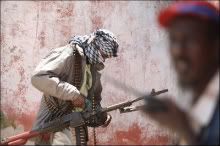
L’EXPRESS.fr: Des miliciens seraient impliqués dans l'enlèvement de ces journalistes mardi matin dans leur hôtel à Mogadiscio.
Deux journalistes étrangers ont été enlevés mardi matin dans leur hôtel à Mogadiscio par des hommes armés, a-t-on appris auprès de la police somalienne.
"Plus d'une dizaine de miliciens à bord d'un véhicule armé sont impliqués dans les enlèvements. Ils ont désarmé les gardes de sécurité de l'hôtel avant de se rendre directement dans les chambres des deux étrangers", a déclaré un policier somalien, Mohamed Ali.
"Nous devons encore confirmer leurs nationalités et ce qu'ils faisaient en Somalie", a-t-il ajouté. >>> Par LEXPRESS.fr avec AFP | Mardi 14 Juillet 2009
WELT ONLINE: Trotz des Sturzes der Taliban gibt es für viele afghanische Frauen noch immer keine Gleichberechtigung. Fatima Gailani, Präsidentin des afghanischen Roten Halbmonds, erklärt auf WELT ONLINE, die Mentalität des ganzen Landes müsse sich ändern. Sie kritisiert auch die Regierung, ist aber gegen ein Burka-Verbot.

Fatima Gailani, 55, ist seit 2004 Präsidentin des afghanischen Roten Halbmonds, des islamischen Pendants des Roten Kreuzes. Als Tochter von Pir Sayed Gailani, eines einflussreichen Mudschaheddin-Kommandeurs, wuchs sie in einer privilegierten wie politischen Familie auf.
Nach dem Sturz der Taliban nahm die studierte Islamwissenschaftlerin im Jahr 2001 an der Konferenz zur Zukunft Afghanistans in Königswinter bei Bonn teil. Schon damals war die Verbesserung der Lebenssituation der Frauen in ihrem Heimatland ein wichtiges Thema für Gailani. In den letzten Jahren, sagt sie heute, hat sich die Lage eher wieder verschlechtert.
WELT ONLINE: Wie muss man sich das Leben afghanischer Frauen heutzutage vorstellen?
Fatima Gailani: Eine gewöhnliche Frau in Kabul arbeitet, falls sie eine Ausbildung hat, als Lehrerin oder Regierungsangestellte. Wenn sie nach Hause kommt, dann ist sie diejenige, die kocht und putzt, und der Anteil ihres Mannes an der Hausarbeit ist Null. Eine Frau ohne Ausbildung arbeitet als Haushaltshilfe, Wäscherin oder Putzfrau. Dann kommt sie müde nach Hause und macht den Haushalt. Und schließlich sind da die Frauen, die - gebildet oder nicht - nicht arbeiten dürfen, selbst wenn die finanzielle Situation sehr schlecht ist. Das ist der schlimmste Fall. >>> Von Christina Neuhaus | Dienstag, 14. Juli 2009
Monday, July 13, 2009
TIMES ONLINE: Chinese police today shot dead two Uighur men and wounded a third in the first official report of the use of firearms to quell unrest in the western, mainly Muslim region where a riot last week left 184 people dead.
Frightened residents of Urumqi ran into their homes and shops, slamming the doors, as police waved their guns and shouted. Reinforcements were rushed into the city, backed by armoured personnel carriers.
Officials said that officers opened fire after they were attacked as they tried to prevent three men from assaulting another with knives and rods.
"Police shot and killed two suspected lawbreakers and injured one suspected lawbreaker using legal means," said a statement released by the government of the capital of China’s westernmost region of Xinjiang.
State radio said that the two men who died were members of the ethnic Uighur minority. A third Uighur was wounded. >>> Jane Macartney in Beijing | Monday, July 13, 2009

THE TELEGRAPH: Michael Jackson had at least two gay lovers and would go out disguised as a woman for secret liaisons in motel rooms, according to a new book.
The star was allegedly “madly in love” with a half-Asian construction worker and had another fling with a Hollywood waiter.
Writer Ian Halperin claims in his unauthorised biography that “virtually everybody” around Jackson knew that the singer was gay.
Jackson’s affair with the builder, who was in his early 20s, began in Las Vegas in 2007, according to Halperin. “He rarely left his residence, but when he did, according to one of Jackson’s closest confidants, it was to meet a boyfriend at a run-down motel.
“Michael would leave the house in disguise, often dressed as a woman, and would go to meet his boyfriend at a motel that was one of Vegas’ grungiest dives. Michael was broke. He struggled to put food on the table for his children. It was all he could afford then.” >>> | Monday, July 13, 2009
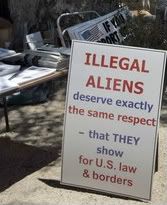
LOS ANGELES TIMES: The measure would end public benefits to illegal residents, challenge the citizenship of their U.S.-born children, cut welfare payments to those children and impose new birth certificate requirements.
In a stretch of desert just north of the U.S.-Mexico border, men and women in khakis and the colors of the American flag recently gathered at a border watch post they call Camp Vigilance and discussed their next offensive in the nation's immigration wars.
The target: Illegal immigrants and their U.S.-born children who receive public benefits.
The plan: a California ballot initiative that would end public benefits for illegal immigrants, cut off welfare payments for their children and impose new rules for birth certificates.
"We will be out in full force to qualify this initiative," said Barbara Coe, who helped develop Proposition 187, the 1994 measure that would have ended benefits to illegal immigrants but was ruled unconstitutional. "Illegals and their children are costing the state billions of dollars. It's invasion by birth canal."
Supporters of the initiative, recently unveiled by San Diego political activist Ted Hilton, hope to challenge the citizenship of children born in the United States to parents who are here illegally. >>> Teresa Watanabe | Monday, July 13, 2009
NZZ Online: Der nordkoreanische Staatschef Kim Jong Il ist laut südkoreanischen Medienberichten an Bauchspeicheldrüsenkrebs erkrankt. Der Bericht des Fernsehsenders YTN beruft sich auf chinesische und südkoreanische Geheimdienstkreise.
Bauchspeicheldrüsenkrebs wird gewöhnlich erst im letzten Stadium festgestellt. Ziehe man Kims Alter von 67 Jahren in Betracht, werde mit einer Lebenserwartung von höchstens noch fünf Jahren gerechnet, heisst es in dem Bericht vom Montag weiter.
Der südkoreanische Geheimdienst erklärte, er könne den Bericht nicht bestätigen. >>> ap | Montag, 13. Juli 2009
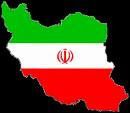
TAGES ANZEIGER: Der Staat breche zusammen, wenn nicht bald etwas geschehe, sagt der Drittplatzierte bei den iranischen Präsidentschaftswahlen, Mohsen Rezai. Er macht Ahmadinejad einen gewagten Vorschlag.
Um die jetzige Situation zu ändern, würden Entgegenkommen und Bruderliebe benötigt. Die Menschen und ihre Rechte müssten respektiert werden. Der konservative Politiker Rezai kritisierte in einem Eintrag auf seiner Internetseite vom Sonntag die Vorgänge während und nach der Wahl als Missmanagement der öffentlichen Wünsche.
Dies habe zu der Krise geführt, die der Westen jetzt ausschlachten könne. Gemäss Rezai muss die Islamische Revolution fortgesetzt werden. Einige Reformen auf der politischen Ebene seien nötig. >>> oku/sda | Montag, 13. Juli 2009
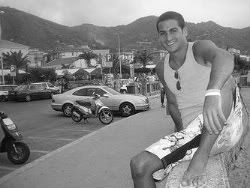
LE FIGARO: Comme le demandait Michèle Alliot-Marie, le parquet va faire appel des condamnations inférieures aux réquisitions de l'avocat général. Les complices de Youssouf Fofana comparaîtront devant une cour d'assisses.
Il y aura un deuxième procès pour le meurtre d'Ilan Halimi. Quatorze complices présumés de Youssouf Fofana dans le meurtre d'Ilan Halimi seront rejugés devant une cour d'assises, a annoncé lundi le parquet général. Sont concernés notamment les deux complices jugés les plus actifs dans le rapt et la séquestration d'Ilan -condamnés à 15 et 18 ans, là où l'accusation avait réclamé 20 ans de réclusion contre chacun- et la jeune fille ayant servi d'appât pour attirer le jeune juif dans le piège, condamnée à 9 ans contre 10 à 12 requis.
Le parquet a ainsi suivi les voeux de Michèle Alliot-Marie. Dans la matinée, la ministre de la Justice avait demandé au parquet de «faire appel des condamnations inférieures aux réquisitions de l'avocat général». >>> B.F. (lefigaro.fr) | Lundi 13 Juillet 2009
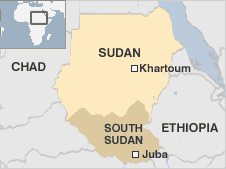
BBC: Several Sudanese women have been flogged as a punishment for dressing "indecently", according to a local journalist who was arrested with them.
Lubna Ahmed al-Hussein, who says she is facing 40 lashes, said she and 12 other women wearing trousers were arrested in a restaurant in the capital, Khartoum.
She told the BBC several of the women had pleaded guilty to the charges and had 10 lashes immediately.
Khartoum, unlike South Sudan, is governed by Sharia law.
Several of those punished were from the mainly Christian and animist south, Ms Hussein said.
Non-Muslims are not supposed to be subject to Islamic law, even in Khartoum and other parts of the mainly Muslim north.
She said that a group of about 20 or 30 police officers entered the popular Khartoum restaurant and arrested all the women wearing trousers.
"I was wearing trousers and a blouse and the 10 girls who were lashed were wearing like me, there was no difference," she told the BBC's Arabic service.
Ms Hussein said some women pleaded guilty to "get it over with" but others, including herself, chose to speak to their lawyers and are awaiting their fates.
Under Sharia law in Khartoum, the normal punishment for "indecent" dressing is 40 lashes.
Ms Hussein is a well-known reporter who writes a weekly column called Men Talk for Sudanese papers. She also works for the United Nations Mission in Sudan. [Source: BBC] | Monday, July 13, 2009
USA TODAY: WASHINGTON — Pentagon health experts are urging Defense Secretary Robert Gates to ban the use of tobacco by troops and end its sale on military property, a change that could dramatically alter a culture intertwined with smoking.
Jack Smith, head of the Pentagon's office of clinical and program policy, says he will recommend that Gates adopt proposals by a federal study that cites rising tobacco use and higher costs for the Pentagon and Department of Veterans Affairs as reasons for the ban.
The study by the Institute of Medicine, requested by the VA and Pentagon, calls for a phased-in ban over a period of years, perhaps up to 20. "We'll certainly be taking that recommendation forward," Smith says.
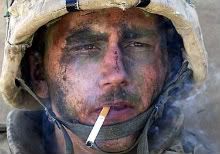
A tobacco ban would confront a military culture, the report says, in which "the image of the battle-weary soldier in fatigues and helmet, fighting for his country, has frequently included his lit cigarette."
Also, the report said, troops worn out by repeated deployments often rely on cigarettes as a "stress reliever." The study found that tobacco use in the military increased after the wars in Iraq and Afghanistan began.
Pentagon spokeswoman Cynthia Smith said the department supports a smoke-free military "and believes it is achievable." She declined to elaborate on any possible ban.
One in three service members use tobacco, the report says, compared with one in five adult Americans. The heaviest smokers are soldiers and Marines, who have done most of the fighting in Iraq and Afghanistan, the study says. About 37% of soldiers use tobacco and 36% of Marines. Combat veterans are 50% more likely to use tobacco than troops who haven't seen combat. >>> Gregg Zoroya, USA Today | Thursday, July 09, 2009
Subscribe to:
Posts (Atom)