Tuesday, February 01, 2011
 THE INDEPENDENT: The world watches and waits to see how the 30-year reign of Egypt's corrupt, incompetent President will end – whether the man who has reduced his country to a political slum will fight or take flight. Patrick Cockburn studies the lessons of his past
Will he or won't he go? And if he goes in what circumstances will he do so? Never has there been such acute interest in Egypt and the rest of the world about what goes on inside the head of President Hosni Mubarak.
Almost everybody is agreed from street protesters in central Cairo to US Secretary of State Hillary Clinton in Washington that Mubarak is going to lose power in the short or medium term. His 30-year regime has long been notorious for its corruption, incompetence, authoritarianism and brutality, and it now appears to be losing the monopoly of force which alone guaranteed its survival. The riot police fled the streets at the weekend and the tank commanders who replaced them are pictured fraternising with demonstrators.
But the uncontested transition to a democratically elected government, largely preserving the political status quo, which the US and Britain would like to see, will not happen easily. First of all, Mubarak shows no signs yet of departing, though he is unlikely to advertise his travel plans.
His appointment of a new government led by Omar Suleiman, the chief of intelligence, might open the door for Mubarak to step down, but it might also mean that he believes he is not finished yet.
For all Mubarak's three decades as president of Egypt it is difficult to read his mind or his likely reactions, particularly as he faces an unprecedented crisis. Egyptians have long mocked his bovine appearance and utterances. "La vache qui rit" was the contemptuous phrase used to describe him. But he would not have held power for so long if he did not know how to manipulate political forces inside and outside Egypt. Read on and comment >>> | Tuesday, February 01, 2011

THE DAILY TELEGRAPH: Effigies of President Mubarak have been hung in Cairo's Tahrir Square as tens of thousands of protesters gather for the largest demonstration yet in Egypt.
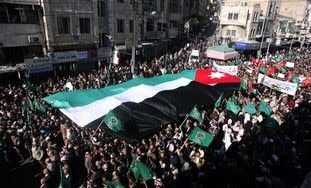 THE JERUSALEM POST: King Adullah nominates ex-army general Marouf al-Bakhit as prime minister after thousands of Jordanians take to the streets and call for the current PM to resign, due to rise in food, fuel prices.
Jordan's Royal Palace said the king has sacked his government in the wake of street protests and has asked an ex-army general to form a new Cabinet.
King Abdullah's move comes after thousands of Jordanians took to the streets — inspired by the regime ouster in Tunisia and the turmoil in Egypt — and called for the resignation of Prime Minister Samir Rifai who is blamed for a rise in fuel and food prices and slowed political reforms.
The Royal Palace says Rifai's Cabinet resigned on Tuesday.
Abdullah also nominated Marouf al-Bakhit as his prime minister-designate. No other details were immediately available. >>> Associated Press | Tuesday, February 01, 2011
GOBAL POST: Syrians are watching Egypt's popular uprising carefully.
DAMASCUS, Syria -- In one of Old Damascus’ new cafes the text messages buzzed between mobile phones in quick succession, drawing woops of joy and thumbs up from the astonished Syrians.
Suzan Mubarak, wife of the reviled Egyptian president, had flown into exile with her son, so the rumours went, driven out of the country by days of unprecedented protest against the 30-year rule of her husband, President Hosni Mubarak.
The news from Cairo has brought with it a flutter of excitement to this country, founded on principles so similar to Egypt that the two nations were once joined as one.
Like Egypt, Syria has been ruled for decades by a single party, with a security service that maintains an iron grip on its citizens. Both countries have been struggling to reform economies, stifled for generations by central control, in an effort to curb unemployment among a ballooning youth demographic.
Could the domino effect that spread from the streets of Tunis to Cairo soon hit Damascus? >>> Hugh Macleod | Sunday, January 30, 2011
 YNET NEWS: American response to uprising in Egypt shows Washington has no qualms about 'dropping' long time ally. Is Israel in danger of receiving similar treatment? Experts say 'possibility always exists,' recommend strengthening relations with India, China
The United States sided with protesters over the weekend, threatening to stop aid to Egypt if President Hosni Mubarak does not promote reforms in the country. Washington also added that the Egyptian public's grievances require an immediate response from the government
"The possibility of being abandoned over interests is always possible," says Hebrew University Professor Michal Pomerantz, an expert on international law and US foreign policy.
According to Pomerantz, "The United States is not completely committed to a state, and what happened in Egypt as well as in Iran – with which it had such close relations at one point, that Carter was considering transferring it nuclear technology – proves that it is always possible, especially when there are changes in the administration, as has happened in the United States." >>> Aviel Magnezi | Tuesday, February 01, 2011
BUSINESS INSIDER: This revolution in Egypt is more likely to result in something like Iran, than it is to be like the fall of communism in Eastern Europe, according to Niall Ferguson.
Speaking to the German daily Handesblatt, Ferguson says that because the forces for democracy in Egypt are not well organized, Islamic fundamentalism will have a chance at success.
Ferguson also says there is a real threat that what happens in Egypt will spread to other countries, including Saudi Arabia.
The most important lesson from this crisis though, according to Ferguson, is that state capitalism, like that conducted by Egypt and China, is not perfect. [Source: Business Insider] | Gregory White | Monday, January 31, 2011
EXCLUSIVE INTERVIEW WITH NIALL FERGUSON: Yes, The US Is Screwed >>> Henry Blodget and Mamta Badkar | Friday, January 28, 2011
BBC: Google and Twitter have launched a service which circumvents the ban on net services in Egypt.
The so-called speak-to-tweet system allows people caught up in the unrest to post messages without any need to use an internet connection.
The service, which is already live, allows people to dial an international telephone number and leave a voicemail message.
The message is then sent out as a tweet with the hashtag #egypt.
People can listen to messages by dialling the same phone numbers (+16504194196 , +390662207294, +97316199855) or going to a special Twitter page. >>> | Tuesday, February 01, 2011
NZZ ONLINE: «Es ist eine Frage von Tagen, bis Mubarak aufgibt» : Der Fall Ägypten könnte auf weitere arabische Staaten Einfluss haben >>> | Dienstag, 01. Februar 2011
THE AUSTRALIAN: BENJAMIN Netanyahu has warned of the dangers of an Iranian-style regime led by Islamic extremists arising out of the political chaos sweeping through Egypt.
"In a time of chaos, an organised Islamic group can take over the state. It happened in Iran and it also happened in other places," the Israeli leader said at a press conference with visiting German Chancellor Angela Merkel.
His remarks were made as the Egyptian regime wrestles with a wave of unprecedented anti-government protests, which have pitted hundreds of thousands of demonstrators against the regime of embattled President Hosni Mubarak.
Although it was not extremist elements that provoked the instability in Tunisia or Egypt, the fear was that they could exploit the political vacuum left by the collapse of the ruling power, Netanyahu added, saying he was being updated about developments "every half hour."
"Every one hopes that this will be resolved peacefully, that stability will return and peace will be maintained," he added.
In Iran, mass protests against the Western-backed shah erupted in January 1978 and he was forced out a year later, leaving a power vacuum that was grasped by the exiled Ayatollah Ruhollah Khomeini who returned to set up the Islamic Republic. >>> AFP | Tuesday, February 01, 2011
NZZ ONLINE: «Ägypten könnte ein Erdbeben auslösen» : Harvard-Professor Niall Ferguson im Interview >>> Interview: Marco Metzler | Dienstag, 01. Februar 2011
 THE DAILY TELEGRAPH: Factories are closed, cash machines running dry, and food and petrol shortages feared, but some say it is a price worth paying
The industrial city of Abu Rawash sits in the desert beyond the pyramids. You reach it down a dusty road that seems to lead to nowhere. Then the factories and warehouses begin: Toyota, Hyundai, Mazda and Jeep deserted save for a handful of security guards sitting in front of a vacant parking lot for absent staff.
Outside the gates of the Toyota warehouse Ayman Ibrahim is talking to the gatekeeper. The factories are closed, the man tells Ibrahim, who owns a window business on the same site. They won't reopen until at least mid-week. Perhaps even Friday. No one really knows.
The closures in places such as Abu Rawash have been accompanied by calls from unions for an indefinite general strike. "I'm losing £10,000 pounds a week," says Ibrahim. "But it's worth it, I've been to the protest in Tahrir Square for the past three days with my kids. Mubarak is costing me money, but he has been costing Egypt money for 30 years." >>> Peter Beaumont in Cairo | Monday, January 31, 2011

THE DAILY TELEGRAPH: Risk analysts and intelligence agencies fear that Egypt's uprising may set off escalating protests in the tense Shia region of Saudi Arabia, home to the world's richest oilfields.
"Yemen, Sudan, Jordan and Syria all look vulnerable. However, the greatest risk in terms of both probability and severity is in Saudi Arabia," said a report by risk consultants Exclusive Analysis.
While markets have focused on possible disruption to the Suez Canal, conduit for 8pc of global shipping, it is unlikely that Egyptian leaders of any stripe would cut off an income stream worth $5bn (£3.1bn) a year to the Egyptian state.
"I don't think the Egyptians will ever dare to touch it," said Opec chief Abdalla El-Badri, adding that the separate Suez oil pipeline is "very well protected". The canal was blockaded after the Six Days War in 1967.
There has been less focus on the risk of instability spreading to Saudi Arabia's Eastern Province, headquarters of the Saudi oil giant Aramco. The region boasts the vast Safaniya, Shaybah and Ghawar oilfields. "This is potentially far more dangerous," said Faysal Itani, Mid-East strategist at Exclusive.
"The Shia are 10pc of the Saudi population. They are deeply aggrieved and marginalised, and sit on top of the kingdom's oil reserves. There have been frequent confrontations and street fights with the security forces that are very rarely reported in the media," he said.
The Saudi Shia last rose up in mass civil disobedience in the "Intifada" of 1979, inspired by the Khomeini revolution in Iran. Clashes led to 21 deaths. Mr Itani said it is unclear whether the Saudi military could cope with a serious outbreak of protest in the province.
Saudi King Abdullah is clearly alarmed by fast-moving events in Egypt and the Arab world. In a statement published by the Saudi press agency he said agitators had "infiltrated Egypt to destabilise its security and incite malicious sedition". Read on and comment >>> Ambrose Evans-Pritchard | Monday, January 31, 2011
Monday, January 31, 2011
THE DAILY TELEGRAPH: Ministers secretly advised Muammar Gaddafi’s Libyan regime how to secure the successful early release of the Lockerbie bomber, documents obtained by The Daily Telegraph have disclosed.

A Foreign Office minister sent Libyan officials detailed legal advice on how to use Abdelbaset al-Megrahi’s cancer diagnosis to ensure he was released from a Scottish prison on compassionate grounds.
The Duke of York is also said to have played a behind-the-scenes role in encouraging the terrorist’s release.
The Libyans closely followed the advice which led to the controversial release of Megrahi – who was convicted of the murder of 270 passengers on Pan Am Flight 103 – within months of the Foreign Office’s secret intervention.
The disclosure seriously undermines British Government claims that is was not complicit in the release of al-Megrahi, and that the decision to free the convicted terrorist was taken by the Scottish Executive alone.
It will also lead to renewed pressure from senior American politicians on David Cameron to release all internal documents detailing Britain’s role in the scandal. Last summer, the Prime Minister pledged to release the relevant information – but the publication has yet to occur sparking fears that a cover-up may have been ordered. >>> Christopher Hope and Robert Winnett | Monday, January 31, 2011
THE DAILY TELEGRAPH: WikiLeaks cables show Government was 'playing false' over Lockerbie bomber: WikiLeaks documents that disclose how British ministers secretly advised Libya on securing the successful early release of the Lockerbie bomber demonstrate that Tony Blair's Government was "playing false" over the issue, Alex Salmond has said. >>> Christopher Hope, and Robert Winnett | Tuesday, February 01, 2011
THE DAILY TELEGRAPH: WikiLeaks: How Libya trade fears forced British ministers to back release of Lockerbie bomber >>> Robert Winnett and Christopher Hope | Monday, January 31, 2011
THE DAILY TELEGRAPH: WikiLeaks: Yvonne Fletcher suspect 'a key player in US-Libya relations' – One of the two men who faces accusations over his role in the shooting of the British policewoman Yvonne Fletcher is now a “key player” in American-Libya relations, the documents show. >>> Christopher Hope | Tuesday, February 01, 2011
THE DAILY TELEGRAPH: President Hosni Mubarak of Egypt made a last desperate attempt to cling on to power on Monday night ordering his new vice-president to make concessions to demonstrators.
Omar Suleiman, the long-standing security chief appointed as Mr Mubarak’s deputy on Saturday, went on state television to announce negotiations for constitutional reform.
His move came after the army issued a statement promising it would not fire on demonstrators planning “million-strong marches” in the capital Cairo and Alexandria on Tuesday.
There was no immediate sign that Mr Mubarak was in a mood to concede to the demonstrators’ central demand that he hand over power, despite calls from world leaders, including those of America, Britain and the European Union, for an orderly transition.
He ordered a closure of railway lines and Egypt Air flights to prevent people flocking to join “million-strong marches” planned for Cairo and Alexandria on Tuesday. He also swore in a new cabinet, including a general, Mahmoud Wagdy al-Solaya, to replace the hated interior minister, Habib al-Adly, who was sacked on Friday.
Western diplomats who have talked to officials close to the president earlier said he seemed determined to stay on.
“President Mubarak still regards himself as playing a clear role in the future government of Egypt and he is not persuaded of the need to leave,” commented one diplomat. >>> Colin Freeman, Cairo and Richard Spencer in Cairo and Bruno Waterfield in Brussels | Monday, January 31, 2011
THE DAILY TELEGRAPH: A "march of a million" against the Egyptian regime has been called for Tuesday in Alexandria after one was announced in Cairo and all train services were cancelled, an aide to dissident Mohamed ElBaradei said.
Protest organisers announced earlier that they would stage a mass march from Cairo's Tahrir Square, the epicentre of nationwide protests against President Hosni Mubarak's regime that have been raging for a week, leaving at least 125 people dead.
"We wanted to take part in the march from Tahrir Square tomorrow but given that all the trains have been stopped and there's no other means of transport we have decided to stay and organise a march of a million tomorrow," Abeer Yussef told AFP on Monday by telephone from Alexandria.
Mr Yussef said separate demonstrations would leave different districts of the Mediterranean port at 11:00am (0900 GMT) on Tuesday and congregate on the square in front of the main Masr train station.
Countries around the globe stepped up evacuation of foreign tourists and workers from Egypt on Monday as anti-government protesters applied further pressure to force out beleaguered President Hosni Mubarak.
Britain was advising its nationals to leave flashpoint Egyptian cities, but tour operators stressed there was no need to pull tourists out of popular Red Sea resorts.
"We do want people to take the opportunity if they are able to leave ... but as yet the situation has not reached the stage where we would necessarily be considering chartering planes and getting larger numbers out," Foreign Office minister Alistair Burt told the BBC. >>> | Monday, January 31, 2011
THE TIMES: Mubarak’s hopes vanish as Army refuses to crush uprising >>> Martin Fletcher, Cairo | Monday, January 31, 2011 [£]
 THE DAILY TELEGRAPH: France's first lady, Carla Bruni-Sarkozy, has confessed to no "longer feeling left-wing" after three years of marriage to the country's conservative president, Nicolas Sarkozy.
The supermodel-turned-singer's reputation as a "luvvie Lefty" has been cited as a major handicap to Mr Sarkozy's re-election, and her political change of heart is an attempt to boost support for her unpopular husband among his core Right-wing electorate.
Only two years ago Mrs Bruni-Sarkozy had claimed that she was "instinctively left-wing" after at one stage supporting her husband's Socialist rival in the 2007 presidential elections. She had also publicly opposed Mr Sarkozy's plan to conduct DNA tests on immigrants.
In 2008, she told the Libération newspaper: "Nobody has to be joined at the hip in politics or with one's husband". A year earlier she told a British newspaper: "I would never vote on the Right."
But in Monday's interview with Le Parisien newspaper, she said her previous political persuasion was only due to her belonging to a "community of artists." "We were bobo (bourgeois bohemians), we were left-wing but at that time I voted in Italy (her native country)." I have never voted for the Left in France and I can tell you, I'm not about to start now. I don't really feel left-wing anymore," she said. >>> Henry Samuel, Paris | Monday, January 31, 2011
CHICAGO TRIBUNE: Tunisians wary as Islamists emerge from hiding: Islamists, long oppressed under the former regime, had little to do with the uprising, but they could benefit from a transition to democracy. The thought unsettles some in this largely secular country. >>> Borzou Daragahi, Los Angeles Times | Sunday, January 30, 2011
YNET NEWS: Op-ed: Obama offers hesitant response while America’s most important Mideast ally collapses
American President Barack Obama has divorced the Middle East, even if it he did not declare it or present the world with the divorce certificate.
US Administration officials are treating the protests in Egypt as a constitutive event in the Mideast and comparing them to the revolution in Europe in the wake of the Berlin Wall’s collapse. However, Obama, loyal to his worldview that the US should not build or ruin foreign regimes, presented the world with a hesitant response over the weekend: He did not support Mubarak, but also did not go all the way to the other end of the spectrum and called for general elections or the replacement of the Egyptian regime.
Obama could have led a revolution in the Middle East: As the leader of the Free World, he could have facilitated peace agreements, if not by coercion then at least by exerting massive pressure. Yet precisely when he chose to take one step back, America’s most important ally in the Middle East, Egypt, collapsed right before his eyes. >>> Orly Azoulay | Sunday, January 30, 2011
 YNET NEWS: Likely US Republican presidential candidate attends cornerstone-laying ceremony in Jewish neighborhood in east Jerusalem, tells MKs 'I don’t see why bedrooms for their children built by Jews on hilltop in Samaria pose threat to world peace'; calls lack of construction in settlements 'irrational'
Israelis should be able to live "anywhere in Israel they wished to live," Iikely US presidential candidate Mike Huckabee said Monday during a visit to the Mount of Olives for a cornerstone-laying ceremony in a Jewish east Jerusalem neighborhood.
"It is inconceivable in many ways that we would have to even argue and debate whether or not Israelis could live in Israel, not just in parts of Israel but anywhere in Israel they wished to live," said Huckabee, who is expected to run against US President Barack Obama in the 2012 elections on behalf of the Republican Party.
"I cannot imagine as an American being told that I could not live in certain places in America because I was Christian, or because I was white, or because I spoke English. I would be outraged if someone told me that in my country, I would be prohibited and forbidden to live in a part of that country, for any reason," the former governor of Arkansas added. >>> Yair Altman | Monday, January31, 2011
YNET NEWS: Hosni Mubarak never thought this moment would arrive. But tough general, who has ruled Egypt with iron fist for 30 years, found himself in a dark corner, in a battle for his own survival. At 82 he's all alone: Hated by masses that idolized him, abandoned by world's leaders
President Hosni Mubarak's popularity reached its peak 18 months ago when his 12-year-old grandson Muhammad died suddenly of a blood hemorrhage. Millions throughout Egypt, especially among the lower sectors of Egyptian society sympathized with the pain of the 'Rais'.
They took to the streets, begging to be interviewed by any media outlet that would give them the opportunity to offer their condolences.
"We are one family and Mubarak is everyone's father," the Egyptians said between heartfelt sobs. "The Rais' tragedy is our tragedy." And yet, for over a week now, those same sobbing masses are thronging the city streets and squares, screaming "Go home Husseini," while tearing up his portraits in anger.
Meanwhile, the target of the protestors' anger is sitting in front of his television watching each and every one of his rebellious citizens. What is going through his head as he's holed up in the family villa in Cairo's Helipolis suburb or at the nearby Unity Palace?
Wherever he is, he will be surrounded by a close ring of security guards from the elite of Egypt's security forces, tense silence around him. The presidential guard is charged with watching over the top of Egypt's governmental pyramid, they won't be out in the streets trying to instill calm – they are responsible for the president alone.
Mubarak is never alone at his private villa in Helipolis – a modest residence when compared with the extravagant palaces enjoyed by other Arab rulers. His wife Suzanne, his firstborn son Alaa with his wife Heidi and young grandson Omar, his younger son Gamal with his wife Khadiga and baby Sara, are all there with him.
But that isn't where it ends; a battery of his senior advisors and aides has remained with him since last Tuesday, and has yet to abandon ship. Each advisor with his own advice, each aide with his own recommendations for how to proceed, but those who know Mubarak will swear: Even at the ripe old age of 82, with his ill-health creating worry lines among the international intelligence community – Mubarak makes the crucial decisions on his own. He listens, digests, gets updates, reads the influx of intelligence reports, and makes the final decision – alone. >>> Smadar Peri | Sunday, January 30, 2011
THE GUARDIAN: • Calls for general strike as street demonstrations continue • Police been ordered back on to the streets • President Mubarak orders reforms in a bid to cling to power >>> | Monday, January 31, 2011
 LE FIGARO: Israël risque de perdre avec Hosni Moubarak son dernier «ami» dans la région au moment où les relations avec l'ancien allié turc traversent une crise aiguë.
Israël croise les doigts pour Hosni Moubarak. Les menaces sur le régime d'un président qui a connu huit premiers ministres israéliens depuis son accession au pouvoir ont provoqué une véritable bouffée d'angoisse. «Un nouveau Moyen-Orient» : ce titre barrait dimanche la une de deux quotidiens populaires, faisant référence non pas à une région sur le point de devenir un havre de paix, mais plutôt à une montée des périls tous azimuts.
Officiellement, Benyamin Nétanyahou, le chef du gouvernement a imposé le silence dans les rangs parmi ses ministres. Il s'est contenté d'affirmer que «la paix avec l'Égypte dure depuis plus de trois décennies. Notre objectif est que cela continue.» Il a prôné «la stabilité et la sécurité dans la région». Une déclaration dont chaque mot a été soigneusement pesé pour éviter de fournir le moindre argument aux opposants du président Moubarak. >>> Par Marc Henry | Lundi 31 Janvier 2011
LE FIGARO: Égypte : Moubarak promet le dialogue avec l'opposition – Face à la mobilisation de la rue qui ne faiblit pas, le chef de l'État égyptien a appelé à davantage de démocratie dans une allocution télévisée. L'opposition appelle à la grève générale. >>> Par lefigaro.fr | Lundi 31 Janvier 2011
 NZZ ONLINE: Angesichts der unsicheren Lage haben mehrere Staaten ihren in Ägypten weilenden Bürgern empfohlen, das nordafrikanische Land zu verlassen. Auch viele Ägypter versuchten am Sonntag, ihr Land per Flugzeug zu verlassen, darunter viele Reiche und Prominente.
Die US-Botschaft in Kairo kündigte am Sonntagabend an, sie werde vom Montag an Flüge «zu sicheren Orten in Europa» organisieren. Neben den USA gingen Kanada, die Schweiz und die Türkei einen Schritt weiter und legten ihren sich in Ägypten aufhaltenden Staatsbürgern die Ausreise nahe. >>> ddp | Montag, 31. Januar 2011
REUTERS AFRICA: PARIS - Egyptian film legend Omar Sharif on Monday joined the calls for President Hosni Mubarak to step down, saying he had failed to improve the standard of living for ordinary people and that 30 years in power was enough.
The 78-year old from Alexandria is best known for his role as Arab reformer and revolutionary Sherif Ali in the 1962 movie Lawrence of Arabia.
"The president should have resigned," Sharif told France Inter radio from his home in Cairo. "Given that the entire Egyptian people don't want him and he's been in power for 30 years that's enough." >>> Reporting by John Irish; editing by Jon Boyle | Monday, January 31, 2011
SULTAN KNISH: It's no coincidence that major revolutions against Western backed governments have occurred under weak American presidents. The Iranian revolution against the Shah happened on Jimmy Carter's watch. The current violence in Tunisia and Egypt is taking place under Obama. And the timing is quite interesting. Revolts which coincided with a new opposition congress almost suggest that they were scheduled for a time when Obama would be at his politically weakest.
Additionally the 2010 defeats would have indicated to the Iranian regime that they might only have a 2 year window in which to act before Obama is replaced by an unknown, but probably more conservative politician. A "Now or Never" moment. The Iranian Revolution might never have happened under Reagan. But Carter's weakness, left wing politics and contempt for the very notion of defending American interests made it possible. Similarly despite attempts by some Bush advisers to take credit for Tunisia and Egypt, it is unlikely that they would have taken place on Bush's watch. Not because the Bush administration was so omnipotent, but because it had regional credibility. The general perception was that the Bush Administration was on alert and supportive of allies. That is not at all the regional perception of the Obama Administration which doesn't seem to know what an ally is.
Obama's mistreatment of the UK, Israel and Honduras, the alienation of Karzai and continuing humiliation at the hands of China and Russia through diplomatic insults, showed weakness and stupidity. The Iranian takeover of the region is premised on that incompetence. Lebanon was a test. The next step was Tunisia. Then Egypt.
Iran has three major obstacles to regional dominance. Egypt, Israel and Saudi Arabia. Of these three, Egypt with its radicalized population, great poverty and limited influence in Washington D.C. was the most vulnerable. Any overthrow of Mubarak will move the Muslim Brotherhood closer to taking power. But for Iran the priority is to take Egypt out of the game. Whatever happens in Egypt, it will weaken the country. And what weakens Egypt, only strengthens Iran. Read on and comment >>> Daniel Greenfield | Sunday, January 30, 2011
THE NEW YORK TIMES: Clinton Calls for ‘Orderly Transition’ in Egypt: WASHINGTON — Secretary of State Hillary Rodham Clinton called on Sunday for “an orderly transition” to a more politically open Egypt, stopping short of telling its embattled president, Hosni Mubarak, to step down but clearly laying the groundwork for his departure. >>> Mark Landler | Sunday, January 30, 2011
THE NEW YORK TIMES –OP-ED CONTRIBUTION: Date With a Revolution >>> Mansoura Ez-Eldin | Sunday, January 30, 2011

 THE SUN: THE panic-stricken family of President Mubarak has reportedly fled Egypt for the luxurious refuge of their £8.5million London townhouse.
The leader's son Gamal, 47, is said to have spearheaded the move, flying to Britain on a private jet with his own family and NINETY-SEVEN pieces of luggage.
He owns the six-floor Georgian mansion a stone's throw from Harrods in Knightsbridge, West London.
But according to rumours sweeping Britain's Egyptian community, the President, 82, and wife Suzanne, 69, are also planning to head to the ritzy five-bed haven. >>> Rhodri Phillips | Monday, January 31, 2011
WIKI: Gamal Mubarak >>>
YAHOO! NEWS: NEW YORK – Egypt President Hosni Mubarak's family dynasty—from his wife Suzanne, who pals around with Carla Bruni, to his son who disappeared—has no shortage of drama, Karen Leigh reports. Plus, view photos.
The dictator’s wife is not who you’d expect.
 Suzanne Mubarak —who reportedly fled to London from Cairo this week as husband Hosni, the country’s embattled president, struggled to keep his government from toppling in the midst of violent protests—is a half-Welsh heiress who loves fur, hangs with French First Lady Carla Bruni and sits on the board of the Arabian version of Sesame Street.
For decades she has been the silent, tweed-wearing force behind a Mubarak dynasty that began with Hosni’s 1981 swearing in and looked likely to continue with high-flying ex-banker son Gamal, until public backlash came to a fiery head last week.
"The majority of Egyptians over the last 15 years have grown very familiar with the family—they’re highly visible. Mubarak tried to present them as a dignified family in eyes of Egyptians—that they are to be loved and respected,” said Adel Iskandar, professor of Arab media at Georgetown University.
It’s a bit Beaver Cleaver—“that he's the father of the nation, the wife a maternal figure who embraces women and children—all of this an attempt to present her as someone very warm and nurturing."
But in December, a WikiLeaks cable from the U.S. Embassy in Cairo attested to an almost Manchurian hold on her son—“her power and influence, many argue, are keys to Gamal's viability,” it said. “Sources tell us that she has kept Mubarak pere from naming a Vice President.” (Mubarak appointed a vice president on Saturday.)
Gamal became a known entity once he was appointed to the National Democratic Party.
According to Iskandar, “he suddenly became a major figure without the credentials.”
Over the last half-decade, the public has grown increasingly weary of how Mubarak’s younger son has been presented—front-page newspaper coverage, sponsorship of youth empowerment initiatives—almost overnight and without media criticism.
“It became very clear in the last five years that he was being groomed to be a major figure politically in his own right—not just the son of the president. In that capacity he was very distant from [everyday] Egyptians,” he said. “And he became very ceremonial, traveling to D.C. to meet with state leaders. The Egyptian public was like, ‘who is this guy? This all happened behind our backs.’”
(Egyptians are adamantly opposed to hereditary rule, and have been since the 1952 coup that overthrew King Farouk.) “Gamal's image was suddenly being looked at under a microscope,” Iskandar said. “He looked like an impending reality." >>> Karen Leigh | Saturday, January 29, 2011
WIKI: Suzanne Mubarak >>>
The mother-in-law of President Mubarak of Egypt grew up in Pontypridd. Lily May Palmer, daughter of colliery manager Charles Henry Palmer, married Saleh Sabet [also Thabet] and had a daughter Suzanne, who was born in the province of Menya (Upper Egypt) and later married Mubarak. [Source: BBC]
Sunday, January 30, 2011

INDIA TV: Dubbed ‘the Pharaoh’ for his 30-year iron rule, President Hosni Mubarak is said to have amassed a fortune of £25 billion for his family, reports Daily Mail, London.
Mubarak, 82, his half-Welsh wife Suzanne and sons Gamal and Alaa are seen in Egypt as symbols of nepotism and corruption with properties and business interests worldwide, including London.
The First Lady keeps a firm grip on Egypt’s leading social circles and is often pictured at diplomatic and charity events in stylish outfits alongside dignitaries’ wives including Carla Bruni.
Her charity donations total millions of pounds a year, though rumours have swirled that some of this money has found its way into her bank accounts.
As her profile in the state-controlled media has soared, critics have likened her to French Queen Marie-Antoinette.
Critics say the closest their sons have got to ordinary Egyptians was when they were driven past them in limousines. Both sons have been linked to arms-dealing.
Mubarak has survived at least six assassination attempts and fears have also been growing that he plans to groom the more political Gamal to inherit the throne.
Will first family flee to London? >>> | Updated: Sunday, January 30, 2011
WELT ONLINE: Die Proteste reißen nicht ab, gleichzeitig versinkt Ägypten im Chaos. Oppositionspolitiker Mohammed al-Baradei verlangt von den USA eine Änderung ihrer Politik. (Die Unruhen im Live-Ticker) [Mit Video] >>> | Sonntag, 30. Januar 2011
 BBC: The leader of Tunisia's main Islamist movement has returned home after 22 years in exile following the ousting of President Ben Ali earlier this month.
Thousands of people went to the airport to welcome Rachid Ghannouchi, 69, as he arrived in Tunis from London.
He told AFP he would not run in the next presidential poll but his party would contest a parliamentary election.
Observers say his return is the most potent symbol yet of the change that has swept the country since then.
Mr Ghannouchi fled Tunisia after a crackdown President Ben Ali against his banned Ennahda movement.
He returned after the interim government's announced that media curbs would be lifted, banned political parties allowed to register and political prisoners given amnesty.
Alongside his supporters, the Reuters news agency said, was a small group of secularists with banners reading: "No Islamism, no theocracy, no Sharia and no stupidity!"
"I myself will not run for the presidency... We (Ennahda) have no intention of fielding a candidate in the upcoming presidential election," he said. >>> | Sunday, January 30, 2011
THE GUARDIAN: Britons should avoid nonessential travel, says Hague, but government does not offer to evacuate those already there
International alarm about the political and security implications of continuing unrest in Egypt intensified tonight as the United States, Israel and Turkey sent aircraft to evacuate their stranded citizens, and other countries advised their nationals to get out by any means possible.
Britain's foreign secretary, William Hague, said UK nationals should avoid nonessential travel to large cities such as Cairo, Alexandria and Suez. But the government did not offer to help evacuate those already there. They should leave by commercial flights unless they had vital reasons for remaining, Hague said.
The situation in Egypt's Red Sea resorts, where most Britons are staying, remained calm, he added. "We will watch over it very, very carefully, I'm sending extra resources to our embassy there."
The US government announced an immediate airlift for all Americans wishing to leave. "The department of state is making arrangements to provide transportation to safe haven locations in Europe," it said. Airlifts were also announced by Turkey and Israel.
Hague said Britain was concerned that Egypt could fall into the hands of extremists, but would not intervene directly. "What matters is that the process [of political reform] takes place, whatever that means for President Mubarak personally," he told Sky News. "It is important for him to initiate that transformation and broadly based government, and that is what we would like to see. That is far preferable of course to Egypt falling into the hands of extremism or a more authoritarian system of government." US, Israel and Turkey evacuate citizens from Egypt >>> Simon Tisdall | Sunday, January 30, 2011
THE SUNDAY TELEGRAPH: President Hosni Mubarak came under increased pressure from the West yesterday, when Hillary Clinton called for an "orderly transition" to democracy as lawlessness took hold on the streets of Egypt.
As an anti-government revolt raged for a sixth day, with thousands of protesters still on the streets, the US Secretary of State and William Hague, the Foreign Secretary, only just stopped short of demanding that Mr Mubarak end his 28-year rule immediately.
But in a clear sign that their support for his regime is wavering, they made it clear they could envisage a time without the 82-year-old in charge in the not too distant future.
In an attempt by the Egyptian military to demonstrate its muscle power, two F-16 fighter jets swooped low over central Cairo in the afternoon, making multiple passes of a crowd of 10,000 people or more thronged in Tahrir Square. Mr Mubarak was pictured on state television in a meeting with his vice-president and defence minister at the military operations headquarters.
Before dawn, gangs of armed men attacked at least four jails across Egypt, helping to free hundreds of Muslim militants and thousands of other inmates. Young men with guns and large sticks smashed cars and robbed people in Cairo. The official death toll from the turmoil stood at 74, with thousands injured.
Two leaders of the Muslim Brotherhood, the best-organised opposition to the regime, who were among those freed from jail were given a tumultuous welcome when they arrived at Tahrir Square last night. Esam al-Erian told the cheering crowd: "they tried every way to stop the revolution of the people. >>> | Sunday, January 30, 2011
Subscribe to:
Posts (Atom)