Thursday, July 09, 2009
REUTERS: More Web Attacks, North Korea Suspected
SEOUL - A fresh wave of cyber attacks that slowed U.S. and South Korean websites this week hit more targets on Thursday, a Web security firm said, while the South's spy agency has said the hacking may be linked to North Korea.
The impact of the attacks, aimed so far at dozens of sites including the White House and the South's presidential office, was seen as negligible, experts said, but served as a reminder that Pyongyang has been planning for cyber warfare.
"The anticipated attack did take place, but considerable counter-measures were taken and it did act as a defense to some degree," an official at the online security firm Ahnlab said.
Some government websites, including the Defense Ministry and the National Intelligence Service, were affected. Access to some U.S. government sites, including the State and Defense Department, from South Korea appeared to be disabled. >>> Jack Kim | Thursday, July 09, 2009

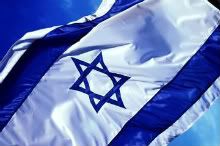
YNET NEWS: Israel needs leader willing to face Obama and say: ‘No, you can’t’
"…for the first time we have reached a national agreement on the two states for two people concept." – Prime Minister Benjamin Netanyahu at cabinet meeting, June 5, 2009.
In uttering these words, Benjamin Netanyahu proved himself to be unworthy of the leadership of the nation. For they clearly show that he lacks either the political wisdom or the political will for the task.
The stark contrast between Netanyahu's cabinet statement and his first rousing and resolute address to the Likud Central Committee as premier in 1996, evoke feelings of profound sadness, bitter disappointment, and deep concern. His opening words then to the eager crowd were: "There will be no Palestinian State."
Rarely does history afford leaders of nations a second chance to redeem themselves. Netanyahu is one the fortunate few who has been afforded such an opportunity. Sadly he has proven unworthy of the extraordinary favor fate granted him, His mettle has been tested and found wanting. His capitulation – however reluctant - to the notion of "two-states" which he has rejected reflects a failure of will or of intellect - or of both.
The essential point for the Israeli leadership to grasp and for the Israeli public to internalize is that the conflict between Israel, as the nation-state of the Jewish people, on the one hand, and both the Palestinians and the wider Arab world on the other, is neither complex nor complicated. Any attempt to characterize it differently reflects neither erudite sophistication nor progressive enlightenment – but rather, ill-informed ignorance at best and disingenuous denial at worst.
For the unvarnished truth is indeed brutal - and binary: In the narrow sliver of land between "The River" and "The Sea" there can prevail – and eventually there will prevail – either exclusive Jewish political sovereignty or exclusive Arab political sovereignty. The side that will endure will be the side whose political will is stronger and whose political vision is sharper. Who will protect Palestinian state? >>> Martin Sherman | Wednesday, July 08, 2009
Wednesday, July 08, 2009
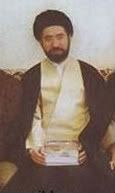
THE GUARDIAN: Mojtaba Khamenei's move dismays clerics and Revolutionary Guard generals / Tehran doctor says death toll much higher than official figure
The son of Iran's supreme leader, Ayatollah Ali Khamenei, has taken control of the militia being used to crush the protest movement, according to a senior Iranian source.
The source, a politician with strong connections to the security apparatus, said that the leading role being played by Mojtaba Khamenei had dismayed many of the country's senior clerics, conservative politicians and Revolutionary Guard generals.
But these conservatives are reluctant to challenge the Khameneis openly out of fear that any conflict would destabilise the Islamic Republic and weaken Iran in the region. Instead they will use their positions in the organs of state to make it hard for the supreme leader and President Mahmoud Ahmadinejad to govern.
"This game has not finished. The game has only just started," the source said, on condition of anonymity because of the sensitivity of his own position in Iran.
He said Mojtaba had played a leading role in orchestrating Ahmadinejad's disputed election victory on 12 June and had led the backlash against protests through direct control of street militias, known as basiji.
The official death toll from that backlash is less than 20 but, according to a Tehran doctor who has given his account to the Guardian, the actual number is much higher – 38 in the first week at his hospital alone. He said the basiji covered up the deaths and pressured doctors not to talk. >>> Julian Borger, diplomatic editor | Wednesday, July 08, 2009

THE TELEGRAPH: Iran's crackdown proves that the 'Twitter revolution' has made things worse
Almost a month on from Iran’s presidential election, it is now time to recognise that the so-called “Twitter revolution” has utterly failed to achieve anything - save dead and injured young Iranians, and up to 2,000 new political prisoners. President Ahmadinejad retains power after a violent crackdown. There has been no recount of the votes. And the blatantly rigged election results have been upheld.
So what went wrong? Well, I would argue that the answer is twofold. Firstly we need to accept that there was a hell of a lot of hype surrounding the online freedom emerging in Iran. Despite what Bobbie Johnson wrote in The Observer, Tweets do not “shake” the political world. More accurately, we have just witnessed a mini dotcom boom and bust: YouTube, Facebook, Twitter and Flickr were seen to be “powerful political tools”. They aren’t. Especially when they are only being used by a relatively small urban elite. >>> Will Heaven* | Wednesday, July 08, 2009
*Will Heaven is a 21-year-old journalist who writes about politics and religion.
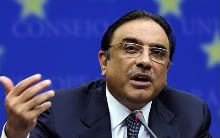
THE TELEGRAPH: Pakistan's president has admitted his country created terrorist groups to help achieve its foreign policy goals.
Asif Zardari told a meeting of former senior civil servants in Islamabad, it was time to be honest about their deployment.
"Let us be truthful to ourselves and make a candid admission of the realities," he said. "The terrorists of today were the heroes of yesteryears until 9/11 occurred and they began to haunt us as well."
These groups were not thrown up because of government weakness, but as a matter of policy. He said they were deliberately "created and nurtured" as a policy to achieve some short-term tactical objectives.
His comments amount to an admission that Pakistan trained Islamic terrorists to launch attacks on India as part of its long war over its claim on Kashmir.
It came as at least 40 people were killed in a suspected US missile strike in north-west Pakistan.
Three US drones are believed to have fired missiles at militants near Ladha in South Waziristan. It is the third strike in two days and follows strikes in which 19 reportedly died.
Mr Zardari first confirmed that many of the Islamic militants now waging war against his government were once "strategic assets" in an interview with the Daily Telegraph earlier this week. >>> Dean Nelson, South Asia Editor | Wednesday, July 08, 2009
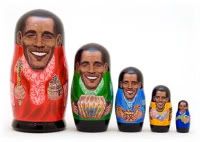
HAARETZ: In the past two weeks, in advance of U.S. President Barack Obama's visit to Russia, chapters of the Bible have become hot current events items in the Russian-language media in Israel. This is not necessarily a matter of an increasing link to the Jewish sources, but rather the use of verses found relevant to eroding the American president's legitimacy.
The Torah portion "Noah" has become particularly popular, and especially his son Ham. This Ham - whose name in Russian also means a very crude person - was punished in the Bible by having his skin turn black, with all his descendants doomed to be blacks destined for a life of slavery. Another very popular text lately is a verse from Proverbs: "Under three things the earth trembles, under four it cannot bear up." The first of the heralds of evil, according to the verse, is "a slave who becomes king."
Each of these chapters is important in itself, but the real sparks are created by the connection between the two: Ham the black man who is doomed to eternal slavery and brings suffering to the world when a black slave becomes king - or in this case, ascends the throne of the presidency of the United States.
The large community of Russian-speaking Jews in America is not enthusiastic about the new president either. But here there is an interesting cultural difference. While Russian speakers in Israel proudly proclaim their rejection of political correctness, their colleagues in America have actually internalized what is politically correct. They are far less preoccupied with the color of the president's skin, and focus on his Muslim background. That is considered legitimate. >>> Lily Galili | Monday, July 06, 2009

THE NEW YORK TIMES: CAIRO — The streets of Iran have been largely silenced, but a power struggle grinds on behind the scenes, this time over the very nature of the state itself. It is a battle that transcends the immediate conflict over the presidential election, one that began 30 years ago as the Islamic Revolution established a new form of government that sought to blend theocracy and a measure of democracy.
From the beginning, both have vied for an upper hand, and today both are tarnished. In postelection Iran, there is growing unease among many of the nation’s political and clerical elite that the very system of governance they rely on for power and privilege has been stripped of its religious and electoral legitimacy, creating a virtual dictatorship enforced by an emboldened security apparatus, analysts said.
Among the Iranian president’s allies are those who question whether the nation needs elected institutions at all.
Most telling, and arguably most damning, is that many influential religious leaders have not spoken out in support of the beleaguered president, Mahmoud Ahmadinejad, or the supreme leader, Ayatollah Ali Khamenei. Indeed, even among those who traditionally have supported the government, many have remained quiet or even offered faint but unmistakable criticisms.
According to Iranian news reports, only two of the most senior clerics have congratulated Mr. Ahmadinejad on his re-election, which amounts to a public rebuke in a state based on religion. A conservative prayer leader in the holy city of Qum, Ayatollah Ibrahim Amini, referred to demonstrators as “people” instead of rioters, and a hard-line cleric, Grand Ayatollah Nasser Makarem-Shirazi, called for national reconciliation.
Some of Iran’s most influential grand ayatollahs, clerics at the very top of the Shiite faith’s hierarchy who have become identified with the reformists, have condemned the results as a fraud and the government’s handling of the protests as brutal. On Saturday, an influential Qum-based clerical association called the new government illegitimate. >>> Michael Slackman | Tuesday, July 07, 2009
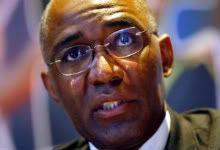
THE INDEPENDENT: Discrimination, conflicts of interest, financial irregularities: allegations against Trevor Phillips and his commission are building.
It was not supposed to work like this. The Government's equality watchdog – which is charged with rooting out discrimination on the grounds of sex, race, religion, sexuality, age or disability – was yesterday in the dock charged with discrimination by a member of its own staff. It only adds to the mound of political embarrassment being heaped upon the chairman of the Equality and Human Rights Commission, Trevor Phillips, whose days in the job look increasingly limited.
The woman before an employment tribunal yesterday was Brid Johal, from Tipperary. (These things are important when it comes to equality). She was an aide to the aide of Mr Phillips. Even aides have aides in the wonderful world of quangos, until David Cameron gets his way at any rate. While she was on maternity leave the person who was covering for her – whom we might, unkindly perhaps, describe as the aide of the aide of the aide – was promoted over Ms Johal's head. It happened just as a commission bigwig was holding forth publicly about how unfortunate it was that women get penalised if they take a year off. Ms Johal told the tribunal that she had not been informed that there was a vacancy available despite her bosses' promises that she would be "kept in the loop" while she was away.
There is now muttering inside the EHRC about how it has not, after all, consigned to history a world in which some people are more equal than others. "There is something oddly old-fashioned going on in terms of plum jobs at the higher level," one insider said recently.
Some are beginning to think that the man at the top, Trevor Phillips, may have feet of clay. Indeed some are murmuring that the clay goes up to knee-level and beyond. The commission has been hit in recent months by a succession of internal disputes and allegations of financial irregularities. There is talk now that the former television executive, who wanted a second term in the job, will be forced to step down when his contract ends in the autumn. >>> Paul Vallely and Kevin Rawlinson | Wednesday, July 08, 2009
TIMES ONLINE: A teacher was barred from joining students on a visit to a Roman Catholic sixth-form college because she refused a request to remove her Muslim veil.
She was accompanying two teenage girls on an open day to see if they wanted to study for their A levels at St Mary’s College, in Blackburn. The town is in the constituency of Jack Straw, the Justice Secretary, who once said that he preferred Muslim women not to wear veils that covered their faces.
The teacher and students were from the Tauheedul Islam Girls’ High School. A spokesman for St Mary’s said that the request was made because veils were against school policy. The two pupils agreed to take off their veils but the teacher declined and left. >>> Russell Jenkins | Tuesday, June 30, 2009
Tuesday, July 07, 2009
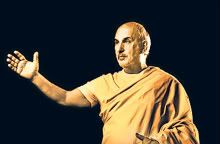
THE TELEGRAPH: The BBC is crumbling under the weight of its own monolithic structure, and suffering from the extravagances of its self-indulgent leaders, writes Gill Hornby.
Who can begrudge the groaning pension pot of the BBC's Alan Yentob? Not many serious cultural figures, scions of the arts establishment, would be willing to dress up in a toga for a bit of publicity. Surely that's worth a million or two straight off?
Yet somehow, the news that the BBC's arts supremo has a pension pot worth £6.3 million if bought as an annuity on the open market to cushion his retirement, after a life spent working for the corporation, has caused an outcry. Admittedly, the fact that this comes after another dispute over his expenses in 2004 (he was cleared), the revelations that the BBC paid for a large party at his country home (business contacts were present), and that he had not exactly been present at interviews for a documentary (look, he's a busy man, OK?) does not help his case. But that doesn't matter, because that case has been made for him by the corporation's director-general, Mark Thompson.
Thompson, whose own pension pot is valued at a mere £3.2 million, has stressed time and again that the BBC has to pay competitive salaries to compete in a competitive market. Otherwise, he fears, there will be a "talent drain" from his corporation. So, of course Yentob needs an annual salary of £325,000, with all the perks and the long-term securities that come with it. There aren't many little bearded men out there capable of making the sort of programmes that we have all enjoyed from his Imagine series. If the BBC doesn't pay for long documentaries about Werner Herzog, surrealism and the "mysterious, offbeat, sexually charged world" of the Japanese writer Haruki Murakami, then… hang on, who would snap him up, exactly?
If you look around, the answer is simple: nobody. The director-general may not have noticed, but commercial television in Britain is in a state of collapse at the moment. His talk of a "talent drain" began in defence of Jonathan Ross's ludicrous pay deal of £18 million over three years, which was, of course, negotiated well before he disgraced himself in the Andrew Sachs fiasco. Back then, Thompson's argument might have had some substance. But now, unless Ross fancies being a judge on The X Factor, he has no option but to stay put at the BBC. And unless Yentob would like to employ his wealth of cultural knowledge in the production of Britain's Got Talent – plenty of surrealism there for him to play with – he's better off where he is, too.
Also, if the corporation is so keen on hanging on to its talent, it is rather curious that it throws such fabulous parties for that talent when it leaves. The cost of sending off John Birt, the former director-general, is estimated at £150,000. Stories about £100 bottles of champagne for celebrities and £400 cakes are never going to go down well with those scrimping to pay for their licence fees. And it is simply not good enough for Thompson to defend it all by comparing the BBC to the commercial sector. It is not the commercial sector. The commercial sector is a tough place to work: you have to fight your corner and earn your ratings, or you're finished. It is completely market-reactive out there, whereas the BBC is the cushiest outpost left in the media world. >>> Gill Hornby | Tuesday, July 07, 2009
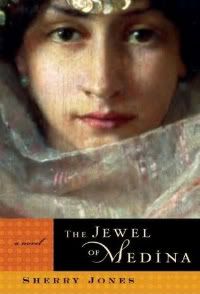
THE GUARDIAN: Muslim trio who attacked publisher's home days before release of The Jewel of Medina each get four and a half years in prison
Three Muslim men were jailed today for an arson attack on the home of the publisher of a novel about Aisha, the child bride of the prophet Muhammad.
The trio poured diesel on the front door of the house in Islington, north London, and set it on fire. The attack in September last year took place days before Martin Rynja's company, Gibson Square, was scheduled to publish The Jewel of Medina, by the American author Sherry Jones.
Ali Beheshti, 41, and Abrar Mirza, 23, pleaded guilty to conspiracy to commit arson, while 30-year-old Abbas Taj was convicted of the same offence at Croydon crown court in May. Today, Mrs Justice Rafferty, sitting at London's Royal Courts of Justice, sentenced each of them to four and a half years in jail.
Andrew Hall QC, representing Beheshti, said in mitigation that it was "an act of protest born of the publication of a book felt by him and other Muslims to be disrespectful, provocative and offensive".
The judge said: "If you chose to live in this country, you live by its rules. There is no such thing as a la carte citizenship and, in your case, there is no such thing as a la carte obedience to the law." >>> Peter Walker | Tuesday, July 07, 2009
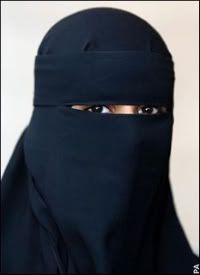
TIMES ONLINE: Wearing my niqab is a choice freely made, for spiritual reasons
I put on my niqab, my face veil, each day before I leave the house, without a second thought. I drape it over my face, tie the ribbons at the back and adjust the opening over my eyes to make sure my peripheral vision is not affected.
Had I a full-length mirror next to the front door, I would be able to see what others see: a woman of average height and build, covered in several layers of fabric, a niqab, a jilbab, sometimes an abayah, sometimes all black, other times blue or brown. A Muslim woman in 'full veil'. A niqabi.
But is that truly how people see me? When I walk through the park with my little ones in tow, when I reverse my car into a parking space, when I browse the shelves in the frozen section, when I ask how to best cook asparagus at a market stall, what do people see? An oppressed woman? A nameless, voiceless individual? A criminal?
Well, if Mr Sarkozy and others like him have their way, I suppose I will be a criminal, won't I? Never mind that "it's a free country"; never mind that I made this choice from my own free will, as did the vast majority of covered women of my generation; never mind that I am, in every other respect, an upstanding citizen who works hard as a mother, author and magazine publisher, spends responsibly, recycles and tries to eat seasonally and buy local produce!
Yes, I cover my face, but I am still of this society. And, as crazy as it might sound, I am human, a human being with my own thoughts, feelings and opinions. I refuse to allow those who cannot know my reality to paint me as a cardboard cut-out, an oppressed, submissive, silenced relic of the Dark Ages. I am not a stereotype and, God willing, I never will be.
But where are those who will listen? At the end of the day, Muslim women have been saying for years that the hijab et al are not oppressive, that we cover as an act of faith, that this is a bonafide spiritual lifestyle choice. But the debate rages on, ironically, largely to the exclusion of the women who actually do cover their faces.
The focus on the niqab is, in my opinion, utterly misplaced. Don't the French have anything better to do than tell Muslim women how to dress? Don't our societies have bigger problems than a relative handful of women choosing to cover their faces out of religious conviction? The "burka issue" has become a red herring: there are issues that Muslim women face that are more pressing, more wide-reaching and, essentially, more relevant than whether or not they should be covering with a niqab, burqa or hijab. Niqabi, interrupted >>> Naima B. Robert | Friday, June 26, 2009
Subscribe to:
Posts (Atom)